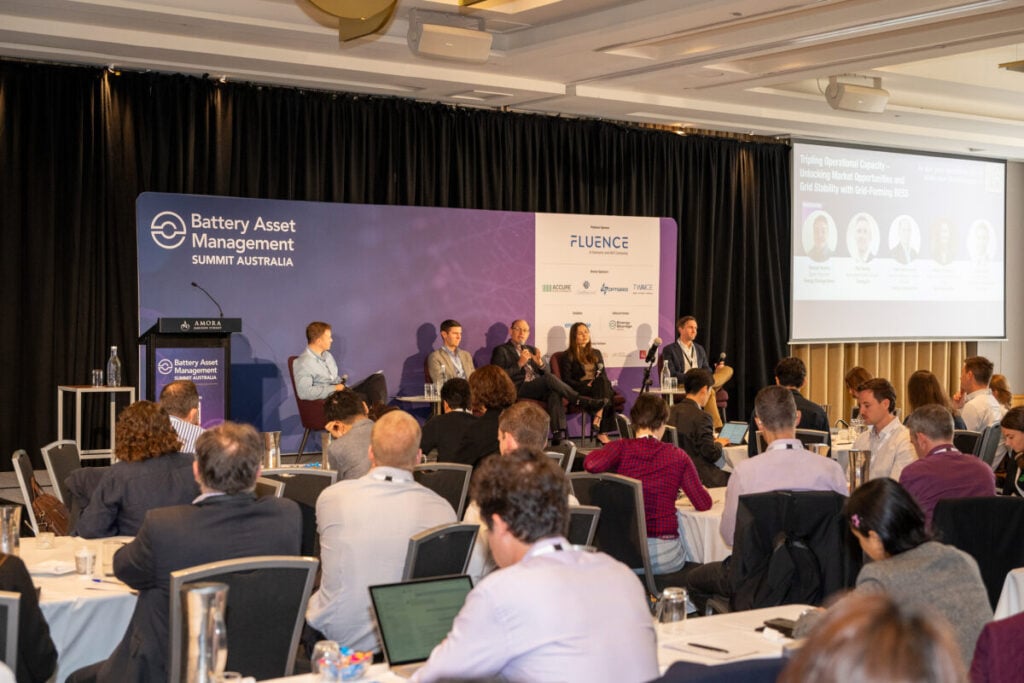
“Australia is one of the leading countries for grid-forming inverters,” said Natalie Thompson, senior analyst of energy storage and solar at Wood Mackenzie, when discussing the Australian energy storage market.
Talking on the ‘Tripling Operational Capacity—Unlocking Market Opportunities and Grid Stability with Grid-Forming BESS’ panel discussion at the Battery Asset Management Summit Australia 2025, Thompson noted that the country is leading in grid-forming inverter deployment, with many other countries not yet considering using the technology.
“For Australia, for our population size, we have a pretty world-leading uptake of utility-scale renewables and storage. We are also one of the leading countries in terms of having systems with grid-forming inverters in the next few years,” Thompson notes.
“Some countries globally haven’t considered integrating grid-forming as part of their batch of deployments. Grid-forming is very nascent in certain parts of the world, but in Australia, it can be a really interesting use case for other countries.”
Try Premium for just $1
- Full premium access for the first month at only $1
- Converts to an annual rate after 30 days unless cancelled
- Cancel anytime during the trial period
Premium Benefits
- Expert industry analysis and interviews
- Digital access to PV Tech Power journal
- Exclusive event discounts
Or get the full Premium subscription right away
Or continue reading this article for free
Grid-forming BESS differs from traditional battery storage systems in its ability to actively stabilise the grid by mimicking the behaviour of synchronous generators.
These systems are designed to support the grid’s operational continuity and ensure uninterrupted power supply, even during grid outages.
They often set their own internal voltage waveform reference and can synchronise with the grid or operate independently of other generation sources. This makes them ideal for maintaining system strength in a renewables-dominated grid.
One key aspect of a grid-forming BESS is its ability to provide synthetic inertia to maintain the grid’s frequency. Coal, gas, and hydropower plants have traditionally provided this inertia to the grid.
However, with the impending withdrawal of coal-fired power, attention has been diverted to emerging technologies that could replace this, such as grid-forming battery storage or synchronous condensers.
Examples of grid-forming BESS in Australia include the likes of French independent power producer (IPP) Neoen’s 540MWh Western Downs stage one BESS in Queensland, Australian energy major AGL Energy’s 2,000MWh Tomago BESS in New South Wales, and specialist infrastructure investor Sosteneo’s 370MWh Koorangie BESS in Victoria.
Data centre demand ‘will transform energy sector’ in Australia
During the panel discussion, Thompson also noted the impact data centres are likely to have on electricity demand in countries across the globe and the opportunity that could arise for energy storage.
“Globally, we’ve seen some jurisdictions where data centres will represent around 10% of demand, which is quite significant when you see where it is today. Australia is on a bit of a slower trajectory at the moment, but I think that will change rapidly,” Thompson said.
The growth in data centres and AI will “transform the global energy sector”, resulting in a surge in energy demand in the next decade.
According to a report from the International Energy Agency (IEA), global electricity demand from data centres is set to more than double by 2030 to more than 945TWh annually. This will be driven by demand from “AI-optimised data centres,” which is set to more than quadruple in the same period.
Energy storage is being touted as one of the technologies that could help facilitate the uptake of data centres worldwide. For instance, earlier this month, engineering equipment manufacturer Caterpillar announced it would deploy a combined heat and power (CHP) plant featuring more than a gigawatt-hour of batteries for a new data centre complex in Utah, US, while yesterday, Energy-Storage.news reported on plans for gigawatt-scale private grid solutions from three developers in the US, each featuring batteries alongside other technologies like nuclear, gas and solar PV.
Inside the Waratah Super Battery SIPS contract
Representing the Energy Corporation of New South Wales (EnergyCo) on the panel discussion was Phil Bratby, executive project director, who commented on the System Integrity Protection Scheme (SIPS) for the world’s most powerful BESS: the 850MW/1,680MWh Waratah Super Battery.
“Ultimately, the SIPS scheme allows the existing transmission lines to be run harder, essentially, by using up some of the contingent capacity that would be reserved in those power lines,” Bratby said.
“That allows us to get more generation from the renewable energy generators, which are located regionally, typically into the load centre, which is Sydney, Newcastle, etc.”
The SIPS contract for the Waratah Super Battery is widely recognised as the largest of its kind in Australia. It enables Transgrid to send signals to the BESS to inject energy into the grid while simultaneously instructing paired generators to adjust their output.
Specifically, the SIPS Control System can monitor 36 transmission lines in real time and respond instantaneously to system events.
This dynamic balancing act prevents disruptions and allows existing transmission infrastructure to operate at higher capacities, effectively “running harder” without compromising reliability.
In an exclusive interview with ESN Premium, Nick Carter, the CEO of Akaysha Energy, the developer of the Waratah Super Battery, noted that enabling the first half of the SIPS was “a massive amount of work” despite its relatively simple nature.
“It all sounds straightforward, but the actual implementation of it, and doing it at the speed at which we need to do it, in conjunction with the grid connection, in conjunction with the control system, across 288 inverters at a massive site, is really, really hard for a single connection point,” Carter told ESN Premium.
Bratby added that the Waratah Super Battery’s functionality means it can still participate in energy arbitrage; however, its true value will be unlocking cheap variable renewable energy generation on the grid.
“The Waratah Super Battery can still trade in the arbitrage market; there’s still the ability, depending on different times of the year, we trade different amounts of that battery,” Bratby said.
“But the large benefit is towards unlocking that cheap renewable energy generation, such as solar and wind, that would have been constrained otherwise, and getting that into the load centre to make sure that we’ve got enough energy to supply the needs. This brings prices down, because that’s often-displacing gas heating plants and things like that.”
Our publisher, Solar Media, will host the Energy Storage Summit Asia 2025 on 7-8 October 2025 in Manila, the Philippines. The official website has more information about the event, including how to book your ticket.