
Elias Saba of Eku Energy speaks to ESN Premium about how data centre demand for shared equipment is affecting BESS development, proposed firming rules and the company’s ACT contract model.
Data centre demand for equipment shared with battery energy storage systems (BESS) is making long lead time items harder to secure and changing developers’ cost exposure, says Elias Saba, chief commercial officer at Eku Energy.
Asked by ESN Premium whether data centre competition for power conversion systems (PCS) and transformers has affected Eku’s ability to secure contracts for BESS projects, Saba says the company has “definitely seen a flow-through effect of the demand from data centres on equipment through to storage”.
“We’re seeing it through different forms,” he says.
Try Premium for just $1
- Full premium access for the first month at only $1
- Converts to an annual rate after 30 days unless cancelled
- Cancel anytime during the trial period
Premium Benefits
- Expert industry analysis and interviews
- Digital access to PV Tech Power journal
- Exclusive event discounts
Or get the full Premium subscription right away
Or continue reading this article for free
Long lead time equipment shared between the two asset classes “has definitely become more difficult to lock down”, according to Saba.
As a result, the need to secure that equipment through early works is “becoming more pronounced”, he says, so that Eku’s projects “can still secure the right equipment to come online in a timely manner”.
Saba also sees a change in cost exposure “based on the demand of different bits of equipment that is shared”.
Transformers were already a pressure point for the BESS industry supply chain before the latest wave of data centre demand.
Energy-Storage.news has reported that, even as lithium supply improved, lead times for transformers and other components had become a headache for BESS developers, with one EPC contractor citing 32 to 36 months for large transformers compared with about 12 months previously.
In Europe, transformer prices have more than doubled from pre-pandemic levels, and lead times for power electronics have risen sharply, according to a guest article by Omri Tayyara, business manager at CSA Group, who argues that the grid is the real bottleneck in the age of AI data centres.
Saba links the equipment squeeze to a broader rise in demand for storage itself. “Energy storage is a critical piece in helping meet the firm supply and unlocking the capacity for data centres,” he says.
In the US, that has driven “quite a large demand for storage equipment” to help enable the data centre build-out, Saba says, and Eku expects to see the same pattern “in all the countries that we operate in”.
“To be able to expand the data centre build-out in the way that you project, you will need a decent level of energy storage to accompany it,” he says.
Firming rules and FID timing
In Australia, the federal government is moving to make data centres contract firming.
The Australian Energy Market Commission (AEMC) has recommended that data centres contract for firming capacity alongside renewable energy certificates, one of four recommendations published in August.
In a National Press Club speech on 5 August, energy minister Chris Bowen said the federal government would mandate that new data centres connect only on terms consistent with the national framework, whether or not every state signs on.
Asked whether a requirement for data centres to contract new firming, defined by final investment decision (FID), would give near-FID BESS projects an edge, Saba says it does, but “it depends on how near FID we’re talking about”.
“Time is required to work through these contractual structures to reach FID,” he says. “I think it helps with FID certainty. So, it helps commercialise a project.”
Saba suggests that “an adequate level of time and maybe buffer to those requirements could be helpful as well”.
Closing a project and locking in an offtake contract has to happen “in a way that’s quite methodical”, he says, and developments across the country will be at different stages when the requirements come in.
The requirement “might benefit some projects”, Saba says. “For others, it might come a bit too late in the piece, or it might not leave enough time to reach FID in the appropriate manner.”
Contract structures and the ACT model
Data centre operators are also buying storage bundled with generation. AirTrunk has secured exclusivity on more than 800MWh of BESS as part of a 1GW renewables deal in the Hunter region of New South Wales with European Energy Australia, while Amazon has signed nine power purchase agreements (PPAs) in Australia totalling 430MW, eight of which include co-located BESS.
Asked whether standalone BESS developers are at a disadvantage as a result, Saba says no.
“We don’t see ourselves at a disadvantage because there are many ways that we can structure products to provide these forms of solutions,” he says.
That includes working with other renewable energy developers to structure products alongside Eku’s sites in different locations.
“We need to ensure that we are working with the right counterparts, structuring the right products,” Saba says, so that Eku remains competitive “in bringing these products to market for data centres”.
That fits with what Saba told ESN Premium earlier this year in an interview on Australia’s Capacity Investment Scheme for firm renewable energy procurement, when he said “the main underpinning commercialisation pathway for us remains private offtakes”.
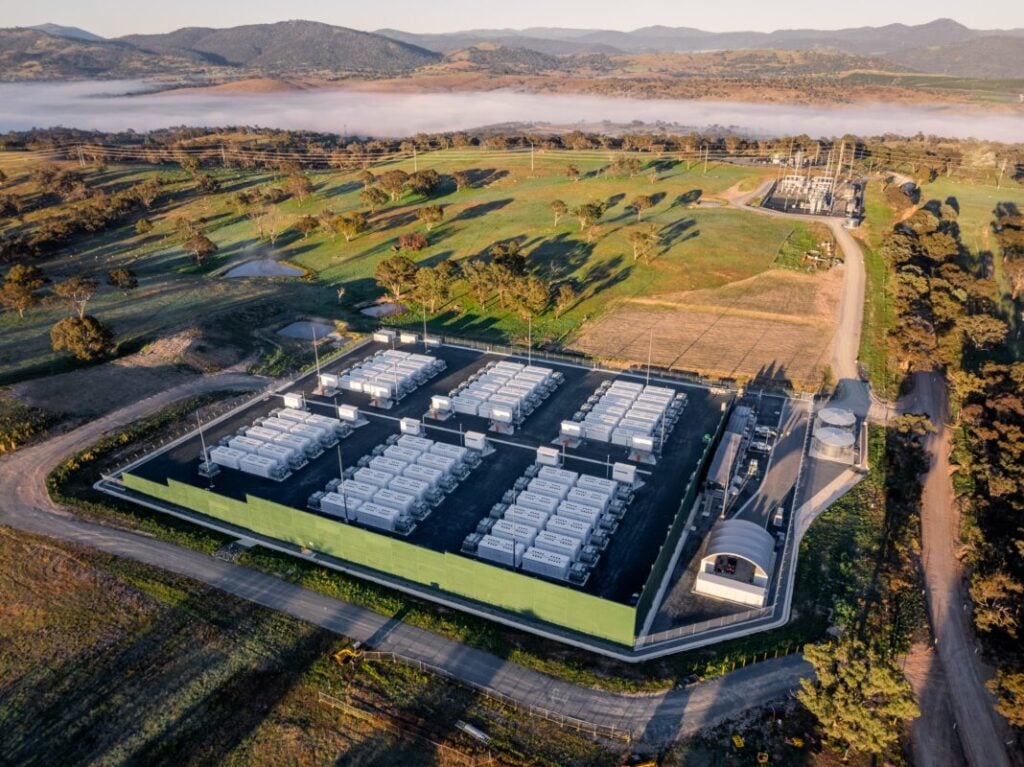
Eku’s 250MW/500MWh Williamsdale BESS in the Australian Capital Territory (ACT) has been in commercial operation for a couple of weeks after Eku announced it on 5 November.
“The asset has come online well, so we’re very happy with how it’s operating,” Saba says, adding that operations have been “quite steady and seamless”.
Under its contract with the ACT government, Eku receives fixed quarterly payments over 15 years for system strength and frequency control ancillary services (FCAS), while the territory takes a share of the BESS’s National Electricity Market (NEM) revenue through a revenue swap arrangement detailed when the project reached financial close.
Saba says Eku would use that structure again, depending on the asset. “In principle, the structure makes a lot of sense and works for both parties when structured well,” he says.
Asked for his key message on Eku and data centres, Saba says the company’s purpose is “to accelerate the energy transition” by deploying storage and enabling more renewables, with “deep consideration to the communities that we impact”.
Eku is “keen to ensure that we’re helping data centres secure capacity and secure firm energy in a sustainable manner”, he says.
“We also think that we’ve built the expertise and capability to help bring together sophisticated commercial and technical structures to enable this rollout in a sustainable way with the right community and social considerations,” Saba says.
Never miss an Australian energy storage story. Sign up for our Australia newsletter and get the latest project announcements, policy updates and market analysis delivered directly to you.