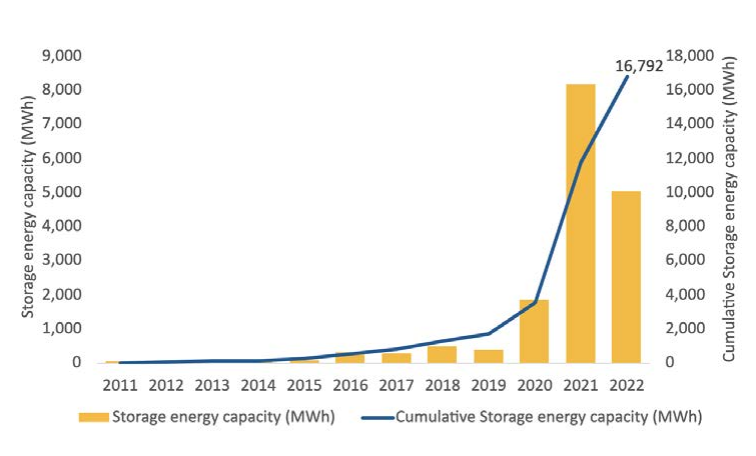
Some 5GWh of utility-scale battery energy storage was deployed in the first half of 2022, up one third while wind and solar fell 50-70%, according to American Clean Power (ACP).
In the trade body’s quarterly report covering all renewable energy resources, ACP said that 14 new storage projects were installed in quarter two totalling 992MW/2,468MWh of new battery storage capacity, up 13% year-on-year.
758MW/2,537MWh was installed in Q1, up 173%. Wood Mackenzie had a slightly lower figure of 2,339MWh installed in Q1 in its own figures.
That means that a total of 1,751MW/5,015MWh of utility-scale battery energy storage was deployed in the first half of the year. ACP did not spell out the year-on-year growth this equates to, but a basic calculation using the two quarterly figures shows deployments grew by about a third.
Try Premium for just $1
- Full premium access for the first month at only $1
- Converts to an annual rate after 30 days unless cancelled
- Cancel anytime during the trial period
Premium Benefits
- Expert industry analysis and interviews
- Digital access to PV Tech Power journal
- Exclusive event discounts
Or get the full Premium subscription right away
Or continue reading this article for free
The largest project by power installed in Q2 was Vistra’s DeCordova Energy Storage in Texas, a one-hour 260MW system which is the state’s largest, while the largest by capacity was the 800MWh Diablo Energy Storage developed by LS Power in California.
These installations mean that by the end of June, the US’ cumulative utility-scale battery storage deployments totalled 6,471MW of power and 16,792MWh of energy capacity.
Although both quarterly figures were positive, the strongest on-record was the 1GW-plus of deployment that was achieved in the last quarter of 2021 as per ACP’s annual report, covered by Energy-Storage.news.
Some 327MW of hybrid (co-located) solar and storage capacity was brought online in the quarter. Solar and storage hybrid resources account for three quarters of the 9,023MW of hybrid capacity in the US, the ACP said.
While battery storage deployments grew over the first half of the year, overall clean power deployments fell by 25%, the ACP said, the largest drop in installations over a six-month period since 2018.
The fall in Q2 was even more dramatic at 55%. Battery storage, the only sector to experience growth, accounted for 31% of the 3,188MW of clean power installed during the period. Wind installations fell 78% and solar fell 53% year-on-year.
Part of this is down to supply chain constraints and grid connection issues causing project delays. There are now 32GW of delayed projects according to the ACP, of which 64% is solar, 13% is storage and 23% is wind.