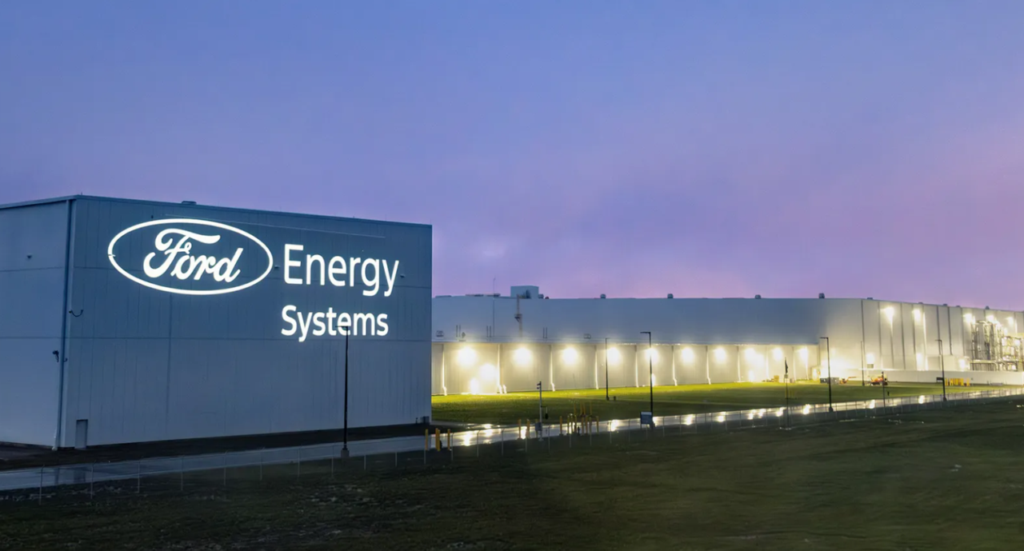
In May, US automotive group Ford made the surprise announcement that it was launching a BESS product via new division Ford Energy. In this deep dive article, we look at its product’s specifications and how they compare to other existing solutions.
Ford pushing into the 500+Ah cell-based BESS segment
Known for its automobiles, Ford, has joined some of its peers in making moves into the BESS space. The company has been using new battery innovations in its EVs, but this signals a move into other areas of the energy sector, and it has come in with a product that has taken advantage of the latest generation of high-capacity battery cells.
While a lot of the current BESS installations use 280Ah and 314Ah cell configurations―which have become the standard cell capacity―a number of battery manufacturers have started to develop and sell BESS configurations that use cells with 500+Ah. 500Ah represents the current upper end of cell capacity for BESS, bar a handful of standout higher-capacity cells.
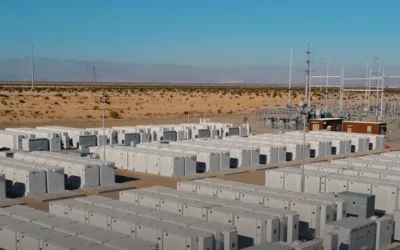
The flagship BESS product from Ford, the Ford Energy DC block, is a standard 20-foot container. Ford is using 512Ah LFP cells that are available in 2-hour and 4-hour configurations. Each of these units is liquid-cooled and comes with a 5.45MWh rated energy, a 1040-1500VDC voltage range, an ingress protection rating of IP55, container weight of 43.5 tonnes and an operating altitude up to 4000m without derating. Ford has stated that it will have a 20GWh annual manufacturing capacity for the DC block and will be developed at their gigafactory in Kentucky. Because the BESS is going to be fully assembled in the US, it means that it will be compliant with foreign entity of concern (FEOC) and prohibited foreign entity (PFE) restrictions and will also be eligible for domestic bonuses.
Try Premium for just $1
- Full premium access for the first month at only $1
- Converts to an annual rate after 30 days unless cancelled
- Cancel anytime during the trial period
Premium Benefits
- Expert industry analysis and interviews
- Digital access to PV Tech Power journal
- Exclusive event discounts
Or get the full Premium subscription right away
Or continue reading this article for free
While Ford is coming in at the higher capacity end of the BESS sector, as a newcomer to this part of the energy sector, it is up against some stiff competition―as many established battery manufacturers are now starting to push into the 500+Ah space. It should be noted that even though they are above 500Ah, a lot of the ones in this range being pushed by manufacturers are at 587Ah or above. So, the cells are well above the current standard capacity but are still a little bit less than some of the 500+Ah systems being developed―as the 587Ah capacity level is seen as the ‘golden balance point’ because it offers a high capacity without necessarily making the BESS exceed the standard 45-ton weight limits for transportation.
So, how does Ford’s new BESS compare to the other 500+Ah systems? The rest of the article looks at how it compares to some of the other 500+Ah systems being developed by leading battery manufacturers. It should be noted, that for fairness, only the systems within a similar capacity range have been compared. There’s no point in comparing against 280Ah cell-based systems, nor is it worth comparing systems on the other extreme, for example, in the case of Hithium which is developing heavier but ultra-high capacity systems beyond 1000Ah.
Rated capacity and energy density
The rated energy capacity for the Ford BESS container is 5.45MWh with a rated cell capacity of 512Ah. No energy density has been given at this time but many other systems that hover around the 587Ah cell capacity have a similar energy density, so it’s expected that the energy density shouldn’t be too far away from other BESS but might be slightly lower. The FE-250 is a 2-hour configuration system with ≤ 0.5 P working ratio and the FE-450 is a 4-hour configuration system with ≤ 0.25 P working ratio.
In terms of other 500+Ah systems being developed today, CATL is currently developing its 3rd generation LFP cells for its BESS containers. CATL has stated that the rated energy capacity for the BESS container will be 6.25MWh with a rated cell capacity of 587Ah. CATL has stated that the volumetric energy density will be around 430-434Wh/L.
EVE Energy meanwhile has developed the 4-hour duration ‘Mr Big’ with a rated BESS capacity of around 5MWh and a rated cell capacity of 628Ah. EVE Energy has stated that its systems will have a have a volumetric energy density of 386Wh/L and a gravimetric energy density of 193.3Wh/kg. Rept Battero’s 4- and 6-hour duration BESS has been rated for a 6.26MWh capacity and a cell capacity of 588Ah, making it very similar to CATL’s offering. Rept Battero’s cells also have a stated volumetric energy density of 430Wh/L, with a stated gravimetric energy density of 190Wh/kg.
Hithium has many 500+Ah configurations, but the closest to the Ford BESS is 587Ah cell capacity system with a 2-hour configuration. This system has been rated for a 6.25MWh capacity with a volumetric energy density of 413-415Wh/L and gravimetric energy density of 185Wh/kg. CALB also has a 6.25MWh rated BESS with a 588Ah cell capacity and a volumetric energy density of 450Wh/L.
So, as noted above, while Ford is entering at the higher end of the spectrum in terms of cell capacity, because the cell is only rated for 512Ah compared to 587Ah+, it does mean that a lot of the other leading battery manufacturers have a higher rated energy capacity at the container level in the 500+Ah BESS category.
Cycle and calendar life
While no specific cycle life has yet been mentioned, Ford has stated that its BESS will have a calendar life of at least 20 years. This calendar life is similar to many of the other 500+Ah BESS being developed, so it can be assumed, based on other systems, that the Ford BESS will be good for at least 10,000 cycles, potentially more.
This assumption is based on the comparison of cycle life and calendar life of the other systems. For example, CATL’s BESS has a stated cycle life of at least 12,000 cycles and an expected lifespan above 20 years. EVE Energy’s BESS takes 8000 cycles to reach 80% state of health (SOH) with a calendar life of 15–20 years. REPT Battero has stated a cycle life of 10,000–12,000 cycles and a service life of at least 20 years. For the 587Ah cell, Hithium has stated a cycle life of at least 10,000 cycles with many of their systems being good for 25 years, while CALB has stated that it takes 10,000 cycles for its 588Ah cells to reach a 70% SOH.
Operating temperature range
Ford has stated that its BESS has been equipped with liquid cooling with integrated heating, a three-level battery management system (BMS), and a layered fire protection system that combines smoke, heat, and hydrogen detection with ventilation and suppression. All of these have been included to keep the BESS within the defined operating temperature range of -35°C–55°C and have a similar operating temperature range to other BESS, with the upper temperature range being slightly lower than many other systems being developed today.
In comparison, CATL’s BESS has been designed to work in operating temperatures of -40°C–70°C, and CALB’s have been designed to operate between -35–65°C. Other companies have given more specific information, with EVE Energy’s cell operating between -30–60°C, with a charging temperature range of 0–60°C, discharging temperature range of -30–60°C, and a storage temperature of 0–35°C.
Rept Battero’s cells have an operating temperature range of -40–65°C, with a charging temperature range of -10–65°C, discharging operating temperature of -35–65°C, and a storage temperature of -40-60°C. Hithium’s cells have an operating temperature range of -30–60°C , with a charging temperature range of -30–60°C, discharging operating temperature of -30–60°C, and a storage temperature of -20–35°C.
Round-trip efficiency not yet mentioned
Ford has not yet published the round-trip efficiency (RTE), or other efficiency, but if it’s like any of the other BESS mentioned here, it will likely hover somewhere around the 95% mark. This is a presumption based on the stated RTE of 96.5% by CATL and Rept Battero and a 94% RTE by EVE Energy. Hithium hasn’t specifically given an RTE but has stated an energy efficiency of 94.5%, while CALB has stated a charge-discharge efficiency of up to 95%.
Specification comparison table
| Specification | Ford | CATL | EVE | Rept | Hithium | CALB |
| Cell capacity (Ah) | 512Ah | 587Ah | 628Ah | 588Ah | 587Ah | 588Ah |
| Rates system capacity (MWh) | 5.45MWh | 6.25MWh | 5MWh | 6.26MWh | 6.25MWh | 6.25MWh |
| Duration | 2- and 4- hour | 2 and 4- hours (assumed) | 4 hours | 4- and 6-hour | 2-hour | 2 and 4- hours (assumed) |
| Gravimetric energy density (Wh/kg) | Undisclosed | undisclosed | 193.3Wh/kg | 190Wh/kg | 185Wh/kg | undisclosed |
| Volumetric Energy density (Wh/L) | undisclosed | 430-434Wh/L | 386Wh/L | 430Wh/L | 413-415Wh/L | 450Wh/L |
| Cycle life/calendar life | 20 years calendar life | 12,000+ 20+ year calendar life | 8000 cycles (to 80% SOH) 15-20 year calendar life | 10,000-12,000 20+ years calendar life | 10,000+ Up to 25 years calendar life | 10,000 cycles (to 70% SOH) |
| Efficiency | undisclosed | 96.5% RTE | 94% RTE | 96.5% RTE | 94.5% energy efficieny | charge-discharge efficiency up to 95% |
| Operating temperature range | -35°C–55°C | -40°C–70°C | -30–60°C Charging: 0–60°C Discharging: -30–60°C Storage: 0–35°C | -40–65°C Charging: -10–65°C Discharging: -35–65°C Storage: -40–60°C, | -30-60°C Charging: 0–60°C Discharging: -30–60°C Storage: -20–35°C | -35–65°C |
Use cases
Like many BESS systems, Ford’s BESS has been designed for utility-scale, industrial or commercial applications. The 2- and 4-hour configurations means that they are better designed for short-term grid support rather than long duration energy storage (LDES). Ford has stated that its BESS has been designed to offer frequency regulation, voltage support, rate arbitrage, peak load shifting, demand response, and backup power support services to the grid. The firm expects first deliveries to customers in late 2027.