
ESN Premium speaks with Ben Potter at CO2 Battery startup Energy Dome about the company’s latest project with Google and why the market is turning in favour of long-duration energy storage (LDES).
Carbon dioxide-based energy storage startup Energy Dome has had a fruitful 2026 so far. From being ranked in January by Sightline Climate as the top non-lithium LDES provider, to the more recent announcements of two projects for its strategic investor Google: first in Arizona, US, with utility Salt River Project (SRP) and then in Ireland with developer Lumcloon Energy, and a first planned deployment in Australia with Victoria’s State Electricity Commission (SEC).
Google became an investor in Energy Dome just under a year ago, with the two companies forming a commercial partnership.
Ben Potter, Energy Dome board member and COO of its storage-as-a-service division, notes that the two projects are the first of many in a “multi-continent, many-hundreds-of-megawatts pipeline.”
Try Premium for just $1
- Full premium access for the first month at only $1
- Converts to an annual rate after 30 days unless cancelled
- Cancel anytime during the trial period
Premium Benefits
- Expert industry analysis and interviews
- Digital access to PV Tech Power journal
- Exclusive event discounts
Or get the full Premium subscription right away
Or continue reading this article for free
Potter sees the CO2 Battery and other LDES technologies as a good fit for addressing the twin problems of ensuring utilities have resource adequacy and meeting load growth from data centres and electrification.
It’s the space, he says, “where energy and power collide with AI, the intersection of those two, where electrons are driving tokens, securing the capacity and the interconnections to unlock load growth.”
As regular readers of Energy-Storage.news will know, Energy Dome’s CO2 Battery uses electricity to compress carbon dioxide gas during charging, then releases the stored energy by expanding the CO2 and driving it through turbines to discharge.
The company claims that the closed-loop thermodynamic process makes the technology safe and suitable for long-duration energy storage (LDES) applications at scale, while the CO2 Battery is constructed using off-the-shelf components that are abundant and engineering and manufacturing techniques are drawn from existing disciplines.
Different tolling agreement structures for Arizona and Ireland projects
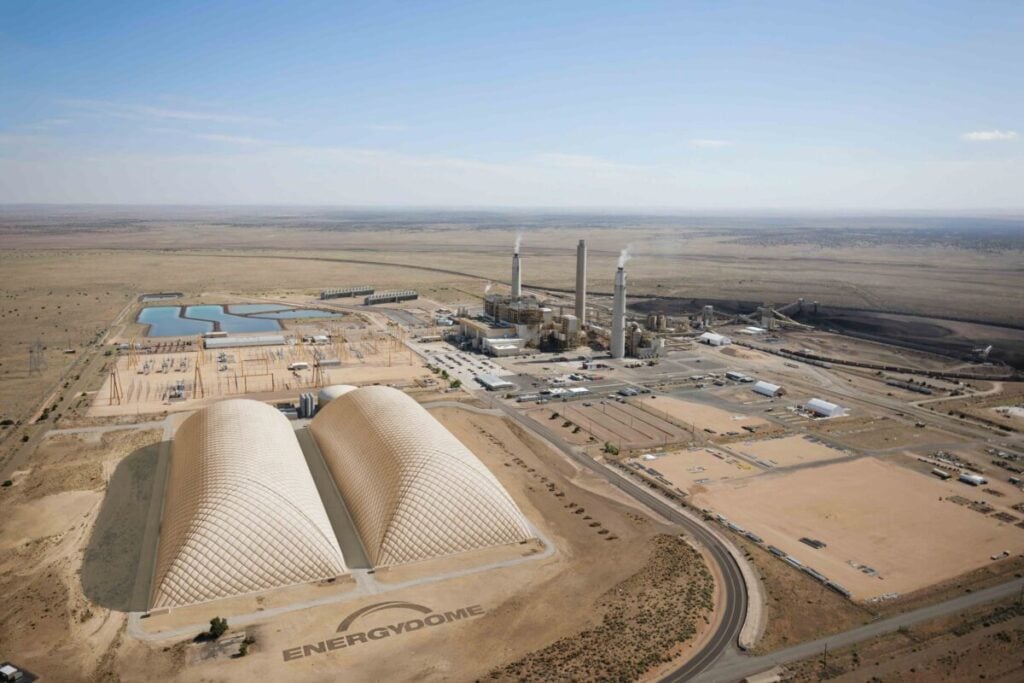
In Arizona, Energy Dome is building a 19MW, 10-hour duration CO2 Battery, (190MWh) with not-for-profit public utility SRP, co-located with an SRP thermal generation plant.
SRP is the biggest utility in the Phoenix metropolitan area and is also its own balancing authority. Energy Dome bid into a 2024 request for proposals (RFP) for non-inverter-based LDES and was successful, winning a 20-year tolling contract with SRP.
The RFP was part of a collaboration between Google and the utility to accelerate the deployment of LDES technologies, and the tech giant is funding a portion of the costs of winning projects, while also evaluating their operational performance.
“Google is extremely interested in understanding which long-duration energy storage technologies work in that market [Arizona], and SRP itself needs long-duration energy storage,” Potter says.
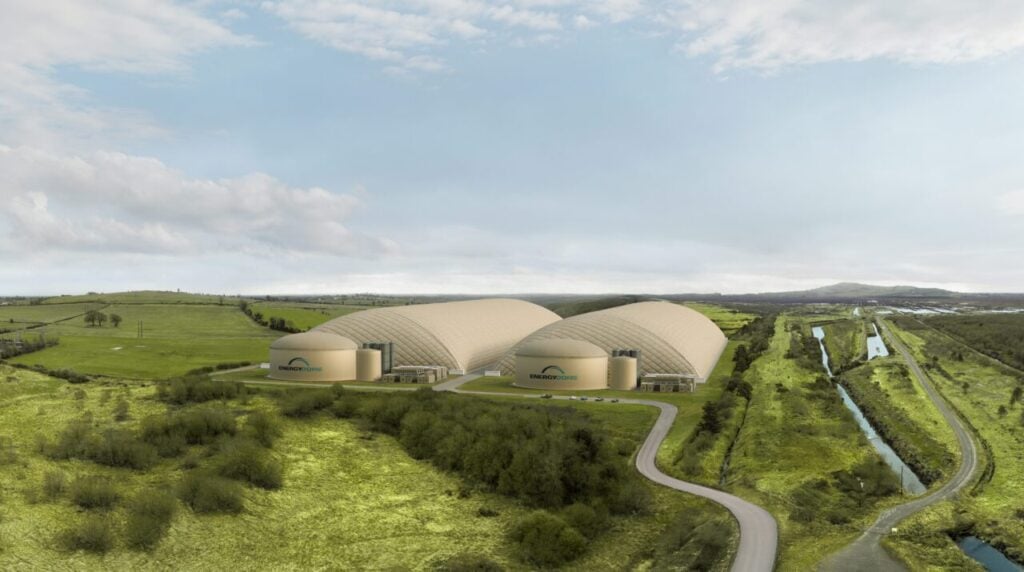
In that instance, therefore, SRP is the offtaker. For the forthcoming 23MW/200MWh CO2 Battery expected to go into operation in County Offaly, Ireland, in 2028, Google has contracted directly with Energy Dome to be the 100% offtaker of the plant’s capacity and energy.
As mentioned in our news coverage of the Ireland project in late June, the asset will provide congestion relief to the local grid from its strategic location close to Ireland’s capital, Dublin, while providing Google with energy capacity for its nearby operations.
“It’s going to feed their operations in Ireland, but it’s also going to relieve congestion, and by doing so, local Irish authorities, the system operators, don’t have to build out further transmission lines, thereby enabling greater affordability,” Potter says.
This will also enable the buildout and integration of further renewable energy capacity in the otherwise congested area, aligning with Google’s mandate of securing carbon-free energy.
Meanwhile, partner Lumcloon Energy is a pioneer of energy storage in Ireland, having deployed a 100MW BESS in 2021 in County Offaly, and a 2022 project that hybridised a 170MWh battery storage system with a synchronous condenser. Potter says Lumcloon’s local expertise is crucial to the CO2 Battery project.
“Lumcloon are one of the first in the country to do large-scale BESS, but they’ve also had a history of being involved in technology innovation. They looked at flywheels, they looked at data centres, etc.”
The developer secured the land from state-owned electricity supplier ESB after the decommissioning of the peat-fired power plant that previously occupied the site. Together, Energy Dome and Lumcloon Energy bid for a T-4 capacity market (CM) contract from transmission system operator (TSO) Eirgrid and won.
The capacity market contract will be stacked on top of the project’s revenues. The CO2 Battery competed against thermal, hydroelectric, BESS and other technologies for it.
“To our knowledge, this is the only 8-hour duration energy storage project ever to be awarded a capacity contract in Ireland,” Potter says.
“We are proud that we’ve been awarded a capacity contract by Eirgrid. It’s going to be a capacity asset playing into the system. It also qualifies for ancillary services, so it shows how established and mature this technology has become.”
What’s perhaps even more interesting, he says, is that derating applied to capacity assets of 8-hour and longer durations in the European context shows that LDES technologies are “reliable capacity assets that play a super-important role on the system, irrespective of which energy it’s using to charge.”
Hyperscalers driving ‘an explosion of demand’ for long-duration energy storage
Energy Dome could contract bilaterally with the hyperscaler, as in the Ireland project, or indirectly through a utility that in turn serves the hyperscaler, as in Arizona.
The huge appetite for power capacity of hyperscale data centres has created “an explosion of demand for long-duration energy storage,” particularly in the US, Potter says.
“We use the accredited capacity mechanism in the US, so these are typically front-of-the-meter (FTM) facilities located in the relevant network of interest to that existing or new data centre,” Potter says.
“The key thing is to get the capacity rights to connect into the network, not only getting interconnection but also securing the power. How it works is that the hyperscaler would contract directly with Energy Dome, so we would have a bilateral contract agreement.”
The hyperscaler customer would buy the asset’s energy and capacity rights. Then the utility would examine the technology to determine whether it is reliable and can be counted towards resource adequacy (RA).
In Europe, that would be called derating, but in the US is described as Effective Load Carrying Capability (ELCC). This is a value attached to a resource’s reliability.
“Energy storage, and particularly long-duration energy storage (8-10-hours) gets a very favourable ELCC, given where the resource mix has gone. The utility determines the ELCC and gives a capacity credit to the hyperscaler: that credit is what allows the hyperscaler to interconnect and allows the hyperscaler to grow their load.”
The utility serves the hyperscaler, which gets very high reliability of power supply by connecting to the grid, but the utility, in turn, benefits from the hyperscaler bringing new resources onto the grid, which the data centre company also pays for, potentially having a positive impact on electricity rates.
In other cases, Potter says, Energy Dome could contract directly with a utility that has arrangements with hyperscalers.
“The key is actually having partnerships where you’re working with all of the big hyperscalers or the neoclouds, but you’re also working with the utilities and the system operators, because the two need to come together for front-of-the-meter assets.”
ELCC is assessed on a variety of metrics around reliability and the likelihood of loss of load, in other words, a resource not being available when it’s needed, which can result in the system operator not being able to meet peak load.
“Therefore, they have to shed load or curtail load, so reliability is the name of the game,” Potter says.
He claims the Energy Dome technology fits the ELCC criteria well, due to it being built on “extremely reliable components.” These include the compressors used in charging, which come from the oil and gas industry. The generation side is driven by medium pressure steam turbines, which are synchronous generators similar to natural gas, coal-fired or steam turbines already on the market.
The synchronous rotating masses of the turbines also produces natural inertia, which can help set the frequency and voltage of the grid akin to grid-forming (GFM) BESS assets.
Meanwhile, the duration and quality of power are also factored into the ELCC assessment.
First-of-a-kind project in Sardinia marks first year of operation
While the hyperscaler possibilities are obviously an exciting new area for energy storage players, and perhaps LDES especially so, Potter’s interview concludes with an update on Energy Dome’s projects to date.
Its first large-scale 20MW, 1-hour duration system in Sardinia, Italy, has been running for around a year, with Engie as its offtaker. The project shows that the CO2 Battery technology is commercial, Potter claims, and Energy Dome’s new units will essentially be replicas of the Sardinia asset.
A project in India with state-owned power generation company NTPC is of the same sizing and is now in “full-blown construction” with a targeted COD in the second half of 2026. NTPC, a “huge utility with a massive thermal fleet,” selected the CO2 Battery technology through a pilot tender project, as noted by Potter in a 2025 interview with the site.
A project with utility Alliant Energy in Wisconsin, US, has received rate-basing approval from the state’s regulatory Public Utilities Commission (PUC). Energy Dome has ordered the long lead items and is fabricating the components and tracking towards COD in late 2027-early 2028. Under an equipment sale contract business model, Alliant Energy is building that project.
Potter hints at the Australia project announcement, which came out after our interview was concluded and says that customers and Energy Dome alike are happy with the “compelling” economics of the CO2 Battery at long duration applications.
“We’re seeing the market is booming. The proper RFP is coming out of utilities. Hyperscalers want it [LDES] directly. The energy security aspect is becoming very real, and our technology uses components which can be manufactured or sourced in the regions where the projects are,” Potter says.
Energy Dome is moving towards manufacturing its own components in the US for US projects, enabling it to qualify for tax credits. It can similarly source European components for European projects and likewise in Asia.
The company is hoping that the combination of energy security, economics and the complementary nature of the CO2 Battery to the applications that lithium-ion BESS are used for will be strong drivers of demand for its technology.
