
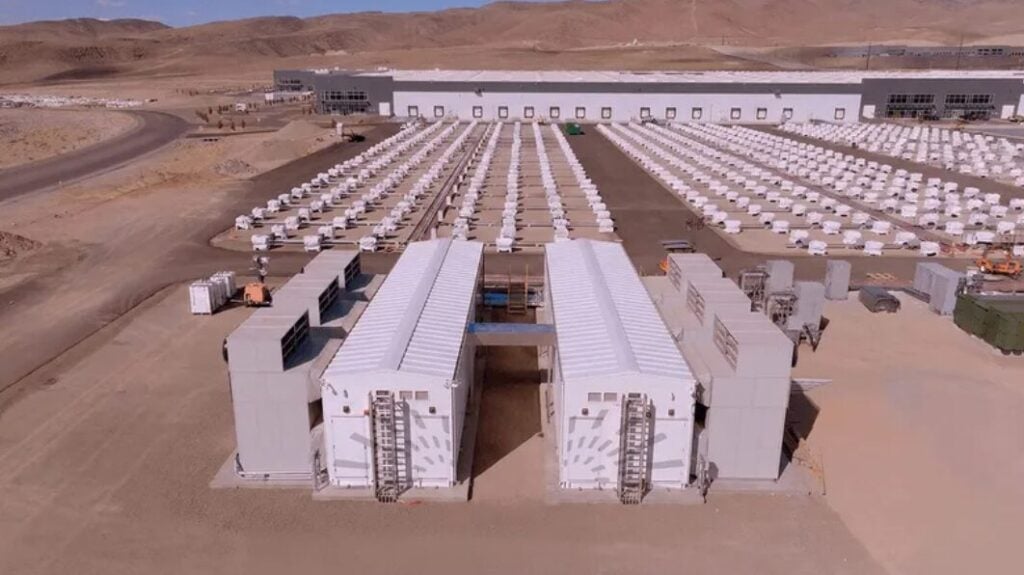
BESS has huge potential to be deployed alongside AI data centres, but how are industry players positioning themselves to capture this opportunity?
McKinsey estimates that global data centre demand could reach as high as 296 GW by 2030, and these all require power. The problem is this. AI data centres require a lot of power 24/7 but there are incredibly long waits for grid connections all around the world. In some locations, it can easily be up to 10 years. While countries such as the UK are starting to prioritise data centres as a national interest for grid connections, rather than on a traditional first-come-first-serve basis, in many cases data centres will need to source their own power.
BESS are needed because data centre demands are increasing, and it can often takes a lot less time to build a data centre than it does to connect it to the grid. So, we’re in a global situation where more data centres are being built than are being connected to the grid. Part of this is that a lot of grids are already under strain, especially as there are more intermittent energy generators and load drawers on the grid, and many local grids are going to need district network operators (DNOs) to make gird upgrades to accommodate the large energy drawing needs of AI data centres.
So, BESS co-located with renewable (or fossil fuel) energy generation is seen as a solution because energy can be generated to serve the data centre at the point of generation, but excess energy from high generation periods can also then be stored for later use during the night and other low generation periods. Installing BESS systems over local diesel generators is not only more sustainable but enables the site to participate in grid services. This could also help build a better business case for DNOs to bring data centres with BESS capabilities online quicker as they can help to stabilise the grid (reducing wait times), but it could also help data centre owners curb some costs by selling energy back to the grid.
Try Premium for just $1
- Full premium access for the first month at only $1
- Converts to an annual rate after 30 days unless cancelled
- Cancel anytime during the trial period
Premium Benefits
- Expert industry analysis and interviews
- Digital access to PV Tech Power journal
- Exclusive event discounts
Or get the full Premium subscription right away
Or continue reading this article for free
This article is going to roundup some of the partnerships that have taken place in recent months between BESS technology companies other technology providers to develop data centre-tailored solutions, as well as data centre owners themselves. They are primarily centred around the US market, which is currently building more data centres than Europe.
Fluence and Siemens
Siemens is set to develop a reference architecture purpose-built for Nvidia AI data centres. This will be in collaboration with Fluence which is supplying the BESS for the AI data centres. The reference architecture will turn Nvidia’s AI factory vision into a deployable architecture for hyperscalers, co-location providers and specialised cloud infrastructure providers.
This reference design from Siemens can support a facility capacity of 136MW, which includes a 100MW IT load, and utility connections for both medium- and low-voltage distribution. The architecture has been developed to support Tier III concurrent maintainability, meaning any component can be serviced without interrupting data centre operations.
Fluence’s role in the partnership is the integration of their Smartstack BESS into the design, which will help to curb grid instability events such as voltage and frequency fluctuations, and will provide black start capability and load smoothing for AI workloads that unevenly draw power. Thermal management services will be provided by nVent, which has deployed over 2GW of global liquid-cooling capacity to date.
The Smartstack from Fluence is a modular, containerised plug-and-play AC BESS unit that can be directly connected to the grid via medium voltage transformers. The BESS units use 300Ah cells and come in either 7.5MWh or 10MWh unit capacity units. They have been designed for 2-8 hour durations at full rated power, depending on the individual use case. The 7.5MWh unit is the longest standing product, and the 10MWh is the latest product launched this year.
The 7.5MWh unit has an energy capacity of 7,308–7,524 kWh, a maximum AC output current of 3,762A, a cell rating of 0.5, and a discharge duration of 2-, 4-, 6- and 8-hours. On the other hand, the new 10MWh unit has an energy capacity around 10,000 kWh, a maximum AC output current of 2,508A, a, cell rating of 0.25, and a discharge duration of 4-, 6- and 8-hours. It’s been stated by Fluence that the latest 10MWh unit can achieve a site-level energy density of approximately 680MWh per acre (168kWh per square metre). Both units have an operating temperature range of -30 to 55°C, derating after 50°C, a DC voltage up to 1500 V, and an AC voltage of 690V 3AC IT.
Prevalon Energy and Emerson
Prevalon Energy, a dedicated-BESS spin out of Mitsubishi Power Americas, and Emerson are partnering to support hyperscaler, colocation, and enterprise data centres. The data centres are going to use gas turbines as the base load but Prevalon’s HD5 BESS solution is going to be installed alongside Emerson’s Ovation automation platform and insightOS’ energy management system (EMS). The BESS is going to be installed to match the load demands during the data centre’s load swings.
Prevalon Energy has HD5 units available as either DC or AC BESS units for deployment, and the two HD5 systems are compared in the following table:
| HD5 AC | HD5 DC | |
| Nameplate Energy | 5MWh per enclosure | 5MWh per enclosure |
| Energy Density | Up to 426MWh per acre | Up to 360MWh per acre |
| Configurations | 2-, 4-, and 8-hour configurations | 2-, 4-, and 8-hour configurations |
| Round Trip Efficiency (RTE) | up to 92.5% (4-hour), 90% (2-hour) | Not disclosed on spec sheets |
| Cycle life | 8,000 full cycles to 65% SOH | 8,000 full cycles to 65% SOH |
| Rated Calendar Life | 20 years | 20 years |
| Voltage | Nominal AC voltage: 690 VAC 3-phase | 1,040 – 1,500 VDC |
| Cooling System | Liquid cooling for batteries and inverters. HVAC for auxiliary equipment | Liquid cooling with central chiller |
| Cell chemistry | 315Ah LFP | 314Ah LFP |
| Temperature operation range | -30–50°C | -30–50°C |
Note that it was recently announced that Nextpower is acquiring Prevalon Energy, but as Nextpower already provide solar and power technology products, its likely that they will be looking to pair this with Prevalon Energy’s BESS technology in AI data centres, and other grid backup and off-grid applications, going forward.
Envision Energy
Envision has launched an LDES-specific energy storage system and a full-stack hybrid wind-solar-battery inverter and PCS solution for AI data centres. The AI power system developed by Envision is designed to coordinate power generation, energy storage, grid interaction and computing loads using 800 VDC power architecture with 2.5MW LFP battery storage and 2.5MW solid-state transformer (SST) technology. Na-ion batteries can also be integrated into the system to handle rapid power smoothing and load fluctuations of the AI data centre. The LFP is designed to provide backup power and multi-hour energy shifting.
The AI power system LDES is aimed at data centres that are facing a sharp growth in computing loads due to increased AI and data demands. The system is built for 8-hour to 16-hour applications, and the integrated PCS technology provides 250% overload capability in grid-forming applications and will help to help maintain voltage-source behaviour during large transients while data centres are operating.
The system is touted to have an RTE of 91%, a calendar life of 25 years, and can operate in temperatures ranging from -40 to 50°C. There is corrosion protection available for harsher climates and Envision says the system runs at noise levels 15 dB(A) below industry norms, improves state of charge (SOC) accuracy by 2%, and reduces footprint by more than 30% compared with typical 5-7MWh systems.
The AI power system is already in operation at Envision’s Chifeng Net-Zero Industrial Park in a project developed with Tencent, and Envision is currently building a GW-scale AI data centre linked directly to renewables in Ulanqab. Both projects are in the Inner Mongolia region of China. The data centre in Chifeng is the world’s first AI data centre running entirely on renewable energy. These data centres are also a part of Mission Gobi, which aims to develop 5GW of green AI data centre capacity in desert regions by 2030.
On.Energy
On.Energy is currently deploying its BESS with different partners in the AI and cloud data centre space. On.Energy currently has 2.5GW of storage capacity deployed across multiple hyperscale campuses with 3GW currently under construction. According to On.Energy, it is involved in over 75 projects across the Americas and has a production capacity of at least 10GW.
The latest DC BESS, AI UPS, is modular and features a 1500V liquid-cooled architecture which can be scaled from 10MW to above 1GW and be used both on- and off-grid. Each module provides 3.2 MW capacity and has can be used for 1-8 hour durations depending on the needs of the data centre. The system has been designed with a cycle life of at least 6000 cycles and comes with a 20-year warranty.
One of the latest data centre developments/partnerships is that On.Energy has recently completed construction of its AI UPS at the National Laboratory of the Rockies in Colorado, where one of the world’s most advanced grid simulators is located. The aim of this installation is to validate how On.Energy’s system stabilises GPU workload spikes under a full range of real-world grid and off-grid operating conditions.
Crusoe partnerships with On.Energy, Form Energy and Redwood Materials
AI data centre developer Crusoe meanwhile has announced partnerships with numerous BESS solutions firms which we’ve covered in separate articles, including On.Energy.
In July last year, it entered into a strategic partnership with battery recycler and second life BESS firm Redwood Materials to power data data infrastructure with large-scale solar and second-life EV batteries.
Then in March this year, it signed a 12GWh supply agreement with Form Energy in the US for the latter’s iron-air batteries to be deployed with AI data centres.
And this week, it partnered with On.Energy to use its BESS-backed uninterruptible power supply (UPS) solution across 5GW of data centres in the US.
Solid state, supercapacitor collaboration from DG Matrix and Skeleton
Also announced this week, solid-state power conversion system (PCS) firm DG Matrix has partnered with Estonia-headquartered startup Skeleton Technologies to provide power solutions to the data centre industry. Skeleton uses both high-power battery and ultracapacitor technologies.
Greenvolt and Pantheon Atlas
Pantheon Atlas has recently revealed plans for a new €50 billion ($58.5 billion) hyperscale AI data centre campus in Topusko, central Croatia. The data centre is set to be paired with 500MW on-site solar energy generation capacity and a 2,000MW/8,000MWh BESS. The solar-plus-BESS installation is set to be built by Greenvolt International Power, and a letter of intent (LOI) has already been signed.
Four 400-kV transmission lines are also being planned to connect the renewables to the Croation grid, with plans to allow up to 5.2GW of new renewable capacity onto Croatia’s national grid. In addition to Greenvolt and Pantheon, Končar Group will support substation development, Ravel Ltd. will spearhead substation design, and Dalekovod Projekt is set to take the lead on transmission design.
The data centre infrastructure is being designed in accordance with ‘NVIDIA GW-Scale AI factory standards’. It’s the largest data centre investment in Croatia and one of the largest private US investments in Europe.
Construction is set to begin early next year, and it’s expected that the site will be fully operational by Q1 2029.
Nodiac and Powerbank
Nodiac and Powerbank are also partnering to co-locate modular data centres with solar-BESS installations across North America. What’s interesting here is that it is data centres being deployed where there already generation and storage sites in operation, under construction or development. Typically the data centre site is set and then generation and storage are added.
The modular data centres are being supplied by Nordiac, which has recently signed a joint development agreement (following from an earlier letter of intent) with Powerbank, which will supply the solar and BESS for selected sites.
The partnership will see Nodiac deploying 20MW modular data centre units at sites where Powerbank currently has generation capacity, land, permits and interconnection points. It’s expected that the data centres can be brought online within months via this approach, rather than waiting for years. However, exact terms are set to be negotiated on a site-by-site basis. Powerbank currently has over 100MW of solar and BESS capacity in operation which will be targeted first, but it’s claimed that Powerbank also has a capacity development pipeline exceeding 1GW.
As well as the deal with Powerbank, Nodiac has also recently signed a letter of intent with SkyVolt Energy to deploy its modular data centres across SkyVolt Energy’s existing sites in North America.
