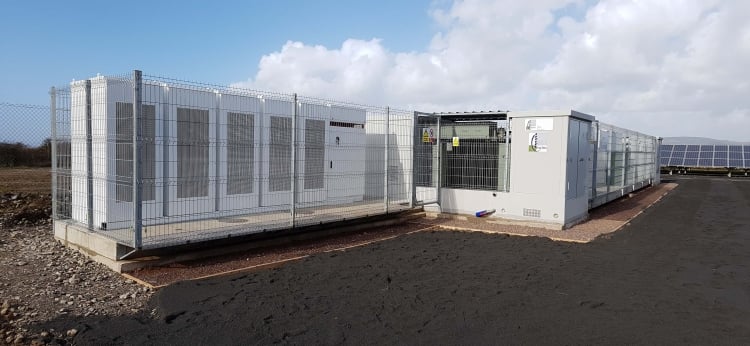
UK demand response and energy resource aggregation company Kiwi Power has unveiled its largest behind the meter battery to date with the completion of the 4MW / 4.8MWh Tesla battery at Cenin Renewables in south Wales.
The battery took three months to build in order to provide firm frequency response (FFR) to National Grid after winning a two year contract offering 24 hour availability at £19/MW (US$26.61) per hour beginning on 1 February.
This will be the sole use of the battery over the first two years of the project’s life, but it will also make use of the onsite renewable generation from the site’s solar, wind and anaerobic digestion resources.
According to Kiwi Power’s commercial leader for battery energy storage Quentin Scrimshire, the battery at Parc Stormy near Bridgend is “responding well” and at much faster speeds that required by National Grid.
Try Premium for just $1
- Full premium access for the first month at only $1
- Converts to an annual rate after 30 days unless cancelled
- Cancel anytime during the trial period
Premium Benefits
- Expert industry analysis and interviews
- Digital access to PV Tech Power journal
- Exclusive event discounts
Or get the full Premium subscription right away
Or continue reading this article for free
The project has used third party finance from an unnamed investor which will take the lion’s share of the FFR revenue, while Kiwi takes a fee for managing the battery and Cenin also gets a share of the project’s revenue.
Once the two year contract is completed, Cenin will then receive further benefits of having the battery on site, as Scrimshire explained.
“The site gets additional benefits like resilience in the future when it’s not providing FFR and there’s some other value that we can unlock behind the meter. At the moment we’re just focusing on FFR but it’s a future-proofed battery, we can do everything with it,” he said.
While being unable to access all of these benefits until February 2020, managing director Martyn Popham told our UK sister site Clean Energy News that Cenin will still benefit from learning about the system over the FFR contract length.
“We hope to be able to use it for anything that we can but it’s going to be a steep learning curve. There is an element of risk, its early days and we don’t know how it will go. It’s a little bit uncertain but the good thing is it’s got contracted income for two years and we’ll learn a lot about how it works and then we hope to introduce anything and everything we can to back it up,” he said.
Popham added that the site had plans for large scale electric vehicles and further expansion of onsite renewables which the battery would be able to accommodate.
As regional developer, he also suggested that batteries could be “part of the next generation of projects” Cenin will carry out and so operating a battery onsite will provide invaluable knowledge should the company start building batteries of its own in the future.
While securing a lucrative FFR contract, the future revenue stack of the battery following the two year contract remains unclear. While National Grid is continuing to reformulate its range of grid services, Scrimshire remains confident the battery will continue to offer a service required by the grid operator.
“Frequency response is not going away and with the system needs and product strategy it’s clear that National Grid has got a requirement for frequency response that looks a little different from how it looks today, but it’s certainly something that batteries will provide.
“But we see it being a full mix. That’s Kiwi’s selling point; we get maximum value through lots of different services and we think that’s the future – stacking services on top of each other is going to get us maximum value,” he said.
Last week, analyst Lauren Cook of Solar Media Market Research explained that at present, there is no “typical” way of stacking revenues, with other providers also likely to look at similar business models to Kiwi’s. Cook and her team forecasted that Britain could deploy more than 9,000MWh of behind-the-meter energy storage by 2022.