
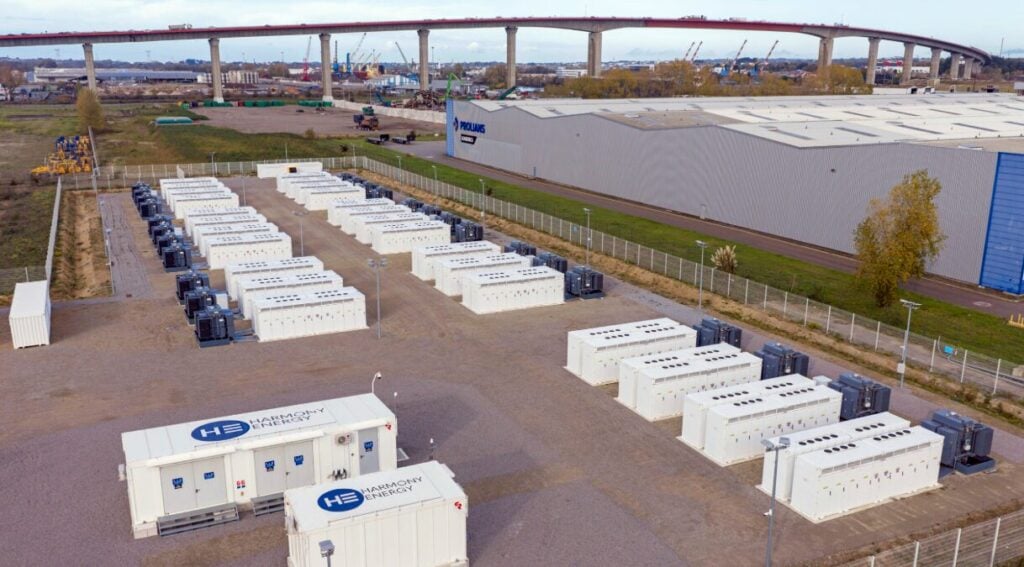
We catch up with Peter Kavanagh, CEO of battery energy storage system (BESS) developer Harmony Energy, after it was acquired by Switzerland-headquartered power group Alpiq.
The deal announced at the start of July saw Alpiq take a 90% stake in UK-headquartered Harmony, which Kavanagh co-founded in 2016 and will retain a 10% stake in going forward. The firm started as a UK BESS developer but has now expanded to France, Germany and Poland.
Harmony Energy enlisted advisors JLL to run a sales process 10 months ago, around the same time that we last spoke to Kavanagh (about the sale and de-listing of the listed Harmony Energy Income Trust, which had until then been the main vehicle that financed Harmony’s developed projects).
In this interview, we dive into the deal and what will and won’t change when it comes to development, financing, offtake and procurement for Harmony Energy going forward.
Try Premium for just $1
- Full premium access for the first month at only $1
- Converts to an annual rate after 30 days unless cancelled
- Cancel anytime during the trial period
Premium Benefits
- Expert industry analysis and interviews
- Digital access to PV Tech Power journal
- Exclusive event discounts
Or get the full Premium subscription right away
Or continue reading this article for free
10-month process
Kavanagh says that selling to a strategic buyer made sense because, since the HEIT sale, the firm has struggled to raise enough private capital to enable it to fully focus on building what it hopes to be one of the biggest BESS platforms in Europe.
“We knew Alpiq really well over the last few years having sold two sites in France to them,” Kavanagh says, referring to the Cheviré and Oise projects, both 100MW/200MWh.
“For me it was always best case scenario having them come through as the winner of the process because culturally they are well aligned with us. They’re super passionate about what we’re trying to achieve in the battery space, and they’ve got such a depth of knowledge across Europe.”
“We’ve now got the financial strength to really accelerate the profile across all the territories we’re in.”
The firm currently has three sites in build, one close to energisation in the UK and another two in France, plus other sites through planning in the UK, Germany and France.
Alpiq meanwhile has been deploying its own own-operate BESS projects across Europe, including two in Finland totalling a combined 286MWh, a 370MW pipeline in Germany, before announcing a 1.2GWh project in Switzerland shortly after the Harmony deal.
It is also a provider of offtake for BESS, notably for one of the largest online in Germany. We’ll dive into what that might mean further down.
So what will and won’t change going forward?
One thing that will definitely change now is that Kavanagh and the Harmony Energy team will not need to deal with financing projects, since Alpiq has the clout to fund projects itself (with a market cap of CHF 1.33 billion or US$1.65 billion).
“There’s going to be a lot of stuff just done on balance sheet. Maybe longer term you look to introduce debt further down the line, but you know within the immediate period, that’s not what we’re looking to do. We will still sell down sites occasionally, just to raise capital and test valuations in markets,” Kavanagh says.
As owner of the company and its pipeline, Alpiq obviously now has control over what sites get built, or not built, or sold, but Harmony will continue to operate independently, Kavanagh explains.
“They have control, but we are keeping Harmony the same team, same brand, same philosophy. They were really keen to operate Harmony as a standalone business to keep the entrepreneurial feel and make quick decisions because the attraction to them was delivering the pipeline, getting the assets operational.”
“So it might sound unusual, but it’s pretty much business as usual, just on an accelerated path without the hassle of having to raise additional equity.”
What about offtake and procurement?
We then ask Kavanagh if this ‘business as usual’ approach applied to offtake and optimisation for its projects too. The key thing here is that Alpiq has provided offtake to BESS owners including that large project in Germany mentioned earlier.
Will Alpiq handle offtake for Harmony’s BESS pipeline or will Harmony still seek optimisers via competitive processes as it has done to-date?
“It’s a really good question. So the central theme is to still run competitive processes, as Harmony as still an independent platform, but no doubt you know our people will integrate trading services. So you know, Alpiq doesn’t have any trading capability in the UK and Poland, so those will naturally stay with whoever is the best in-market,” Kavanagh explains.
“The Chevire project is using Tesla Autobidder which is performing exceptionally well, so that’s a circumstance where they may well retain the existing trading partner rather than bring in-house.”
“There might be a nuance in Germany in a few years’ time where they’d take that trading in-house. But it has to be a competitive market process to do that. If you’re looking at it as an independent platform, you don’t want to have that obligation to use Alpiq. If they’re the strongest, then great. But we’re lucky in that it’s a very competitive market. There are so many good trading partners it’s quite hard to pick.”
Kavanagh also says its approach to procurement would not change under Alpiq. To-date it has used Tesla and Envision Energy, and would continue with having a mixture of these two plus another provider, three in total, for its projects.
UK, France, Poland and Germany activity
Onto the company’s near-term pipeline. In the UK, Harmony is out to tender for BESS and EPC supply on eight projects, which should be contracted Q3/14 for build early next year. In France, it has two in build already and two more that will go into procurement to be ready to build (RTB) in Q4.
In Germany, it has two ‘very big’ projects that should be contracted by the end of the year too. The firm has not revealed too much detail on its Germany projects, only announcing a financing facility from Triple Point for a 3GWh pipeline. It doesn’t list them on its website either, whereas it does for all other countries.
Note that Germany is one country where there is overlap between Harmony and Alpiq’s own-operate development activity. Alpiq announced 370MW BESS pipeline in Germany in December 2025 with developer SPP development.
Harmony will start building a 200MW/400MWh BESS in Poland in Q1 next year, and sold another one of that size in the country to EDF recently.
Kavanagh: “In all territories, grid is the limitation. We’re fortunate to have the projects we do that have grid access already, but certainly going forward, it’s a case that expansion is limited by the grid across Europe. Every country has its issues on that front.”
