
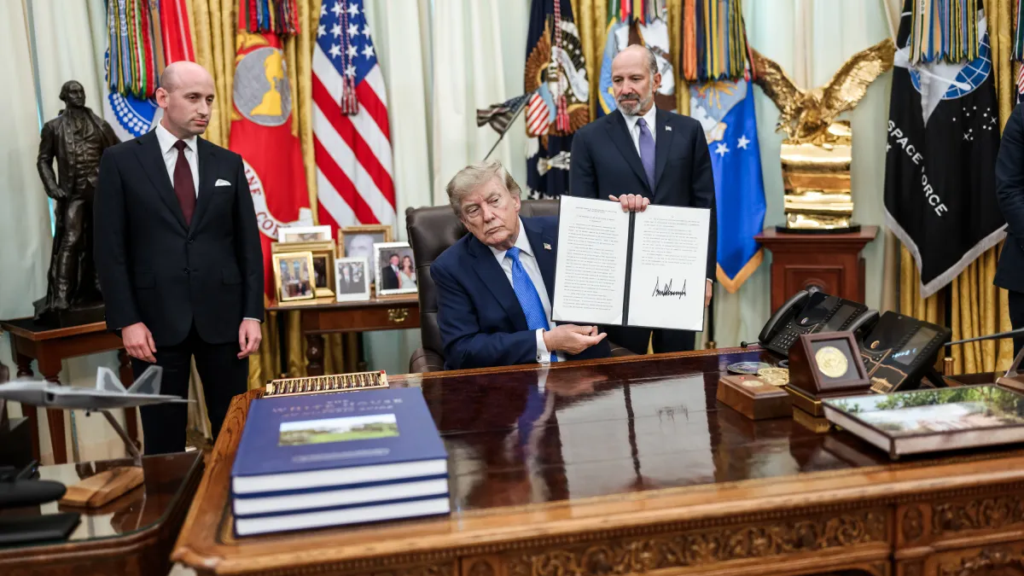
On 26 August, US President Donald Trump banned the import of inverters, transformers and other power equipment citing a potential risk to US grid security, via emergency executive order (EO).
The order applies to specific power system equipment, including grid-connected inverters, transformers and battery energy storage systems (BESS). It covers only equipment connected to transmission lines of 69kV or higher, excluding distributed energy resources (DERS) and local distribution infrastructure.
It targets 24 countries currently subject to US arms embargoes and sanctions, with China being the most significant. Equipment must originate from these countries or from entities owned, controlled or directed by them—a framework similar to US foreign entity of concern (FEOC) regulations.
The order is not yet active but will apply to all transactions “initiated” after 26 August 2026. The Department of Energy (DOE) has 120 days to issue implementing regulations.
Try Premium for just $1
- Full premium access for the first month at only $1
- Converts to an annual rate after 30 days unless cancelled
- Cancel anytime during the trial period
Premium Benefits
- Expert industry analysis and interviews
- Digital access to PV Tech Power journal
- Exclusive event discounts
Or get the full Premium subscription right away
Or continue reading this article for free
Transactions will not be prohibited until the DOE determines that the equipment “poses an unacceptable risk” to US security based on cybersecurity, sabotage and remote access threats.
Implementation details remain unclear. Law firm Norton Rose Fulbright suggested the DOE may create a whitelist of pre-approved equipment and vendors or establish a licensing process for power companies seeking to use sensitive equipment. More stringent measures are also possible, including orders to isolate, monitor or remove equipment already in operation.
This also follows the US Federal Communications Commission (FCC) 28 July decision to restrict all new “connected power inverters” produced outside the US, which was already creating widespread confusion and potential disruption across the BESS and solar industries.
Market reactions
Immediately following the EO on 26 August, there was speculation about which companies would stand to gain or lose from its potential follow-through. Multiple analysts began following the stock prices of BESS companies Fluence and Tesla.
The implications become clearer when examining the current BESS supplier landscape. According to the latest Battery StorageTech Bankability Ratings Report for Q2 from our colleagues at PV Tech Research, Chinese suppliers dominate the global market, with the top five players controlling 39% of market share.
Leading Chinese manufacturers like CATL (recently upgraded to AAA rating), Rept Battero, CALB, and Eve Energy have posted strong profit growth and are aggressively expanding internationally, with overseas revenue up 51% in H1 2026.
While Fluence did see a brief spike in its stock price on 26 and 27 August, shares quickly fell below even their previous prices. Analysts at multinational banks Barclays and Piper Sandler expressed doubt over the company’s margins and ability to deliver on its project backlog.
This concern is notable given that Fluence recently posted a record US$5.6 billion backlog, according to the Battery StorageTech Bankability Ratings Report. It raises questions about whether Fluence can execute profitably while facing potential supply chain disruptions from the ban and competing against vertically integrated Chinese players who control both cell production and system manufacturing, giving them significant cost advantages.
However, Tesla, experiencing ups and downs since the EO has continued an upward trajectory. Notably, some analysts are arguing it would be better to sell the company’s stock. Investment research firm Zacks noted that Tesla is cutting prices on its electric vehicles (EVs) in China because it’s losing market share to domestic competitors like BYD and NIO.
While the discounts could temporarily boost sales, they’re likely to further squeeze Tesla’s already-thin profit margins and could spark a broader price war that makes the situation worse for all.
Supply chain vulnerabilities
Expanding out to broader industry forecasting, Eric Hobby, CEO of Primary Transformers, a power, distribution, and specialty transformer supplier wrote on 10 September about the potential threat that foreign-made equipment could pose to the grid.
Hobby continued, “The simplest solution is the one the executive order advocates: a blanket ban on equipment or components tied to any foreign adversary. This option sounds appealing until one considers the consequences.”
“Take bushings, a low-risk, critical transformer component, for example. The only new high-voltage bushings available before late summer 2028 are made in China. A ban on this single component would halt new 345kV+ power transformer purchases in the US for years. A blunt rule that removes a major supplier country overnight trades one problem for a bigger one. An aging grid starved of new transformers is a greater security risk than any single adversary could engineer.”
This supply chain vulnerability extends to BESS equipment. The global battery storage market is highly consolidated, with Chinese manufacturers demonstrating strong financial health and vertical integration—controlling both battery cell production and system manufacturing.
Over 120 billion yuan in new battery manufacturing capacity was announced in China in H1 2026 alone. This vertical integration is a significant advantage, particularly as lithium carbonate prices fluctuate, allowing these companies to better manage input-cost volatility than competitors reliant on external cell suppliers. Cutting off access to this manufacturing base could leave the US dependent on a limited domestic supply chain that lacks the scale and cost competitiveness of established international players.
Nicholas Weaver, senior staff researcher at the International Computer Science Institute in Berkeley, California, wrote that these bans actively harm US security, arguing that the solar inverter ban directly undermines US strategy against Iran.
With the Strait of Hormuz effectively closed and US Strategic Petroleum Reserves depleting at millions of barrels per week, the long-term solution is reducing oil dependence through solar, wind, and batteries. Limiting solar inverters to the small US manufacturing base will severely restrict solar deployment exactly when it’s most needed.
Weaver also highlighted that friends of the administration can apply for exemptions. SpaceX, for example, builds its satellite receivers in Vietnam but continues to do so without issue. As he wrote, “Apparently it is not a national security issue for Elon Musk to make his routers overseas.”
The executive order effectively attempts to wall off the US from an established, financially robust supply chain at precisely the moment when energy storage deployment is critical for grid stability and energy independence.
Meanwhile, Chinese BESS suppliers are redirecting their international expansion toward emerging markets in Eastern Europe, South America, and India, where new policy frameworks are creating significant growth opportunities.
The result could be a US market with limited, expensive domestic options while the rest of the world benefits from competitive pricing and established supply chains—potentially delaying the energy storage deployments needed to reduce dependence on oil and strengthen grid resilience.
Battery Asset Management Summit USA 2026 will be held 15-16 September in Garden Grove, California, hosted by Energy-Storage.news publisher Solar Media (part of the Informa Group). The agenda emphasises addressing the roles of AI, cybersecurity, and second-life applications, broken down into two tracks: Technical Asset Management and Commercial Asset Management. This year, the conference is also co-located with Solar & Storage Finance Summit USA. Visit the official site for more details.
