Energy stored in electric vehicle (EV) batteries will be traded on European power markets by The Mobility House, a specialist in vehicle-to-grid (V2G) technologies.
The company said last week that it has joined EPEX SPOT SE, an exchange for power spot markets active in 13 different EU member and non-EU member countries across the European continent.
There it will be able to trade flexibility in the form of electric power from 4,500 EV batteries, equivalent to 100MW output, The Mobility House claimed. The company’s own software solution, called the EV Aggregation Platform and likened to Tesla Autobidder in its functionality, will enable this aggregation and trading.
While The Mobility House has already been trading on European power markets with both brand-new and second life EV batteries since 2016, until now it has done so through market access of one of its partners.
Try Premium for just $1
- Full premium access for the first month at only $1
- Converts to an annual rate after 30 days unless cancelled
- Cancel anytime during the trial period
Premium Benefits
- Expert industry analysis and interviews
- Digital access to PV Tech Power journal
- Exclusive event discounts
Or get the full Premium subscription right away
Or continue reading this article for free
Now however, with interest in vehicle-to-grid technologies on the rise, leading to greater deployments of bi-directional charging equipment which can feed the grid as well as the vehicle, active participation in a market is mandatory, leading the company to pursue its own membership.
The Mobility House said its EV Aggregation Platform is already in use in Germany, France, and the Netherlands, while launches for the UK and US markets are also planned.
“Over the course of many years, we have gained valuable experience in day-ahead and intraday trading using our EV Aggregation Platform as a basis in numerous projects with well-known partners. So, we are thrilled that we are now even closer to short-term trading as a member of the EPEX SPOT SE power exchange,” The Mobility House’s CEO, Robert Hienz said.
“In this dynamic environment we are increasing our real net output ratio and improving our agility. This will enable us to even better fulfil our promise to partners and customers of generating maximum value in the electrical energy system with electric car batteries.”
V2G has long been considered technically feasible, but some obstacles have stood in the way in the past, largely from regulatory as well as market perspectives – for instance, most manufacturers to date have not launched their EVs with bi-directional interaction with the grid in mind.
That appears to be changing, with the likes of Nissan and Ford among those to put cars onto the market ready to be trialled for vehicle-to-grid applications, and crucially, to be warrantied for them as well.
In early 2020, The Mobility House successfully executed a showcase project in Germany supported by the Germany Ministry for Energy and Economic Affairs’ “Smart Energy Showcases – Digital Agenda for the Energy Transition” (SINTEG) programme and in partnership with regional grid operator TenneT. That project aggregated 40kWh Nissan Leaf EV battery packs to help integrate renewable energy onto the network.
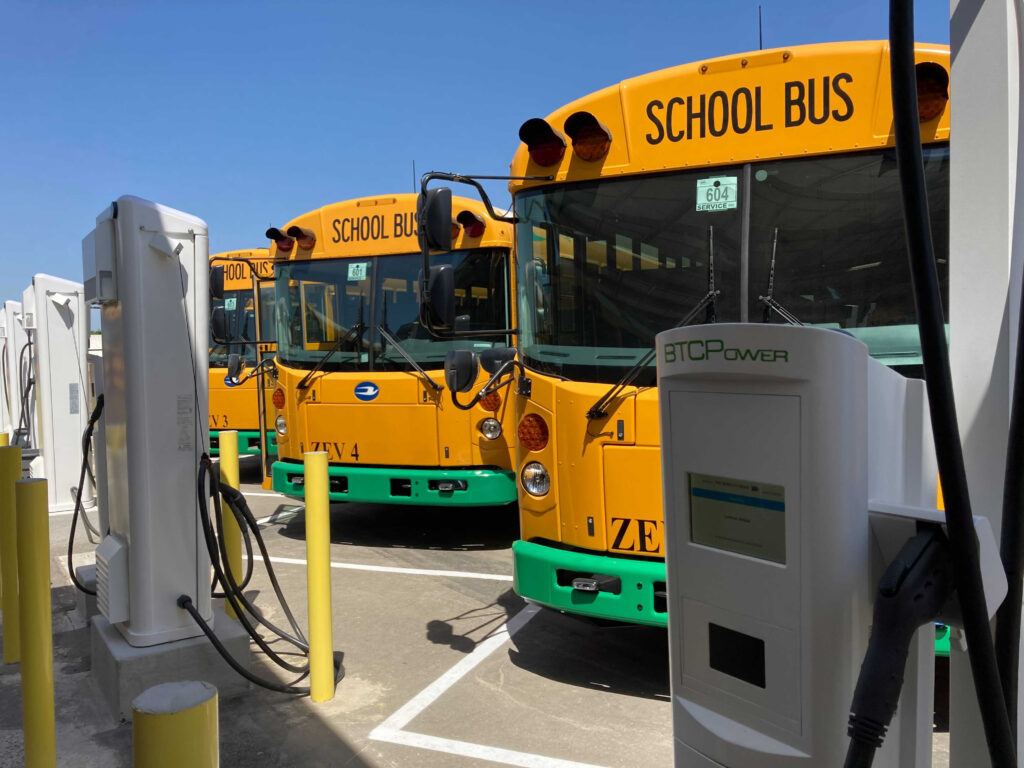
Another approach is to aggregate fleet vehicles, such as electric buses, where the daily usage profile and patterns are scheduled and well-established, meaning that operators are aware of when their batteries will need to be used for transport and when they can be used for grid applications.
In the UK, a recent project between sustainable energy tech company Octopus Energy Group and electricity system operator National Grid ESO proved that V2G could be used successfully in the Balancing Mechanism, through which energy supply and demand on the grid are matched in real time.
Elsewhere, Energy-Storage.news reported on a V2G microgrid trial in Switzerland in which power electronics engineering group Eaton will connect bi-directional chargers and aggregate EV battery capacity. The company noted that Swiss regulations allow for privatised microgrids to supply energy along parts of the electricity network, allowing the large-scale trial of up to 250 chargers to go ahead.
In the US, utility Duke Energy is to try out Ford’s F-150 electric truck’s capabilities as a V2G resource, while one of the country’s fastest moving vehicle-to-grid startups, Nuvve, just reported that it now has 16.1MW of V2G under management from assets including electric buses and contracts and pilot projects with utilities and power producers like Vistra Energy and San Diego Gas & Electric (SDG&E).