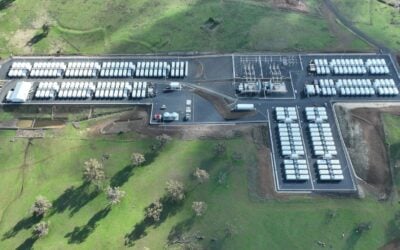
Swift Current Energy has secured US$242 million in financing for what the developer claimed will be the biggest battery storage project in the PJM service area of the US grid.
Massachusetts-headquartered renewables and energy storage developer Swift Current Energy said this morning that it had closed project financing for Prospect Power Storage, a 150MW/600MWh battery energy storage system (BESS) facility in Rockingham County, Virginia.
Joint coordinating lead arrangers on the financing were Truist Securities, Canadian Imperial Bank of Commerce (CIBC), KeyBank and Natixis.
Prospect is Swift Current Energy’s first large-scale battery project and was acquired in 2023 from Clean Planet Energy, a joint venture (JV) between developers Open Road Renewable Energy and Eolian. The company said Prospect is now under construction and expects it to reach commercial operation in 2026.
Try Premium for just $1
- Full premium access for the first month at only $1
- Converts to an annual rate after 30 days unless cancelled
- Cancel anytime during the trial period
Premium Benefits
- Expert industry analysis and interviews
- Digital access to PV Tech Power journal
- Exclusive event discounts
Or get the full Premium subscription right away
Or continue reading this article for free
Eolian CEO Aaron Zubaty said development of Prospect began in 2018 with the aim of deploying “fast-responding and flexible capacity to support increasing load growth in the region” and connecting to transmission networks via existing lines.
Swift Current Energy has a 15-year power purchase agreement (PPA) in place for the BESS asset’s output with utility Dominion Energy Virginia.
PJM, Virginia need energy storage to manage load growth
Regional transmission organisation (RTO) PJM covers parts of 13 US states and the District of Columbia. According to market intelligence firm Modo Energy, it has only added 200MW of grid-scale battery capacity in the past five years, of a total 424MW of operational BESS in the RTO’s territory as of May.
However, as the American Clean Power Association (ACP) recently noted in a fact sheet, PJM’s annual peak load is projected to grow by an additional 100GWh and 15GW by 2030, and there are more than 1GW of pending battery storage projects and 55GW of projects in the interconnection queue.
PJM was actually an early leader in US and global energy storage adoption, through being the first region to implement a ‘pay for performance’ ancillary services market design. This allowed batteries to compete against slower-responding thermal plants in delivering frequency regulation and led to a short-lived boom in the mid-2010s for BESS resources in PJM before the market quickly saturated.
ACP noted that PJM still allows BESS to compete in capacity, ancillary service and energy markets, but rules designed around traditional generation prevent batteries from competing on a level playing field.
ACP called for opportunity cost bidding reform, which could enable storage to include the opportunity cost of charging and discharging based on electricity pricing within PJM.
On a related note, the RTO saw prices for its recent 2025 PJM Reliability Pricing Model (RPM) capacity market auction jump 22% from last year, following an 830% jump the previous year. Advocacy groups Citizens Utility Board (CUB) and Clean Grid Alliance argued that allowing greater participation by renewables and storage would help limit price spikes.
Meanwhile, three states within PJM territory have introduced energy storage deployment targets, including Virginia’s pursuit of 3.1GW of new capacity by 2035. This would be split between utilities Dominion Energy and Appalachian Power, which must petition state regulators for approval to construct, acquire or procure capacity from facilities like Swift Current Energy’s.
A recent legislative push to increase the utility targets and include carve-outs for long-duration energy storage (LDES) was, however, vetoed by Virginia governor Glenn Youngkin in May.
As reported by ESN Premium that same month, Swift Current Energy is developing Rocktown Power BESS, another 150MW/600MWh project at a site adjacent to Prospect’s, but was denied a Special Use Permit (SUP) for it at a meeting by the Board of Supervisors of Rockingham County.
In September last year, the developer secured US$300 million financing through a senior secured revolving credit facility from lenders including First Citizens Bank, which it said would be used as flexible growth capital for its pipeline of projects across solar PV, wind and energy storage.