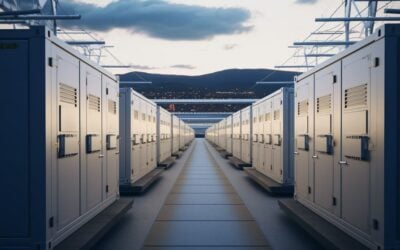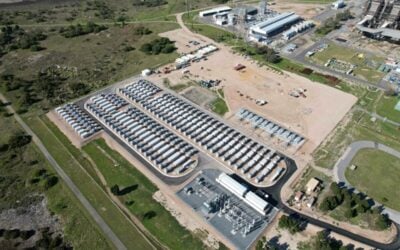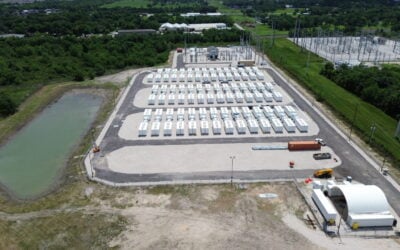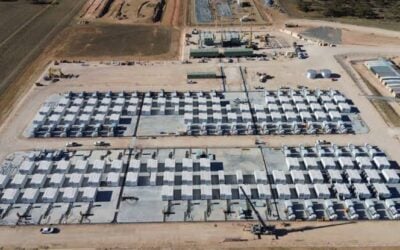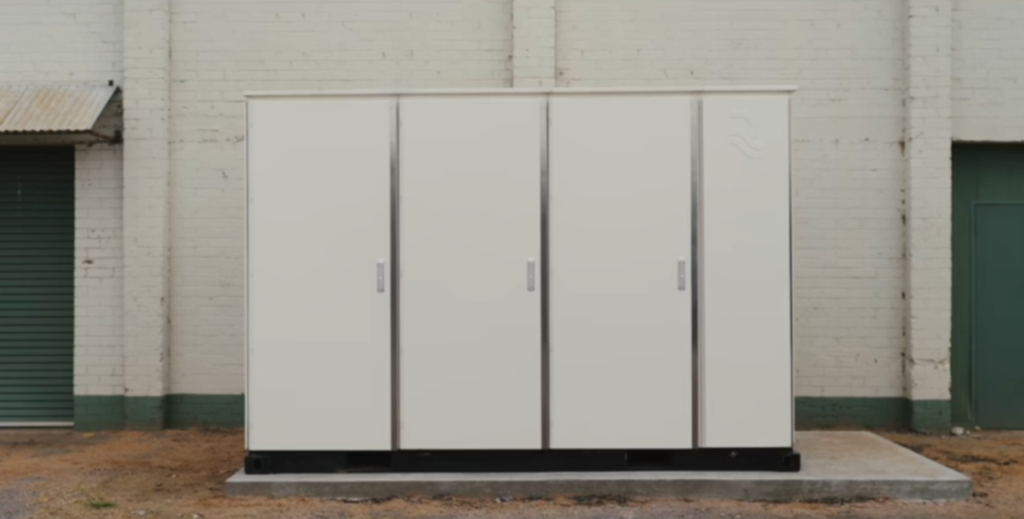
Melbourne-based battery technology company Relectrify has installed its first AC1 battery energy storage system (BESS) in Renmark, South Australia, in partnership with YES Energy.
This marks the commercial debut of a system that generates grid-compliant AC power without a conventional inverter.
Relectrify is an Australian battery technology developer that designs cell-level control electronics for stationary storage applications. The company’s core technology, branded CellSwitch, provides individual monitoring and control of nearly 4,000 battery cells within each AC1 unit, a level of granularity the company says is unmatched by other BESS on the market.
The Renmark installation is sized at 250kVA and 1,089kWh and follows certification of the AC1 to both International Electrotechnical Commission (IEC) standards and the Australian grid connection standard AS/NZS 4777.
Try Premium for just $1
- Full premium access for the first month at only $1
- Converts to an annual rate after 30 days unless cancelled
- Cancel anytime during the trial period
Premium Benefits
- Expert industry analysis and interviews
- Digital access to PV Tech Power journal
- Exclusive event discounts
Or get the full Premium subscription right away
Or continue reading this article for free
The Renmark installation forms part of Relectrify’s More Energy Project, a AU$61.1 million programme with AU$25 million (US$16.23 million) contributed by the Australian Renewable Energy Agency (ARENA) under its Advancing Renewables Program.
The project started in August 2025 and will run until May 2028, with Relectrify deploying the AC1 to customer sites across Australia, targeting a cumulative nameplate capacity of up to 100MWh.
According to ARENA’s project documentation, the funding is intended to generate field performance data that builds market confidence in Relectrify’s battery management system technology, ahead of wider commercialisation.
ARENA has identified three specific advantages it expects the inverterless design to demonstrate at scale.
This includes lower capital expenditure from the absence of a separate inverter, improved usable lifetime capacity through individual cell management, and lower operating expenditure from the ability to identify and replace malfunctioning cells with precision, rather than replacing entire battery modules or packs.
An inverterless approach to battery architecture
Conventional battery storage systems store energy as direct current and rely on inverters to convert it to alternating current for grid connection, adding cost, complexity and additional points of failure to the system.
The AC1 departs from that architecture, using its CellSwitch electronics to generate grid-compliant AC power directly from the battery cells, removing the inverter stage entirely.
That cell-level control also underpins the performance claims Relectrify makes for the system.
The company guarantees the AC1 will retain 40% more of its original capacity after 20 years of daily cycling than conventional battery storage systems, while reliably delivering 99% of available energy per cycle, translating into what the company describes as 20% more usable energy over the system’s lifetime.
Individual cells are continuously monitored for faults, and any anomalous cell can be bypassed without affecting the operation of the rest of the pack.
The AC1 is aimed primarily at commercial and industrial energy users, a segment ARENA has previously described as the “missing middle” of Australia’s energy transition, sitting between small-scale residential storage and utility-scale grid assets.
Relectrify’s website also positions the system for smaller-scale utility applications, arguing that its efficiency characteristics could allow developers to install less storage capacity to balance a given amount of renewable energy generation.
The AU$25 million ARENA funding supporting the AC1’s rollout builds on the agency’s earlier backing of Relectrify’s work on second-life electric vehicle (EV) battery applications, and forms part of a broader push to commercialise Australian-developed battery technology.
The funding sits alongside ARENA’s AU$500 million Battery Breakthrough Initiative, which supports domestic battery manufacturing and deployment, and the federal government’s broader National Battery Strategy, which targets a globally competitive Australian battery industry by 2035.
The AC1’s international rollout is also underway, with Relectrify having entered the Taiwanese market, where the system’s proprietary electronics are manufactured and its components assembled.
Never miss an Australian energy storage story. Sign up for our Australia newsletter and get the latest project announcements, policy updates and market analysis delivered directly to you.
Solar Media (part of Informa Group) will host the Battery Asset Management Summit Australia 2026 on 25-26 August at the Amora Hotel Jamison in Sydney, bringing together asset owners, operators, trading teams and optimisers to address revenue strategy, lifecycle management and operational performance across Australia’s fast-growing battery storage fleet.
Readers of Energy-Storage.news can get 20% off their tickets using the code ESN20 at checkout. Find out more about the Summit on the official website.