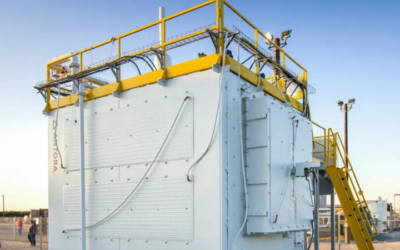
Vacherie containers, inverters and batteries. Source: SimpliPhi Power
Energy storage designer and manufacturer SimpliPhi Power Energy has completed installing a ‘plug and play microgrid’ for an off-grid solar-plus-storage project with Pure Power in California.
The plug-and-play microgrid solution features 22kW of solar PV and 85kWh of non-toxic, cobalt-free ferrous lithium-ion SimpliPhi PHI 3.4 batteries. The batteries were a strong choice for the project, located in Western Sonoma County’s 182 hectare Valerie ranch where temperatures can reach up to 120 degrees Fahrenheit, due to their claim to eliminate the threat of thermal runaway – a chronic issue for many lithium batteries.
The microgrid model is ideal for remote locations with sparse access to a national grid. This project was implemented using standard shipping containers.
“The idea with a containerised plug-and-play microgrid is that depending on what the application is, the territory and what the commercial operations are, we can select different assets to go in the container that can all be delivered at one time, using the container as the primary housing,” SimpliPhi CEO Catherine von Burg told Energy-Storage.News.
Try Premium for just $1
- Full premium access for the first month at only $1
- Converts to an annual rate after 30 days unless cancelled
- Cancel anytime during the trial period
Premium Benefits
- Expert industry analysis and interviews
- Digital access to PV Tech Power journal
- Exclusive event discounts
Or get the full Premium subscription right away
Or continue reading this article for free
“So it cuts down on having to build additional storage to house these assets – whether it’s wind, solar or battery storage etc. It also cuts down on taking up space in existing buildings in existing operations. It’s really a great model.”
This is the first time the Ojai, California-based battery manufacturer has implemented a solar-plus-storage microgrid solution of a domestic nature, but has experience deploying similar in humanitarian and military applications in regions such as Africa, Afghanistan and Iraq. The prospect of implementing a solution of this kind in the residential sector was an appealing opportunity for SimpliPhi, according to von Burg:
“The access on a much smaller, residential-scale takes out of all of the complication of integration and selecting equipment and fine-tuning it. The installer in partnership with SimpliPhi can create the solution at its facility and build it out and then deliver it. It streamlines all the associated costs etc.
The lightweight and modular batteries make transporting containers to site easy and simpler. Source: SimpliPhi Power
“The other benefit, because it is SimpliPhi Power storage, is we can be put in containers. Our batteries can be mounted in multiples in a container in hot climates like the one you see at this ranch. This means the temperature inside the container is hotter. Our batteries are one of the few if not the only lithium-ion ferrous-phosphate batteries that can be in these hot climates without building in cooling, ventilation to protect cycle-life or capacity.”
In addition, the fact that SimpliPhi batteries are modular and light eases the shipping process, von Burg explained.
“It’s a dynamic platform so that we can accommodate what the needs of the end user are; whether it’s an agricultural interest or an industrial interest, we can tailor whatever the assets are that are pre-designed and built into the container before it’s deployed.”
Von Burg claimed SimpliPhi batteries can work efficiently without ventilation or cooling needing to be installed. According to the CEO, that not only saves money but also allows the PV array and the battery bank to be significantly smaller because a percentage of that energy generation is not being used just to cool and protect the battery; creating an efficiency and cost-saving within the system itself.
Significant savings
Therefore, the clean and reliable microgrid application has saved the Valerie Ranch owners more than half a million dollars due to the avoidance of trenching power lines. In addition, the current 10.2kWh application has potential to be scaled-up in tandem with the business and its growing electrical needs – either by adding more batteries into existing containers or because of the modularity and different form factor of containers, add more containers on the property to meet any power requirements.
The addition of the microgrid has achieved not only greater energy security but also energy independence. “[Valerie Ranch] has more security up in the mountains than they would have if they were grid-tied because of the outages and the challenging terrain. It’s just a reminder of how necessary it is and how these solutions really simplify the requirements for these kinds of operations; because it’s so flexible and dynamic.”