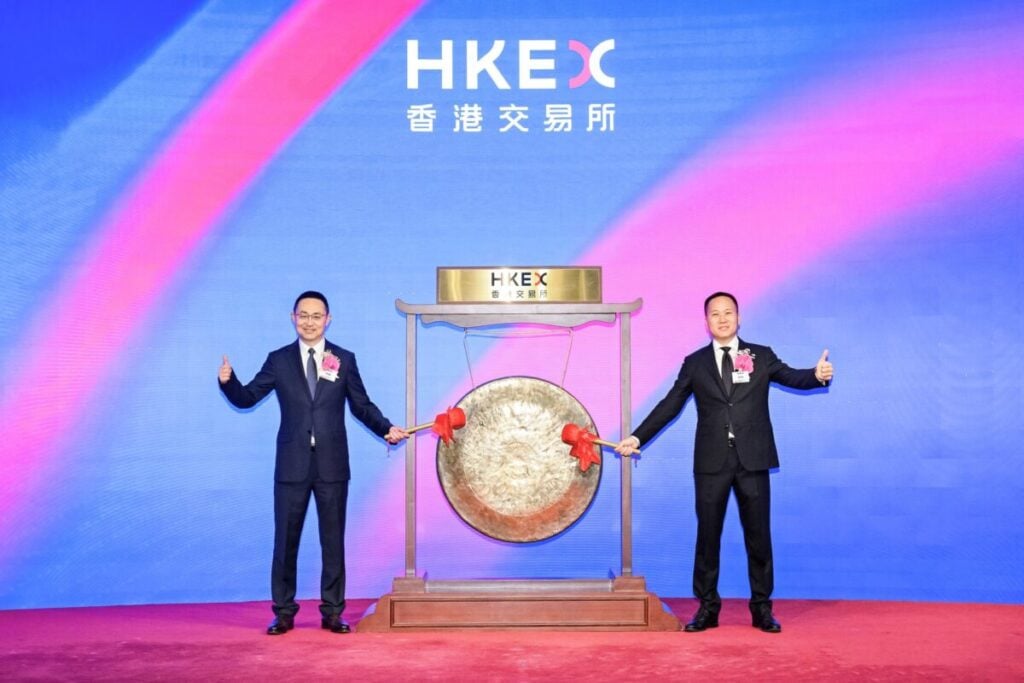
On 16 April, battery storage solutions provider Sigenergy was listed on the Hong Kong Stock Exchange (HKEX) under the stock code 06656.HK.
The company raised over HK$4.4 billion (US$562 million), with the IPO price set at HK$324.20 per share. If the overallotment option (greenshoe) is fully exercised, the total proceeds could reach HK$5.06 billion.
As the first “AI + Integrated PV-Storage Stock” on the Hong Kong stock market, Sigenergy went public in less than four years since its founding, setting a new record for the fastest HKEX listing among mainland Chinese companies.
Hong Kong Securities Clearing Company announced on 14 April that Sigenergy Technologies’ ordinary shares had been approved for admission to its Central Clearing and Settlement System (CCASS), ahead of the commencement of dealings in the company’s H Shares two days later.
Try Premium for just $1
- Full premium access for the first month at only $1
- Converts to an annual rate after 30 days unless cancelled
- Cancel anytime during the trial period
Premium Benefits
- Expert industry analysis and interviews
- Digital access to PV Tech Power journal
- Exclusive event discounts
Or get the full Premium subscription right away
Or continue reading this article for free
In July, ESN Premium noted that the filing of Sigenergy’s HKEX listing prospectus in February was part of a wave of Chinese energy storage firms seeking H Share listings, enabling them to tap financing from a broader base of investors.
Companies already listed in Hong Kong, in addition to prior listings in mainland China exchanges, include CATL, CALB, REPT Battero and ZENERGY, recently joined by system integrator Guoxia Technology. Others pursuing the same route reported by this site include Sunwoda, EVE Energy, Narada Power, Hithium, Shuangdeng and Sungrow.
During its IPO, Sigenergy secured backing from top-tier sovereign wealth funds, global asset managers, leading private equity firms, and major insurers. These institutional investors included Temasek, Goldman Sachs Asset Management, Hillhouse, UBS Asset Management, BNP Paribas Asset Management, CPE Source, ORIX, Barings, Gaoyi Asset Management, Greenwoods Asset Management, Boyu Capital, Fullgoal Fund, Pacific Insurance, Walden International, Orchid Asia, and 3W Fund.
According to Frost & Sullivan, just two years after its founding, Sigenergy ranked first globally in the stacked distributed PV-storage all-in-one solution market, with a 28.6% share in 2024. Australian residential PV and energy storage market research group SunWiz reported that in 2025, Sigenergy led the distributed energy storage market share in key countries such as Australia, Ireland, and South Africa.
Its prospectus shows that overseas revenue accounted for 99% of Sigenergy’s total revenue in 2025, with the Asia-Pacific and European markets contributing 45.9% and 44.6% respectively. The company now operates in 85 countries and regions, working with 172 distributors and over 17,000 registered installers, while maintaining a leading position in core markets including Australia, Germany, and Sweden.
Currently, Sigenergy has three major production bases in Lingang, Nantong, and Jinqiao, primarily manufacturing inverters and storage batteries. Its Nantong Smart Energy Center was officially opened not long ago.