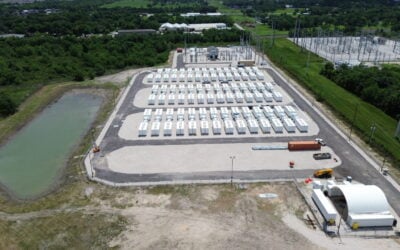
The Tesla storage system will make up the shortfall in energy supply, storage and grid balancing in California that has followed the Aliso Canyo disaster (above), the worst environmental disaster in US history. Source: Flickr/earthworks
Tesla Motors has won a contract to supply a 20MW energy storage system at Southern California Edison’s substation in Mira Loma, California. Upon completion, the system will be the largest lithium-ion battery storage project in the world, the US automotive and energy storage firm said.
Tesla will provide its Powerpack storage solution to the plant. Fully charged, it will deliver 80MWh of energy, enough to power 2,500 households for a day, or charge 1,000 electric vehicles, the company said. Tesla will manufacture the system at its Gigafactory in Reno, Nevada; including shipping and installation, with the process set to last three months.
Tesla was the only bidder in the Southern California Edison (SCE) tender to be awarded a utility-owned storage project.
“In order to achieve a sustainable energy future, one which has high penetration of solar and electric vehicles, the world needs a two-way, flexible electric grid. The electric power industry is the last great industry that has not seen the revolutionary effects of storage,” a Tesla blog post read.
Try Premium for just $1
- Full premium access for the first month at only $1
- Converts to an annual rate after 30 days unless cancelled
- Cancel anytime during the trial period
Premium Benefits
- Expert industry analysis and interviews
- Digital access to PV Tech Power journal
- Exclusive event discounts
Or get the full Premium subscription right away
Or continue reading this article for free
“Working in close collaboration with SCE, the Tesla Powerpack system will be a landmark project that truly heralds the new age of storage on the electric grid.”
The system will charge using electricity from the grid in off-peak hours and will deliver electricity to the grid during peak hours, reducing reliance on natural gas, and enhancing equilibrium within the grid itself. SCE serves 15 million residents in the region.
The new resource is designed to provide renewed stability of energy supply to the Los Angeles region. Last October, a massive rupture at SCE’s Aliso Canyon natural gas reservoir outside Los Angeles, the second largest facility of its type, saw 1.6 million pounds of methane released into the atmosphere, and more than 8,000 local residents displaced.
The gas leak is considered the worst in US history in terms of its environmental impact, with a carbon footprint larger than the Deepwater Horizon oil spill in the Gulf of Mexico in 2010.
Tesla said the Los Angeles basin is at heightened risk of rolling blackouts because of uncharacteristically high winter demand, and the absence of a solution that ensures reliability during peak hours following the Aliso Canyon leak.
The California Public Utilities Commission (CPUC) mandated an accelerated procurement for energy storage in May. Utilities including SCE were directed to solicit a utility-scale storage solution that could be operational by December.
SCE has already selected energy storage manufacturer and developer Powin Energy, a subsidiary of Powin Corporation, to build a 2MW / 8MWh storage system for grid support and capacity services as a result of the CPUC’s emergency procurement call.
Industry commentators and analysts said the Aliso Canyon disaster, and the subsequent CPUC procurement programme, provides energy storage developers in California with a unique opportunity to prove the benefits of energy storage technologies versus fossil fuels.