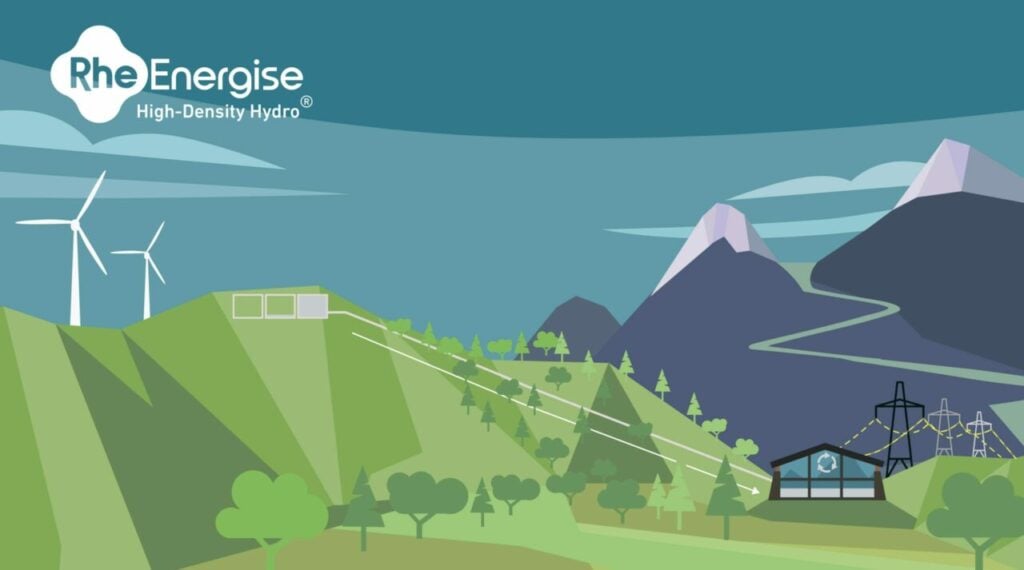
One company that is spearheading innovation within the pumped hydro space is RheEnergise, which has developed High-Density Fluid R-19, a substance that is 2.5x denser than water. Using this fluid, its PHES systems can operate on low hills rather than just mountains, creating an opportunity an order of magnitude greater than traditional pumped hydro.
Utilising RheEnergise’s solution, this figure could increase substantially with increased access to possible project development sites around the UK. To find out more, we spoke with RheEnergise CEO Stephen Crosher.
What are some of the challenges preventing the wider adoption of the pumped hydro industry?
I don’t think there’s a challenge with adoption. There’s a lot of interest in hydropower and traditional pumped hydro power, and even tidal barrages but these tend to be huge projects that take decades to construct. Because of this, there’s not really a lack of interest but the scale of the progress is very slow.
That’s fundamentally what we’re trying to address by bringing smaller projects onto the distribution network. Rather than thinking about a project and having it operational in 20 years, you can have it operational sooner. The developers can do multiple projects in tandem and achieve the same sort of scale but within much shorter time periods.
Try Premium for just $1
- Full premium access for the first month at only $1
- Converts to an annual rate after 30 days unless cancelled
- Cancel anytime during the trial period
Premium Benefits
- Expert industry analysis and interviews
- Digital access to PV Tech Power journal
- Exclusive event discounts
Or get the full Premium subscription right away
Or continue reading this article for free
Traditional pumped hydro power deploys about 4GW a year, which is great. It has its place and will produce large volumes of long duration storage in places where it’s built. But it can’t do everything; you need other solutions that can be deployed fast and solve things quicker.
Are there any geographical regions of the UK in which you see your technology being prominently used? Is planning permission difficult to acquire for these projects?
I think there are several areas. Starting in the south, we see a lot of opportunities down in the southwest. We see some around London and around the Midlands areas. Wales is also going to be strong and, as you go further north, there’s a range of hills and mountains that go right across the North side of the central valley of Scotland. There are others like the Ben Lomond hills and more in Scotland that we think are fantastic opportunities. These really work well with the amount of wind power that they have in Scotland.
In terms of planning permission, the answer to that is no, it hasn’t been too difficult to go through the planning process. But that’s quite a small sample. We think that our instinct and from talking to planning consultants and local authorities, we think a project is probably a bit harder than a solar and battery project but significantly simpler than a wind project. We’re set somewhere in the middle, we’re probably similar to a battery project in terms of contestability.
Planning permission can be challenging. The UK is not the only country and planning permission elsewhere can be easier. Part of our risk mitigation strategy is to develop perhaps ’20 projects in the UK before we go anywhere else and in tandem to seek opportunities in other countries. We don’t mind if our first project is here.
Are there any countries that you think your solution could be a perfect fit?
There are quite a few around the globe. South Africa has a large number of sites in which our technology would be great however the ease of doing business is not very straightforward. In the United States, it’s probably New York State, Texas, or California, or states that neighbour California and are supplying into California. Mexico would also be economically attractive.
In Europe, the solution will probably become necessary for most Central European countries in time. Germany, Czech Republic and Romania will probably be more obvious ones at the moment. Looking further afield, we see huge potential for the technology in Australia – it is an attractive market – and places like India who are rapidly seeking solutions such as RheEnergise’s.
Strangely enough for a hydropower system, we actually think the Middle East is a hugely attractive market because we have a sealed system. We don’t have the evaporation problem; we can control evaporation and so we have an energy storage compensator storage solution for locations in dry climates, which was never there before.
Could you please provide an overview of the solution and maybe how it makes you stand out in the market?
In the energy industry, there has been a discussion around the need for storage for the best part of a decade in some form. That discussion is getting bigger, more vocal and the need is more urgent. It is now being recognised across the world. By power, if you look at pumped hydro by volume or energy, it’s over 99% of the storage capacity, and it will stay like that for quite a long time.
So why is such a mature technology, considered a solution of the past rather than the future? That’s where innovators come in and make a solution for the future, which is what we did by looking at density.
There are a few other solution providers across the world and with the scale of the market, you need different solutions for different locations. There’s not one solution that can be applied to everything. With this, you’ve got short duration technologies, medium duration, long duration technologies, and, now there’s even more niche applications.
For us, there’s nothing fundamentally stopping us technologically. There’s no barrier in terms of fluid formulation, redesigning mechanical equipment to cope with the fluid materials, coatings or how you set up the system, the skills are out there already to enable us to do that.
The challenge is, can you scale? When you look at a battery solution, one of the main challenges in scaling is building a factory or a gigafactory – this can take up to eight years to build. You then must develop supply chains, and this can take a few more years to create. One of the principal advantages that we think that we have over pretty much all other technologies is that our supply chain already exists.
We don’t have to make factories, there’s factories across the world that make pumps, or are able to make our pumps. There are also factories that make the pipes and plenty of companies that come out to dig holes in the ground and embed pipes and backfill them, so actually our supply chain entirely exists. What we must do is plug into this pre-existing supply chain.
We think we’re unique in that we’re going from a relatively early-stage company to something that is mature and bankable. I think the challenge is supply chain scalability and I think a lot of companies have not even realised that yet.
What governmental support would you like to see implemented by the UK Government?
In terms of developing market support mechanisms, we do not see the need for any market specific support. Government support to assist companies such as ours, to develop robust solutions, is welcome. The energy market is quite complicated. There are lots of market mechanisms for different services within the energy market. They may contract for fast frequency response, they contract for reserve capacity, it’s effectively a contracted market. Because of this, there’s very much a need for long duration energy storage.
What is important is the creation of market mechanisms that facilitate what everyone wants – a zero carbon power grid that’s reliable. What this means is the market mechanisms must move away from fossil fuels, but support power grids using other solutions and the flexibility solutions. Effectively, what we’re doing is providing flexibility. We are a grid flexibility solution, probably at the larger distribution level or small transmission level. That’s really what we’re doing: flexibility to firm renewable generation.
This is a trillion-dollar market, and a trillion is a very big number. In the UK, we have solutions that can contribute a good part of that trillion-dollar market should the UK Government continue backing the technology. We’ve got footholds in other markets and we’re starting to understand those other markets. The opportunities are huge.
What do you think our audience should know about you and your company? What’s the one thing you would like to tell them?
Quite simply, we are fundraising and recruiting. If you want to be part of our journey and be a part of our success, look us up and sign up. We’re doing a credit raise on Crowdcube and so anyone from £50 can invest. If you’re an institutional investor, we’re doing a Series A fundraise in the early part of next year, to raise around £8 million to £9 million. We are also expanding and so are recruiting people with good skills.