This Premium article, which was one of the most read Premium articles in 2025, has been made free to all to offer a glimpse of our Premium coverage.
—
Shifting dynamics in the US’ BESS industry could mean that Chinese batteries are not even needed within the foreseeable future, a local consultant told Energy-Storage.news.
The Trump administration maintained the investment tax credit (ITC) for standalone storage, but brought in new foreign entity of concern (FEOC) restrictions on the battery and battery energy storage system (BESS) equipment that can be used while still availing of the ITC.
Try Premium for just $1
- Full premium access for the first month at only $1
- Converts to an annual rate after 30 days unless cancelled
- Cancel anytime during the trial period
Premium Benefits
- Expert industry analysis and interviews
- Digital access to PV Tech Power journal
- Exclusive event discounts
Or get the full Premium subscription right away
Or continue reading this article for free
The rule essentially limits the amount of Chinese-manufactured or controlled technology that can be used, requiring 55% of a project’s capital expenditure (capex) to be spent on non-FEOC-procured technology, rising to 75% by 2030.
There has been an ongoing discussion in the industry about whether Chinese suppliers will still be able to compete when considering the higher cost their products might mean for buyers, plus tariffs on Chinese BESS which will amount to around 55% starting 1 January, 2026.
A consultant we spoke to, speaking anonymously, said that domestic battery cell manufacturing appears to be ramping up to the point that Chinese batteries might not be needed.
“EV demand is going to decrease because of the removal of the EV consumer tax credit. The battery manufacturing capacity from those is now being repurposed to BESS. It’s not cheap to repurpose, but there’s a lot of sunk cost with a gigafactory, so it’s happening,” they said.
“The South Korean battery manufacturers’ announcements could even be enough to meet domestic demand for BESS. You might not even need Chinese batteries online at all, once those are all online.”
Specifically, LG Energy Solution, Samsung SDI and SK On are all ramping up local manufacturing and announcing domestic supply deals with BESS integrators. And US-headquartered system integrators like Fluence and non-lithium battery firms like Eos are also building up local supply chains.
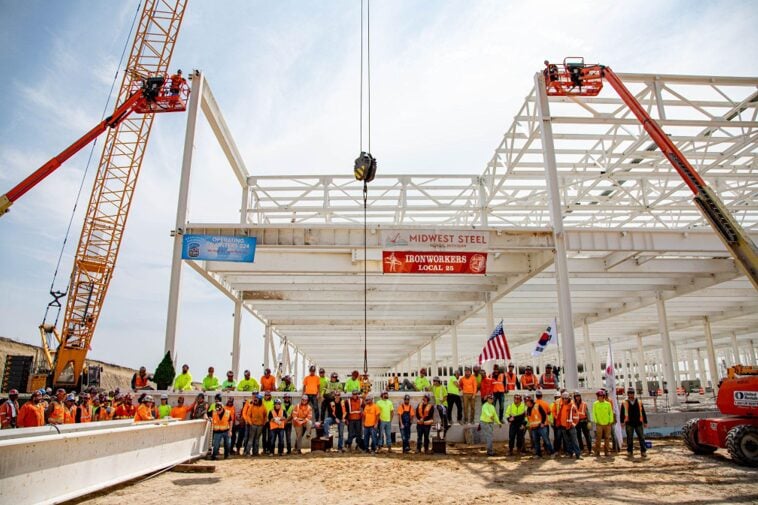
The flexibility of production lines for new factories will likely be a big trend going forward, as seen at Gotion’s US$2 billion Manteno facility in Illinois, at which the Chinese manufacturer has been producing battery packs since earlier this year but plans to add lithium iron phosphate (LFP) cell production capacity in 2026.
Although initially planned as a joint EV and BESS production plant when agreements were signed with Illinois Governor JB Pritzker in 2023, the emphasis on BESS cells has increased since.
There is over 200GWh of cell production capacity in the US; although this is weighted more towards EVs, over 100GWh of specifically energy storage manufacturing capacity has been planned by the end of 2026, notes Solar Media Market Research analyst Charlotte Gisbourne.
There has also been increased interest even further down the supply chain from both lithium mining and refining in the US. Multiple lithium mining, processing, and refining projects have been announced in 2025 in addition to one of the largest lithium refineries in the country currently under construction.
The South Korean battery companies’ announcements have been primarily on battery cells for BESS, not BESS assembly itself.
However, BESS assembly and system integration is much less capex-intensive with a shorter lead time, so that will naturally follow, our consultant said.
“The US has a pretty robust integration space for after-cells. Lots of big IPPs do their own integration, and there are enough domestic system integrators to handle that side of things. Getting the cell manufacturing in is the key part,” they said.
Non-FEOC-compliant projects will be about 43% more expensive by losing the standalone storage ITC compared to FEOC compliant ones. “And proving FEOC compliance is going to be really tough,” our source adds.
The Energy Storage Summit USA, 24-25 March 2026, in Dallas, TX, features keynote speeches and panel discussions on the challenges of FEOC, power demand forecasting, managing the BESS supply chain and much more. For full details, see the Energy Storage Summit USA website.
On April 22-23 in Charlotte, NC, our sister event, The Battery Show South, brings together the new regional value chain in the Battery Belt to discover the latest technologies across commercial and industrial transportation, advanced battery, H/EV, stationary energy storage and more.