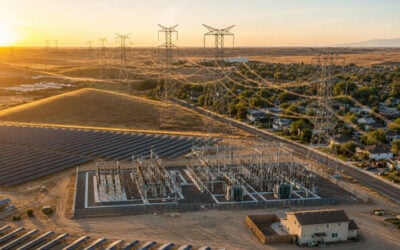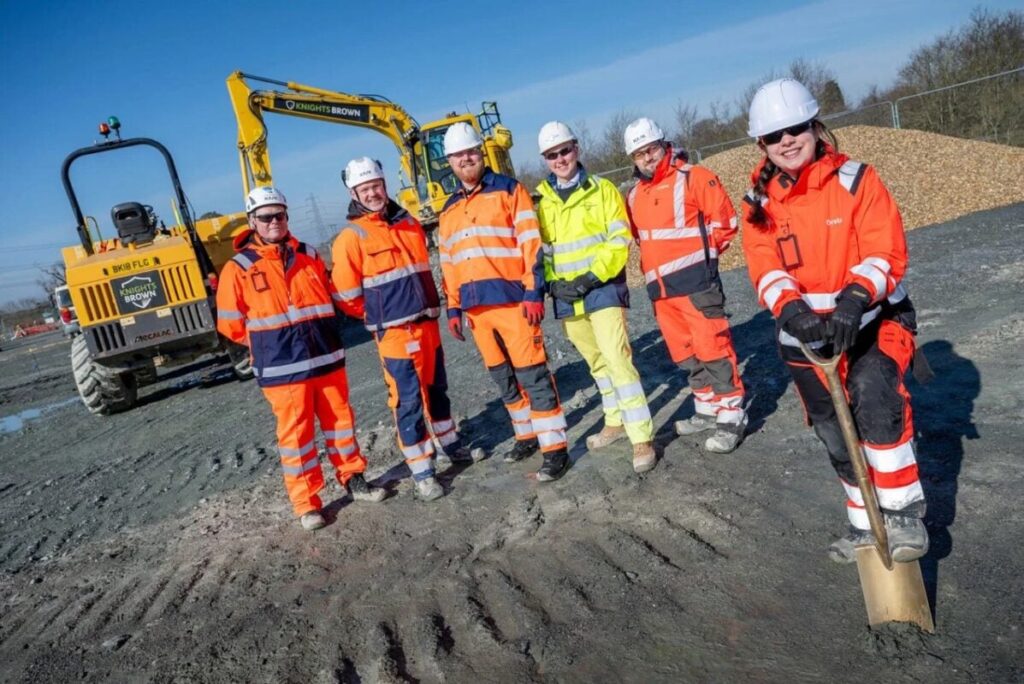
Ørsted has broken ground on a battery energy storage system (BESS) development co-located with onshore substation infrastructure for Hornsea 3 Offshore Wind Farm in the UK.
The BESS development will have a 300MW/600MWh capacity, and is expected to be operational by the end of 2026, Danish multinational energy company and prolific offshore wind developer Ørsted said this week, with the BESS set to be one of the largest in Europe to date.
As previously reported on our sister site Solar Power Portal, the project will be Ørsted’s first large-scale battery installation in the UK, and will be owned by Ørsted ICENI Energy Storage UK, the storage-focused branch of the Danish energy company and developer.
The project is unusual in that the storage system will be co-located with the onshore substation that connects the offshore wind farm to the grid. Ørsted claims the 2.9GW capacity third phase of its Hornsea project, with the start of commercial operations due in 2027, is the largest wind energy plant globally.
Try Premium for just $1
- Full premium access for the first month at only $1
- Converts to an annual rate after 30 days unless cancelled
- Cancel anytime during the trial period
Premium Benefits
- Expert industry analysis and interviews
- Digital access to PV Tech Power journal
- Exclusive event discounts
Or get the full Premium subscription right away
Or continue reading this article for free
Beatrice d’Eufemia, project manager said: “This is a very exciting project to be a part of, not only for Ørsted as it is our first large-scale battery installation in the UK, but also for the UK energy industry as this project involves two generators using one shared grid connection.
“Success here opens up the possibilities for increased use of existing grid infrastructure in the UK, which is critical when there is a real issue of congestion in the network.”
With Hornsea 3 awarded a UK government contract under its Contracts for Difference (CfD) renewables tendering scheme in 2022, Ørsted took its final investment decision (FID) on the battery storage project last summer.
At that time, ESN Premium spoke with John Perkins, senior principal at consultancy AFRY, who said that energy storage could help mitigate negative pricing risks for projects with CfD contracts.
For recent CfDs, if the price goes negative for six hours consecutively you lose the top-up payment. Future CfDs will have this applied for even one hour. That was introduced because without it the CfD risked a problematic market distortion, with no incentive to curtail.”
Perkins said that negative pricing events occur for about 100 hours every year in the UK and the numbers are rising. He added that energy storage could also reduce market risk for developers and project owners by ‘smoothing’ their imbalance costs.
“CfD wind receives fixed income per megawatt-hour, but it is exposed to market risk on its imbalance costs. Greater storage deployment, and therefore a smoothing of imbalance prices, is a benefit to CfD generators. It helps reduce the costs associated with its forecast error and balancing,” Perkins said.
Ørsted also targeting US BESS market
Ørsted deployed its first 20MW UK standalone BESS project in the UK in 2019. Over in the US, the company added a 40MW battery system to a solar PV plant in Texas two years later.
Last May, Ørsted and JP Morgan closed a tax equity financing on Eleven Mile Solar Center, co-locating 300MW of solar PV with a 300MW/1,200MWh BESS in Arizona.
Ørsted then said in August that it was developing a 1GW pipeline of battery storage projects in Midwestern states. The Danish company and US developer Mission Clean Energy had submitted grid connection applications for projects in the Central and North regions of the Midcontinent Independent System Operator (MISO).
Earlier this year, Ørsted made a FID on a 250MW/500MWh BESS project in Texas which will be co-located with an operational solar asset. However, even as this news was revealed in its 2024 Annual Report, the company’s board said it was cutting capital investment spending to 2030 by 25% from previously announced levels, following what CEO Rasmus Errboe described as a “challenging year for the [renewables] industry” (Premium access).
This story first appeared on Solar Power Portal.
Additional reporting for Energy-Storage.news by Andy Colthorpe.