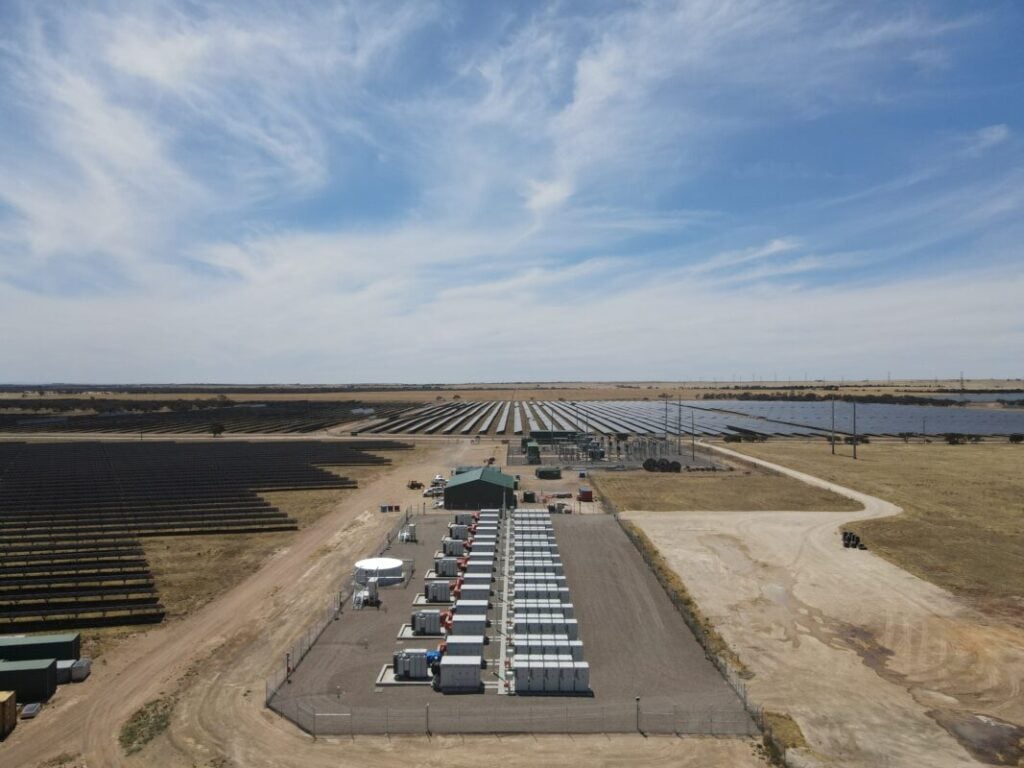
OptiGrid has been selected by Vena Energy to provide trading optimisation services for the Bellambi Heights battery energy storage system (BESS), a 408MW facility comprising two adjacent 204MW units under construction in New South Wales, Australia.
Vena Energy is a Singapore-headquartered clean energy developer operating across the Asia-Pacific region. The company has been active in the Australian market for several years, building out a portfolio that spans solar generation retrofitted with battery storage as well as standalone BESS developments.
Bellambi Heights is one of the larger standalone battery storage projects in the Australian portfolio and is expected to reach commercial operation in 2027.
Each of the two 204MW units at Bellambi Heights carries its own commercial arrangements rather than being financed or contracted as a single combined asset.
Try Premium for just $1
- Full premium access for the first month at only $1
- Converts to an annual rate after 30 days unless cancelled
- Cancel anytime during the trial period
Premium Benefits
- Expert industry analysis and interviews
- Digital access to PV Tech Power journal
- Exclusive event discounts
Or get the full Premium subscription right away
Or continue reading this article for free
One unit, rated at 204MW/510MWh, already carries contracted revenue under a separate agreement, while the optimisation deal now announced with OptiGrid applies across the facility’s wider market participation.
OptiGrid is a South Australia-based battery optimisation and trading intelligence platform built specifically for the National Electricity Market (NEM), with shareholders including the Clean Energy Finance Corporation, IP Group, Hostplus, UNSW, Adelaide University and EnergyLab.
Under the arrangement, OptiGrid’s OptiBidder platform will use AI-powered forecasting and optimisation algorithms to submit bids for the project across energy and Frequency Control Ancillary Services (FCAS) markets, the two primary revenue streams available to grid-scale batteries trading in the NEM.
Vena Energy selected OptiGrid following what both companies described as a detailed, data-driven evaluation process.
Owen Sela, head of Australia at Vena Energy, said OptiGrid’s experience optimising battery storage bidding in the NEM made it well suited to a project of this scale, adding that the arrangement would support the battery storage system’s role in delivering grid stability and reliability for the region while helping integrate more renewable energy into the system.
Revenue certainty and financing have already been secured for the project
As previously noted, one of Bellambi Heights’ two 204MW units already carries contracted revenue.
In March 2026, Vena Energy signed a long-term revenue share agreement with Danish energy trading firm InCommodities covering the 204MW/510MWh unit, valued at approximately AU$200 million (US$143 million) and formally signed during the Danish Royal State Visit to Australia.
Under that structure, InCommodities assumes market risk and trading responsibilities in exchange for a share of revenue, while Vena Energy retains ownership and operational control, a departure from the fixed-price power purchase agreements that have traditionally dominated Australian battery financing.
The deal marked InCommodities’ largest single-asset commitment in the country, taking its total contracted Australian portfolio to nearly 700MW across solar, wind and battery storage.
The wider project has also drawn on broader financing secured across Vena Energy’s Australian platform.
In July 2026, the company raised AU$1.4 billion in green financing across two transactions supporting 614MW of solar and 1,141MWh of battery storage capacity spanning South Australia, Queensland and New South Wales, including two adjacent 583MWh battery units under construction in New South Wales.
With one unit’s revenue underwritten by InCommodities and broader project financing in place, OptiGrid’s optimisation role centres on maximising returns from the portion of the asset still exposed to the energy and FCAS markets.
That combination of partial revenue contracting and dedicated trading optimisation is becoming a common structure among Australian battery storage developers.
OptiGrid’s own portfolio has grown along similar lines. Last month, the company was selected by AMPYR Australia to optimise several of its battery storage systems in its portfolio following a benchmarking process that used a digital twin of one of AMPYR’s proposed systems to stress-test trading strategies and compare projected returns with those of rival platforms.
OptiGrid’s public commentary on the NEM has focused on the gap between the revenue a battery storage system could theoretically capture and the revenue it actually earns due to bidding decisions.
Speaking to ESN Premium about a price cap event in South Australia’s SA1 region on 21 June 2026, when prices hit the NEM’s AU$20,300/MWh cap twice in one evening, Sahand Karimi, CEO and co-founder of OptiGrid, said the divergent outcomes among the state’s 15 grid-scale battery storage systems during that event came down largely to state of charge management and bidding strategy rather than raw capacity, with some assets capturing meaningful revenue while others were caught charging into the cap itself.
“Some decisions look obvious after the event. They rarely are in real time,” Karimi said, adding that assessing genuine trading performance requires looking beyond simple output figures toward metrics such as normalised revenue and percentage of perfect foresight
These are regarded as concepts increasingly used across the industry to benchmark how much of a battery storage system’s theoretical earning potential is actually being captured once forecasting error, contractual constraints and dispatch timing are accounted for.
Speaking exclusively to Energy-Storage.news, Karimi said constraints such as battery warranties and long-term service agreements can, if not properly accounted for, “actually change the trading behaviour in a way that would result in weird outcomes,” pointing to some of the dynamics seen during South Australia’s price cap events earlier this year.
A full interview with Karimi regarding the deal will be released later this week on ESN Premium.