“If there is a gap in getting a project over the line, then we will try and play a role,” said Paul Peters, CEO of the New South Wales Energy Security Corporation (ESC), a newly launched state-owned green bank with a first investment mandate for energy storage.
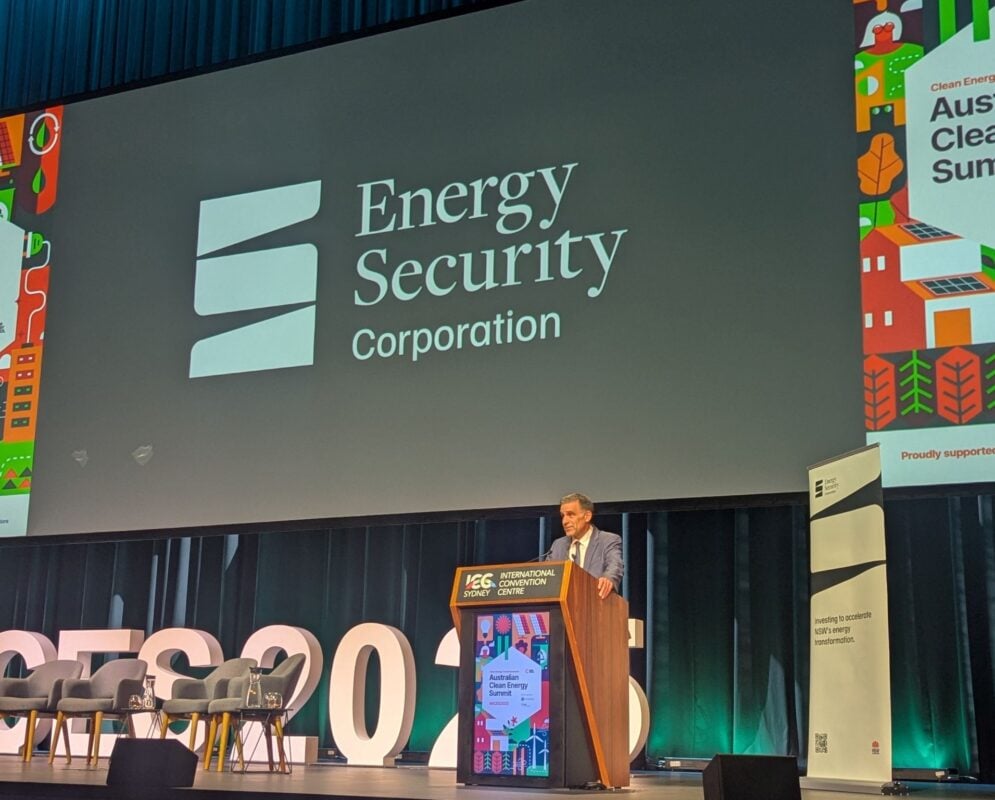
Speaking on day one of the Clean Energy Council’s Australian Clean Energy Summit 2025 last week, Peters, in his first public address since the organisation fully launched in July, explained the role the ESC will play in supporting the state in its energy transition.
“Our role is to support what the private sector is doing and to invest alongside the private sector in critical energy projects in New South Wales. We’re not here to do something already done by either government or the private sector or crowd out any private investment in New South Wales – that makes absolutely no sense,” Peters said.
Armed with an initial funding allocation of AU$1 billion (US$640 million) and an investment mandate that focuses on short – to long-duration energy storage (LDES) projects, Peters explained that the ESC will help fund stable projects should there be a gap.
Try Premium for just $1
- Full premium access for the first month at only $1
- Converts to an annual rate after 30 days unless cancelled
- Cancel anytime during the trial period
Premium Benefits
- Expert industry analysis and interviews
- Digital access to PV Tech Power journal
- Exclusive event discounts
Or get the full Premium subscription right away
Or continue reading this article for free
“We’re here to partner and co-invest in crowdfunding for projects being developed and delivered by the private sector. We work with our government colleagues to accelerate and bring them forward,” Peters stated.
A need for longer-duration energy storage in New South Wales
For Peters, grid reliability is at the heart of the ESC’s first investment mandate. Last month, analysis by the Australian Energy Market Commission (AEMC) predicted that New South Wales will likely experience grid-reliability issues in 2027-28 without intervention.
This is something Peters is aiming to avoid by investing in longer-duration energy storage projects, admitting that, currently, only two of the battery energy storage system (BESS) projects that are in the delivery phase are more than two hours in duration.
“That’s not long enough to provide reliability for New South Wales, and so our immediate priority is to invest to bring forward investment decisions and operation dates for these large-scale storage projects, and extend their duration to four hours or more,” Peters added.
The ESC was established under the Energy Security Corporation Act 2024. According to its official website, the organisation will invest between AU$25 million and AU$150 million per project.
The state’s ESC will result in an overall expansion of private sector renewable energy investment in New South Wales, similar to how the Commonwealth’s Clean Energy Finance Corporation (CEFC) has expanded total renewable energy investment across Australia.
“We’re open for business. We’ve already been engaging with project developers to identify and screen projects, and we are ready to play our part in fast-tracking investment in clean energy projects in New South Wales now and into the future,” Peters concluded.
Our publisher, Solar Media, will host the Battery Asset Management Summit Australia 2025 on 26-27 August in Sydney. You can get 20% off your ticket using the code ESN20 at checkout.