The US National Fire Protection Association (NFPA) has launched the newest edition of its cornerstone battery storage safety standard, NFPA 855.
NFPA 855: Standard for the Installation of Stationary Energy Storage Systems (ESS), produced in updated form on a three-year cycle, provides minimum installation requirements for deployment of energy storage at residential, commercial, and industrial (C&I), and utility scales.
Its recommendations are adopted by local authorities having jurisdiction (AHJs), various US states and are heavily referenced by other stakeholders, such as financiers and insurers.
While it comes from a US-based organisation, many of its takeaways are considered near-universal in their application, and the document is typically used as a best practice reference in many other countries.
Try Premium for just $1
- Full premium access for the first month at only $1
- Converts to an annual rate after 30 days unless cancelled
- Cancel anytime during the trial period
Premium Benefits
- Expert industry analysis and interviews
- Digital access to PV Tech Power journal
- Exclusive event discounts
Or get the full Premium subscription right away
Or continue reading this article for free
In a recent article on grid-scale battery energy storage system (BESS) fire safety for our quarterly journal PV Tech Power (Vol.43), Drew Bandhauer, BESS engineer at developer Leeward Renewable Energy, described NFPA 855 as “the primary fire standard guiding BESS site design and installation” for the industry.
The latest is the 2026 edition. Significantly updated from the 2023 version, a spokesperson for NFPA highlighted to Energy-Storage.news that it features new aspects of system safety, including lithium and non-lithium electrochemical storage technologies that have been newly added, such as iron-air, nickel-hydrogen, hybrid supercapacitors, zinc-bromide, lithium metal, and others.
It also includes electric vehicle (EV) charging systems that integrate energy storage, new requirements for project emergency response plans, recommendations for thermal runaway propagation protection systems, explosion control, backup power supplies, and fire and explosion testing.
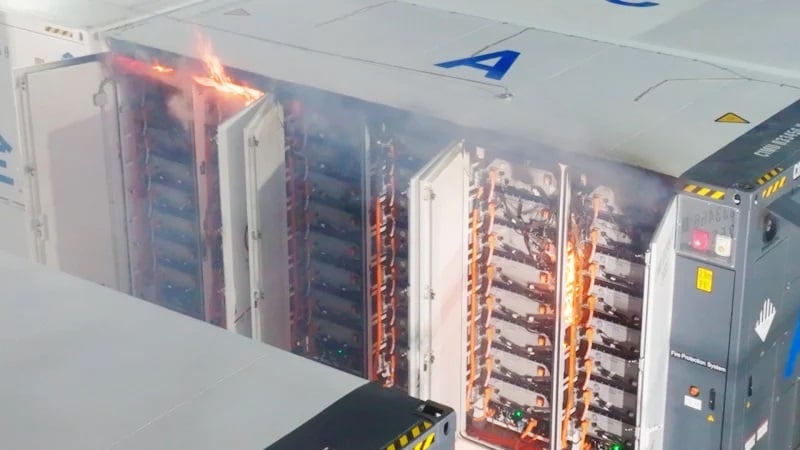
For example, while previous editions already encompassed the UL9540A thermal runaway propagation test, the 2026 version now includes large-scale fire testing (LSFT), where entire units are intentionally set on fire and left to burn with all fire suppression equipment disabled, designed to replicate a real-life worst-case scenario.
A task force that comprises industry players, certification agencies, AHJs, and Nationally Recognised Testing Laboratories (NRTLs) creates the standard as an ongoing, iterative process.
There will undoubtedly be much to write and discuss regarding NFPA 855 (2026) in the coming weeks, months, and even years. The updated standard can be found here on the NFPA website.