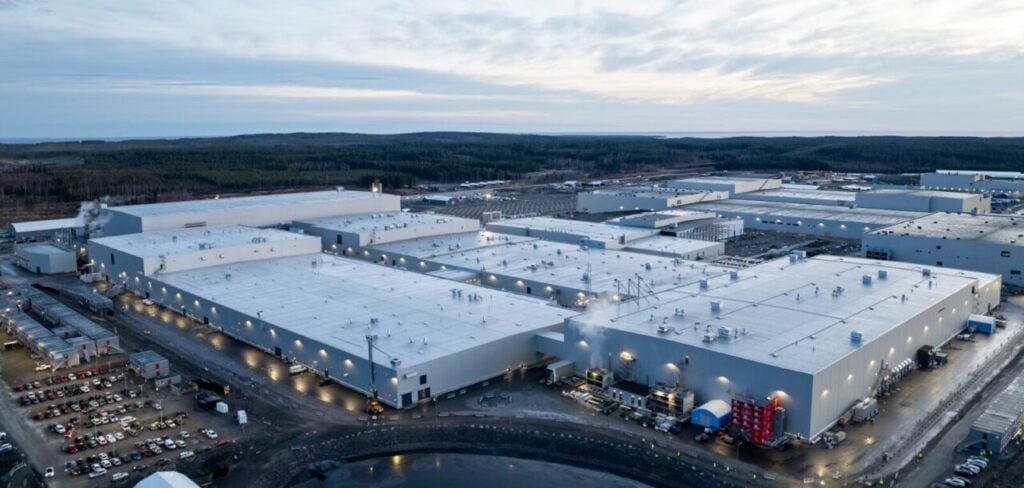
US-based lithium sulfur battery firm Lyten has now acquired nearly all of the assets of failed European lithium-ion battery startup Northvolt, with this deal to buy its gigafactories in Sweden and Germany and all IP.
California-based Lyten today (7 August) announced it has has entered a binding agreement to acquire:
- Northvolt Ett, the flagship Sweden gigafactory
- Northvolt Labs, the Sweden-based battery R&D facilities
- Northvolt Drei, the Germany gigafactory
- All remaining Northvolt intellectual property (IP)
These newly acquired assets were developed with over US$5 billion in capital investment from Northvolt, Lyten said, and amount to 16GWh of operational battery production capacity – all at Ett – and over 15GWh under construction.
Try Premium for just $1
- Full premium access for the first month at only $1
- Converts to an annual rate after 30 days unless cancelled
- Cancel anytime during the trial period
Premium Benefits
- Expert industry analysis and interviews
- Digital access to PV Tech Power journal
- Exclusive event discounts
Or get the full Premium subscription right away
Or continue reading this article for free
Northvolt filed for bankruptcy in the US in late 2024, and then in Sweden in March. It was at one time the great hope for Europe’s battery industry, by far its most-funded company, and its failure has been the most high-profile illustration of that industry’s struggles in the past three years.
Lyten has also expressed its interest in acquiring Northvolt Six, the manufacturer’s integrated factory featuring cell, active cathode material production and recycling facilities in Quebec, Canada, and is continuing to work with Northvolt North America and the federal and regional governments, it said. Multiple members of the current Northvolt executive team plan to join Lyten.
Lyten is a lithium-sulfur battery manufacturer based in Silicon Valley, with a focus on the drone and defense markets. This deal takes it firmly into the lithium-ion space, as well as many other market segments.
Nearly all of Northvolt now under Lyten ownership, lithium-ion ramp-up to continue
This latest acquisition follows Lyten’s acquisition of Northvolt’s Poland-based energy storage system (BESS) manufacturing business, Northvolt Dwa, and its California-based novel lithium metal battery business Cuberg. The company plans to immediately start operations at Northvolt Ett and Northvolt Labs with prior anchor customer collaboration ‘progressing constructively’, while Drei is still under construction.
It plans to do the same at Northvolt Dwa, which Lyten sustainability and chief business officer Keith Norman discussed with Energy-Storage.news in an interview last week, prior to this latest announcement.
Norman explained that the firm will focus on the restart, ramp-up and order fulfilment using Dwa’s existing production lines for lithium-ion products, with shipments planned for Q4 this year. Alongside that, it will continue the commercial and technological development of its lithium sulfur tech. Eventually, the plan is to ‘drop in’ the lithium sulfur battery tech to those production lines in line with demand for lithium sulfur BESS.
Whether this will be the same approach for the lithium-ion gigafactories in Sweden and Germany is not yet clear, but Energy-Storage.news will look to find out more before a full interview with Norman is published next week.
Lyten raised US$200 million in investment at the end of July, after the Dwa deal was announced. Norman said this would partially go to the Dwa acquisition, partially to scale the Cuberg asset, partially for the working capital needed to secure supply chains and start delivering, but also for ‘other acquisition opportunities in the US or Europe’; presumably referring mainly to this deal.