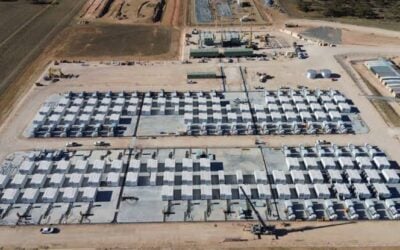
Renewable energy developer Gurin Energy has appointed Saft as the technology provider to a gigawatt-hour-scale battery energy storage system (BESS) in Japan.
It was announced yesterday that TotalEnergies’ battery and storage system subsidiary Saft has been selected by Singapore-headquartered Gurin Energy to deliver a fully integrated lithium-ion (Li-ion) BESS to its project in Fukushima prefecture.
Gurin Energy develops energy storage, solar PV, and wind assets for owning and operating. Its project in Soma, Fukushima, is thought to be the largest publicly announced battery storage project in Japan to date, with Saft supplying the planned 2GWh complex’s first 1GWh.
“Our project in Soma City, Fukushima Prefecture, will be capable of providing 240MW of power for four hours, or a total of 1GWh, once complete,” Franck Bernard, Gurin Energy’s managing director for flexibility and energy storage, told Energy-Storage.news today in an interview.
Try Premium for just $1
- Full premium access for the first month at only $1
- Converts to an annual rate after 30 days unless cancelled
- Cancel anytime during the trial period
Premium Benefits
- Expert industry analysis and interviews
- Digital access to PV Tech Power journal
- Exclusive event discounts
Or get the full Premium subscription right away
Or continue reading this article for free
Bernard explained that it forms Phase One of the 500MW/2,000MWh project Gurin Energy announced in late 2023, marking the developer’s entry into the Japanese market.
This site has reported on a steadily growing number of large-scale standalone BESS projects in recent months and market involvement by big players from Japan and abroad. The Gurin project in Fukushima still stands out as the biggest project covered, although the developer expects it to take about five to six years to fully complete.
Nonetheless, Franck Bernard said Gurin Energy is starting big from its very first project in the country because it makes business sense.
“Japan is a developed economy and the world’s fifth-largest energy market, making it a relatively safe place to develop larger projects, especially where the grid needs what large BESS projects can provide,” Bernard said.
Japan’s renewable energy market is mature, but energy storage is still less developed, “despite the need for grid flexibility across the country,” he said.
Multiple revenue streams under tolling agreement
The rest of the world’s energy storage markets are seeing exponential growth in the sizes of energy storage projects due to fundamental market drivers for demand, falling costs and improving integration technologies. Japan is no different, according to the Gurin managing director.
What is driving Japan’s BESS market forward today, besides a limited set of opportunities to get government subsidies, is the ability to stack revenues from participating in different markets.
As with other recently announced projects, Franck Bernard confirmed that the BESS in Soma will perform ancillary services, help reduce renewable energy curtailment and perform arbitrage energy trading in electricity markets.
Bernard said Gurin Energy plans for the bulk of the project’s revenues to come from operating it under a tolling agreement.
“That said, we are still in discussions with potential offtakers and remain open to other pathways for offtake,” he said.
Bernard said the Japanese market was ready to scale up to larger BESS solutions in an interview with ESN Premium in 2023, shortly after the Fukushima project was first announced. In that interview, Bernard discussed topics including the fundamental drivers for energy storage in Japan, how to select suitable land in a land-restricted country and how to assess the different revenue opportunities in electricity markets.
Meanwhile, for the Phase One buildout, Saft will provide the containerised battery storage system, including integration with third-party power conversion system (PCS) and energy management system (EMS) balance of plant components, along with Saft’s own cloud supervision and data management systems, i-Sight.
The French battery company will carry out installation, commissioning and servicing, and the two partners expect construction to begin in early 2026.