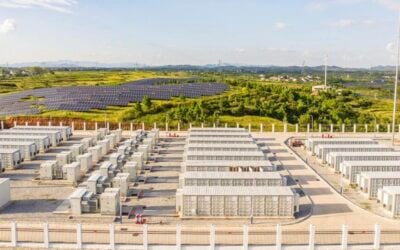
Indonesia’s state-owned utility and battery producer have launched a 5MW battery energy storage system (BESS) pilot project as it seeks to move away from diesel-generated power.
The country’s state-owned utility PLN has signed a memorandum of understanding with another state-owned body, the Indonesia Battery Corporation (IBC), to build the BESS this year, PLN said.
“Because the development of renewable energy plants is currently dominated by solar power plants and wind power plants, which are intermittent, they require batteries to provide consistent electricity supply,” said PLN’s Director of Corporate Planning Evy Haryadi.
Although PLN hasn’t specified where the BESS will be or its specific functions, it appears likely to be located at the site of both fossil-fuel and renewable power generating plants.
Try Premium for just $1
- Full premium access for the first month at only $1
- Converts to an annual rate after 30 days unless cancelled
- Cancel anytime during the trial period
Premium Benefits
- Expert industry analysis and interviews
- Digital access to PV Tech Power journal
- Exclusive event discounts
Or get the full Premium subscription right away
Or continue reading this article for free
PLN plans to convert 250MW of power currently sourced from diesel fired power plants to renewable energy this year, it said.
“In line with the plan, the role of BESS is very important so that the electricity supply to the community can still be on for 24 hours,” added Evy.
PLN’s ‘de-dieselisation’ program will involved 5,200 units of new renewable energy generation with a total power of 2GW by 2024 and is a potential application for battery storage, according to a recent presentation by a local energy and environment policy think-tank.
PLN’s announcement doesn’t go into these specifics but says that BESS technology will in future be applied to all power plants belonging to the PLN group, and that this will be carried out by the joint operation (KSO) set up by the companies to deliver the pilot BESS.
Indonesia Battery Corporation (IBC) was set up last year as a partnership between four state-owned companies: oil and gas group Pertamina, mining groups Aneka Tambang and Inalum, and PLN.
In addition to the MOU, PLN is also working with two Korean companies to research the technology’s potential to help the two countries renewable energy transition, as well as to reduce costs through things like peak shaving. The latter is a very common use case for BESS projects to reduce the demand for power from the grid at peak times, reducing reliance on fossil fuels and lowering electricity costs.
PLN also said it is collaborating with a subsidiary of conglomerate Sinar Mas Group to expand the country’s electric vehicle charging (EV) infrastructure.
The PLN subsidiaries involved in the BESS project are the main electricity provider PT Indonesia Power, plant operator PT Pembangkitan Jawa Bali and support unit Electricity Maintenance Center.
Largest BESS launched by, and for, Indonesia?
Plenty of much larger solar-plus-storage projects in Indonesian territory have surfaced in the past year but these have been primarily developed by Singapore-based entities and intend to mainly serve that market.
Sister site pv-tech.org covered an announcement by Singaporean renewable energy group Sunseap in October that it had signed an MOU to develop 7GWp of solar paired with a huge 12GWh of storage in an Indonesia archipelago. However, the project aims to transmit the energy to Singapore via a subsea cable.
The same month, energy and development group Sembcorp Industries (also Singapore-based) announced an MOU with PLN to develop a solar and storage project in the Batam-Bintan-Karimun island region. It also plans to transmit energy back to the city-state via a subsea cable, although the announcement said local energy needs would also be serviced.
The presentation cited earlier said a 100MW solar-plus-storage project in South Sumatra is also planned by Indonesia Power, a PLN subsidiary – it is not clear if this is the same project as PLN’s recent announcement but it’s unlikely.
Hitachi ABB Power Grids is also building a solar microgrid with 2MWh of storage deeper within Indonesia’s territory at a coal mine, as reported by Energy-storage.news in early 2021.
The country is further behind its neighbours like The Philippines on implementing battery storage projects. There, the global system integrator Fluence recently turned on a 20MW/20MWh grid-connected BESS as part of a 1,000MW portfolio in development and construction for power company SMC Global Power.
Indonesia’s current pipeline of energy storage projects is mostly pumped hydro, totalling 4,063MW according to IHS Markit.