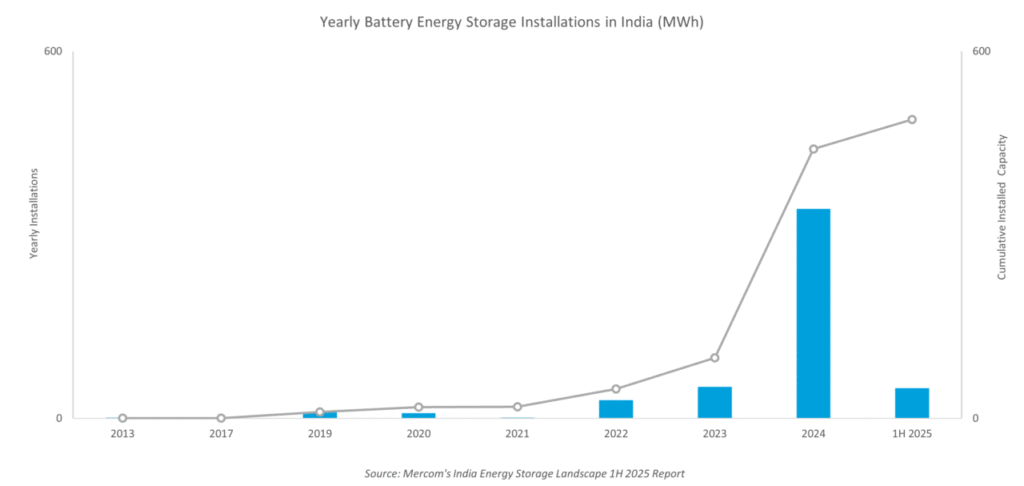
According to the latest report by clean energy market research firm Mercom India, India achieved a cumulative energy storage capacity of 490MWh by the end of June 2025.
The report on India’s Energy Storage Landscape for the first half of 2025 highlights that solar-plus-storage systems made up nearly 56% of the country’s total installed capacity.
According to Mercom, Karnataka led the nation with 33% of total cumulative energy storage installations, followed by Chhattisgarh (24%) and Gujarat (16%). Meanwhile Delhi-NCR emerged as the top contributor to new installations, accounting for nearly 83% of capacity additions in the first half of 2025.
The report credited this surge to robust policy support, including the second tranche of viability gap funding (VGF) and the CEA’s mandate for co-located storage in all solar tenders, with a minimum duration of two hours, equivalent to 10% of solar capacity.
Try Premium for just $1
- Full premium access for the first month at only $1
- Converts to an annual rate after 30 days unless cancelled
- Cancel anytime during the trial period
Premium Benefits
- Expert industry analysis and interviews
- Digital access to PV Tech Power journal
- Exclusive event discounts
Or get the full Premium subscription right away
Or continue reading this article for free
However, despite strong policy momentum, capacity additions have slowed in the first half of the year, with India adding merely 48.8MWh of energy storage capacity. This marks a 74% year-over-year decline compared to the 186MWh added during the same period in 2024.
Meanwhile, the country’s operational pumped storage capacity stood at 5GW, and tendered energy storage capacity rose 44% year-on-year. Auctions surged by 113% compared to 1H 2024, signalling heightened activity in the project pipeline. The lowest tariff discovered for a firm and dispatchable renewable energy (FDRE) project during the period was INR 4.82/kWh.
Furthermore, as of mid-2025, India has nearly 13.7GWh of standalone battery storage, 3.9GWh of solar-plus-wind with storage, 3.2GWh of solar-plus-storage, and over 1.4GWh of round-the-clock renewable projects under development. Additionally, more than 81GW of pumped storage is in the pipeline.
As per the report, Gujarat led the pipeline of standalone battery storage capacity, followed by Maharashtra and Rajasthan. In the first half of 2025, government agencies issued over 16GW of energy storage tenders and auctioned more than 9GW of projects, with or without associated renewable capacity. Notably, solar-plus-storage tenders surged 381% year-on-year, the report said.
Energy Storage Summit India 2025, hosted by our publisher Solar Media, will take place 31 October – 1 November at India Expo Mart, Greater Noida. Visit the event website for more details, including agenda and ticketing information.