
Vishal Mittal, founder and CEO of Delectrik makes the case for flow batteries to meet India’s long-duration needs in an exclusive ESN Premium interview.
Vishal Mittal founded Delectrik in 2016, drawing on a background in chemical engineering and 25 years of experience in fuel cells and flow batteries to pursue the goal of creating an effective vanadium redox flow battery (VRFB) for renewable energy storage.
The startup found it hard to do business in the price-conscious Indian market. So, the flow battery manufacturer went further afield and instead made its first customer deployments overseas, in Australia.
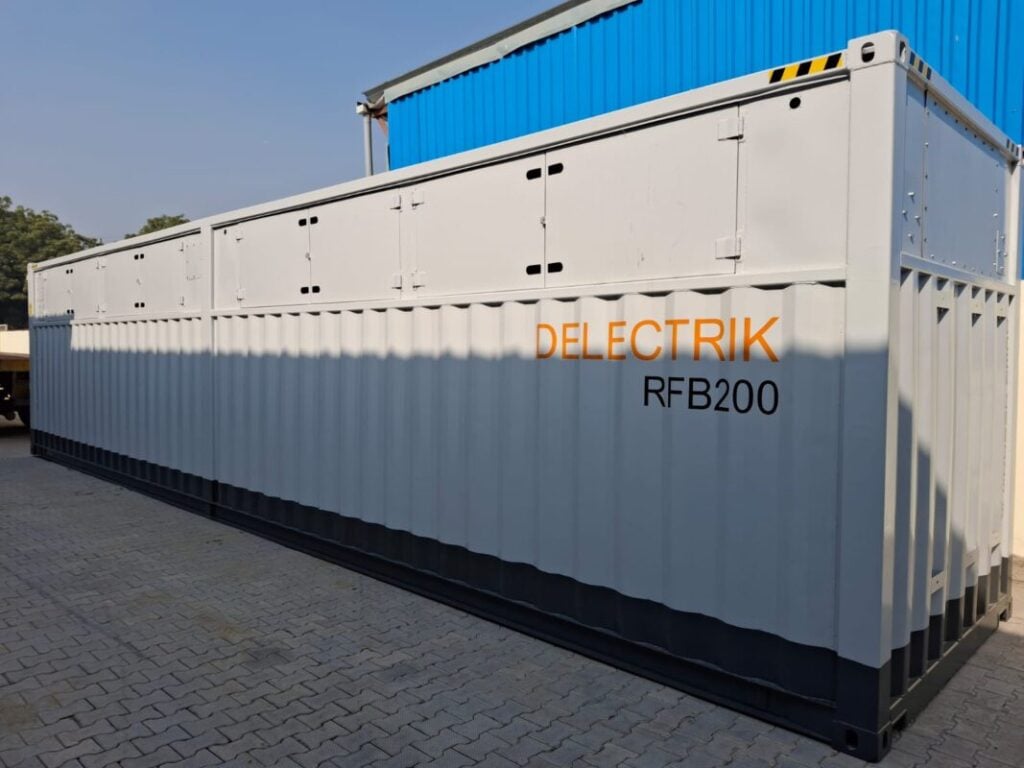
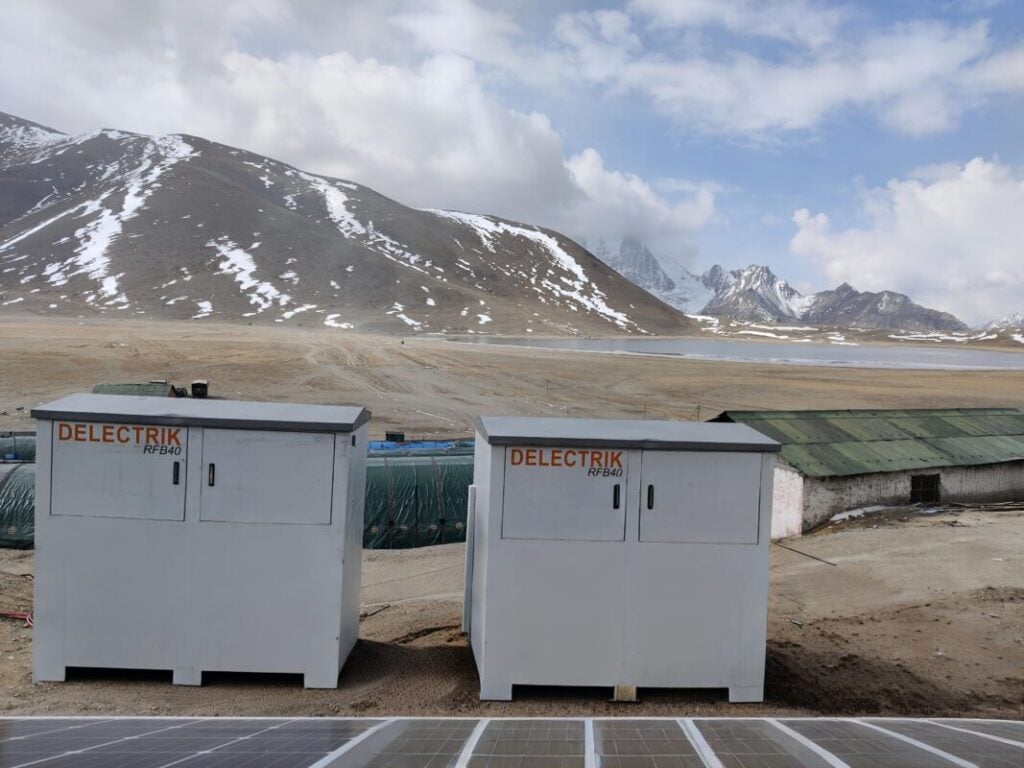
Delectrik—the name is a portmanteau of “decentralised electric network”—began with kilowatt-hour scale batteries. Repeat customer orders saw the systems scale up to 20-foot, then 40-foot and into the megawatt-hours.
Try Premium for just $1
- Full premium access for the first month at only $1
- Converts to an annual rate after 30 days unless cancelled
- Cancel anytime during the trial period
Premium Benefits
- Expert industry analysis and interviews
- Digital access to PV Tech Power journal
- Exclusive event discounts
Or get the full Premium subscription right away
Or continue reading this article for free
By 2024, the vanadium redox flow battery (VRFB) manufacturer was exporting to eight countries, including the Netherlands, Germany, the US, South Africa and Australia. Yet the company, completely self-funded, was still bootstrapped: “surviving based on margins on the products we were selling,” Mittal says.
The answer was, again, about scale: this time, to pursue opportunities that brought the company’s focus back to India. Having built a low-cost battery technology, the next logical step was to close a first utility-scale contract.
“That’s when we started focusing on the Indian market, because as an Indian company, directly going from small megawatt-hour to utility-scale contracts overseas is very difficult,” Mittal says.
India also has an energy sector in which state-owned or partially state-owned companies supply about half of the grid’s electricity. It was a subsidiary of one of these, NTPC, that awarded Delectrik an initial 600kW/3,000kWh flow battery pilot in June 2024.
NTPC had always sought alternative technologies to lithium-ion (Li-ion) batteries and was “quite excited” to see Delectrik as an Indian company exporting advanced energy storage technology overseas, Mittal claims.
The 3MWh, 5-hour duration system has now been in successful operation for close to a year at NTPC’s R&D centre, NTPC Energy Technology Research Alliance (NETRA) in Uttar Pradesh.
“NTPC were quite excited in terms of what we were doing as an Indian company with all these exports,” leading to that initial contract, Mittal says.
NTPC’s 100MWh project
This paved the way for the later award of a milestone project for India’s non-lithium energy storage sector. In February 2026, NTPC subsidiary NTPC Renewable Energy invited bids to deploy a 100MWh VRFB long-duration energy storage (LDES) system at Khavda renewable energy park in Gujarat.
Delectrik was selected to provide the system in July, after making a joint bid with infrastructure solutions provider Bondada Engineering. The project must be designed as a 16.7MW VRFB with 100MWh capacity (~5.9-hour duration) and will be built at the 30GW Khavda complex, which features a mix of renewable energy and storage technologies.
Due to the size of the projects up for tender, Delectrik did not satisfy some of the commercial requirements for bidders, such as minimum company turnover in the tens of millions of dollars. So, the company paired with EPC Bondada, which carried out the bidding, but the project will effectively then be handed back to Delectrik as the OEM-plus-EPC.
The flow battery player is now bidding on several projects overseas, and Mittal hints at interest in tenders in Australia, Japan, South Africa and the ASEAN region.
The CEO won’t share details about the flow battery’s costs but argues that the NTPC tender win is evidence that Delectrik has developed a competitive technology.
“You could argue ‘these are the benefits of the technology,’ but at the end of the day, when you actually talk to utilities, they can pay some premium, but they’ll not pay a very significant premium over where lithium is today, so I think that’s where our advantage comes in, in terms of where we are with respect to our cost points,” the CEO says.
“India is a fairly price-sensitive market, and if we have been able to close such large projects with actual utilities—these are not Amazon or Google’s data centres—these are power utilities, which look at every cent and penny.”
This is why, Mittal says, Delectrik is “very bullish” that the company could “get to a gigawatt-hour-scale order book in the next 12 months.”
Why would the market choose flow batteries?
Nonetheless, utilities are not trialling flow batteries for purely economic reasons. The drivers are manifold: decoupling from China-dominated lithium battery supply chains, the thermal safety advantage and perhaps most of all, the potential for low-cost, long-duration energy storage (LDES) at scale are among them.
“The market is now demanding longer duration storage. Even in India, where it started with 2-hour, 4-hour, now that the penetration of renewable energy is increasing, the market really needs these 6-hours+ of storage,” Mittal says, and the utilities and power generators are typically the ones willing to take the forward bet on technology.
India is pursuing goals of 500GW new non-fossil fuel energy generation by 2030 and net zero emissions by 2070. The Central Electricity Authority (CEA) has modelled a need for ~74GW/411GWh of energy storage in India by 2031-2032. Crucially, this includes two technology types: 47GW/236GWh of battery storage and 27GW/175GWh of pumped hydro energy storage (PHES).
The principle is that battery energy storage systems (BESS) would provide short-duration energy storage, and PHES would provide long-duration energy storage.
“Whenever somebody is looking at [modelling] long-duration, pumped storage is there by default. CEA has said 100GWh of pumped storage [is needed]; essentially, they are saying that they need 100GWh of long-duration batteries, if somebody can provide an alternative.”
The International Hydropower Association (IHA) has just issued the Delhi Declaration on Pumped Storage, which argues India has around 288GW of potential PHES development sites. CEA, meanwhile, has published a roadmap for achieving 100GW of PHES projects by 2035-2036.
“Pumped storage has a long gestation period. These massive projects take four to five years to construct,” Mittal says.
“They need a natural geography where you have the height difference. If we bring a viable alternative to the table, which is a 6-hour or 8-hour battery, there is no reason why you would go for pump storage.”
For India, too, which has national goals on domestic production and import self-reliance, the VRFB could be a tool for de-risking the energy supply chain, Mittal says.
“That’s where, obviously, besides the cost, having a local supply chain, reducing dependence on other countries, is really important. That’s where the flow battery stands out. If we go into Australia, if we go into South Africa, if you go into some of these mid-Asian regions, there is more than enough vanadium available. So, you’re not as dependent on the lithium supply chain as you are today. So that’s more democratic in nature when you scale up your batteries.”
Flow batteries are of course, not the only other game in town besides lithium batteries and pumped hydro. NTPC is itself trialling a number of other non-lithium storage technologies, including the pilot deployment of a carbon dioxide energy storage system from Italian startup Energy Dome and a sodium-ion pilot for which tendering is currently open.
“The sheer size of this market these days is so big. You pick a periodic table, and somebody is making a battery out of something. Zinc, aluminium, everything goes, but the question is, are you ready to scale up? I don’t think the customers are willing to wait 10 years before they decide on the technology,” Mittal says.
“That’s where flow battery has its advantage, it has a track record.”
Taking it out of the container
All of Delectrik’s manufacturing is currently in India. The company buys vanadium oxides from suppliers in India, South Africa or elsewhere and converts them into electrolyte.
Demand is “quite high,” and the company is working toward establishing vertical integration, where it would produce vanadium oxides from sources such as ammonium metabolites through a subsidiary. This would open up the supply chain to a wide range of sources, Mittal claims.
Delectrik has around 100MWh of annual electrolyte production capacity but is aiming to scale up to a gigawatt-hour in the next few months. Battery stacks are also made in-house, while the remaining balance of plant (BOP) comes from a mix of Indian and overseas suppliers, including tanks and pumps.
As Mittal says, for all of its non-economic advantages, the flow battery must be financially viable if it is to enjoy mainstream deployment. According to the CEO, Delectrik is not looking to solve a technology problem; it is looking to solve a scale problem.
“We have been cognisant of the Design for Excellence (DFX) principle. Design for manufacturability, design for cost, design for serviceability, design for reliability, engineering and product design,” Mittal says.
For example, initially, Delectrik’s VRFB was a lower voltage system, which required a specialised power conversion system (PCS). This made it harder to control costs than using a more standardised architecture.
So, the company’s product is now a standard 1000Vdc to 1,500Vdc system, which means it can use the same converters as lithium-ion BESS. Similarly, while Delectrik builds the battery management system (BMS) in-house, it is straightforward to partner with an energy management system (EMS) provider that works with Li-ion.
That “brings a lot of economies within the process,” Mittal claims, beginning with “the very design itself.”
In terms of that design, Delectrik has taken a different approach to the containerised VRFBs seen from other providers, which look more akin to their lithium-ion counterparts.
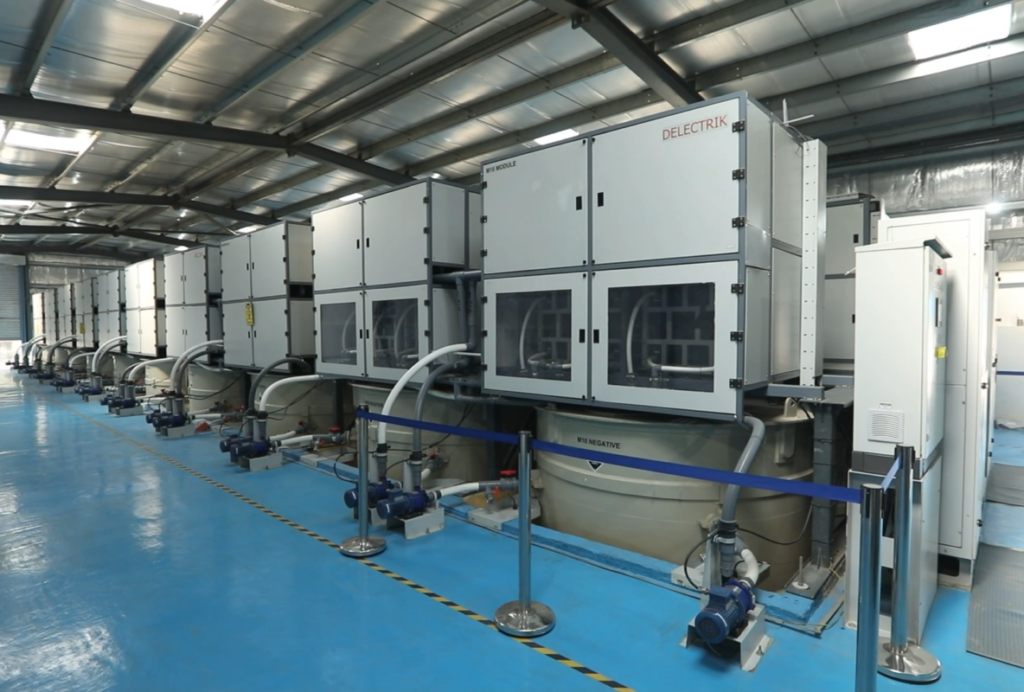
By contrast, Delectrik started off with containerised batteries but decided instead that a VRFB is a chemical process plant and should be packaged as such: in other words, taking it out of the container means that it can be flexibly configured. In 2024, the company launched a 2MW/10MWh product configuration that fits around 200MWh into an acre footprint, while the 100MWh project for NTPC will be built with 4x 25MWh blocks.
It remains modular in the sense that the electrolyte and stack are the same repeatable standard products, but rather than put the balance of plant engineering into an enclosure, it goes into “a very simple industrial building.”
Engineering know-how could be a major differentiator in the flow battery space, Vishal Mittal says. If and when the market reaches a mass manufacturing scale of multiple gigawatt-hours, the cost differences between OEMs will likely level out, he says.
“The challenge is that until you’ve scaled to multi-gigawatt-hours, there is a significant impact from the design because everybody does it differently. Unlike lithium-ion, in flow batteries, there is no standard. There is no cell concept,” Mittal says.
“Even though the inherent cost of vanadium is same across most of the companies, how do you convert that into an engineered product? There is a significant cost difference there, and the fact that most of these companies are still fairly small means the difference could be two times or more when you look at the actual cost. Eventually, if everybody gets to 10GWh, I don’t think the difference would be that much. But until that point, there is a significant difference between the pure materials cost and what it actually takes to build a battery from them.”
The Renewable Energy India Expo and The Battery Show India will run from 22-24 October 2026 at India Expo Mart, Greater Noida, bringing together developers, utilities and global technology providers. The event is co-located with the Energy Storage Summit India, now in its second annual edition, which will offer a dedicated agenda for asset owners, developers and policymakers working through the commercial and regulatory questions shaping India’s energy storage build-out.
