
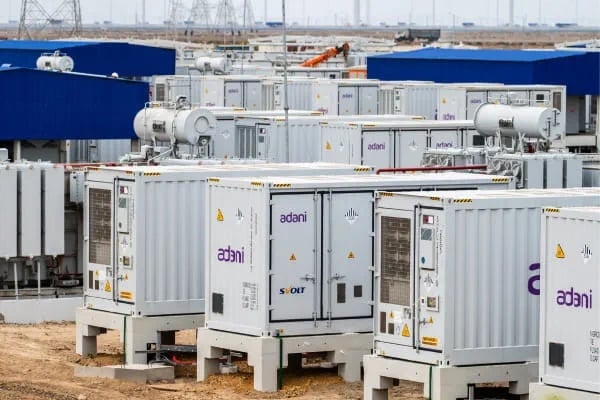
India’s grid-scale storage market remains focused on short-duration firming capacity, but conversations about long-duration energy storage (LDES) are already underway among developers and buyers.
This is according to Rajneesh Khattar, senior group director at Informa Markets India, speaking to Energy-Storage.news ahead of this year’s Renewable Energy India Expo and The Battery Show India, which is co-located with the Energy Storage Summit India (ESS India), in Greater Noida on 22-24 October 2026.
Asked what developers and utilities are telling him about the biggest commercial and regulatory barriers still standing in the way of grid-scale storage delivery, Khattar frames the challenge as much a matter of coordination as of capacity.
“Grid-scale connectivity is not simply about installing batteries and connecting them to transmission lines,” he says.
Try Premium for just $1
- Full premium access for the first month at only $1
- Converts to an annual rate after 30 days unless cancelled
- Cancel anytime during the trial period
Premium Benefits
- Expert industry analysis and interviews
- Digital access to PV Tech Power journal
- Exclusive event discounts
Or get the full Premium subscription right away
Or continue reading this article for free
“It represents a complex orchestration of security protocols, safety standards, and reliability requirements that must work seamlessly across one of the world’s most diverse and challenging geographical landscapes.”
He points to the range of conditions energy storage assets must operate under in India as a factor that adds complexity beyond simple installation.
“From the Himalayan heights to coastal industrial zones, from desert solar farms to monsoon-prone regions,” he says, describing the terrain and environments across which storage infrastructure must perform.
Khattar draws a parallel with India’s earlier renewable energy build-out.
“India’s renewable energy journey offers compelling evidence of what lies ahead for grid-scale storage,” he says.
“Year after year, the nation has shattered its own records for installation capacity and demand fulfilment. What was once considered ambitious has become routine.”
He says the same momentum is now building specifically in storage, pointing to expanding manufacturing ecosystems, evolving policy frameworks, and public-private partnerships, which he says are accelerating technology transfer and localisation.
Short-duration firming dominates today’s procurement, but the long-duration conversation is landing
On whether long-duration storage beyond 4-hours is gaining traction with Indian developers, or whether attention remains fixed on shorter-duration firming, Khattar is direct about where the market currently stands.
“India’s current focus remains substantially centred on short-duration firming capacity, and for compelling reasons,” he says.
He points to the duck curve, the steep evening drop in solar generation just as demand peaks, as the immediate problem 4-hour battery systems are being deployed to solve.
“4-hour battery systems address this critical transition period, providing the firming capacity that keeps lights on and industries running as the sun sets,” he says.
That near-term focus lines up with regulatory signals already in motion. India’s Central Electricity Authority has proposed mandatory co-located energy storage for new ground-mounted solar and onshore wind projects from July 2027, with storage equivalent to at least 10% of project capacity initially, and duration requirements rising from two to four hours from July 2029.
That trajectory broadly tracks the near-term-to-long-term progression Khattar describes.
But Khattar pushes back on the idea that longer-duration technology is a distant conversation.
“The long-duration conversation is absolutely landing with Indian developers and buyers, it’s simply in an earlier stage of maturity,” he says.
He credits international exhibitors for accelerating that process.
“Technology providers from Germany, the US, and other markets are bringing this global expertise directly to our country, demonstrating systems proven in high-renewable grids and adapting them for Indian conditions,” he says, adding that this exchange is “compressing the timeline between awareness and deployment.”
China’s manufacturing dominance shapes conversations at The Battery Show India
On how China’s dominance of the global battery cell supply chain shapes discussions at The Battery Show India about building a domestic manufacturing industry, Khattar again points to China’s own development path as instructive.
“China’s journey offers invaluable lessons for any nation seeking to build battery manufacturing capabilities,” he says.
He cites the country’s success connecting remote and underserved areas through electric mobility as a template worth studying for a market as large and varied as India’s.
“For a country like India, with 1.42 billion population whose demands and usage patterns vary dramatically across urban centers, rural communities, industrial zones, and agricultural regions, understanding how China achieved such comprehensive penetration is instructive,” he says.
That framing sits alongside independent analysis of just how wide the gap currently is. A Wood Mackenzie report published in August found that China’s annual battery cell production capacity is more than 1,000 times India’s.
Wood Mackenzie director Ankita Chauhan described India’s battery storage ambitions as “credible” but said “the gap between policy intent and operational capacity is wide.”
The report put cell-level self-sufficiency at least a decade away, even as more than 226GWh of cell manufacturing capacity has been announced in India through 2035.
Khattar describes The Battery Show India as a venue designed to close that gap through direct engagement rather than one-way technology transfer.
“The Battery Show India 2026 brings together the global battery ecosystem under one roof, from Chinese manufacturing giants to German engineering excellence, from American innovation to Korean advanced materials, from Japanese quality systems to India’s rapidly emerging domestic champions,” he says.
“It’s where dependency transforms into partnership.”
He points to the level of interest already shown by major international players as evidence the approach is working.
“Industry giants like CATL, EVE Energy, BYD, and numerous other leading manufacturers are not merely observing India’s potential, they’re actively engaging with it,” he says.
That international engagement is unfolding alongside a domestic manufacturing push of its own. Indian solar manufacturer Premier Energies and Germany’s RCT Group recently established a joint venture to build a 12GWh BESS manufacturing facility in Telangana.
India’s largest utility, NTPC, has separately issued an expression of interest for a sodium-ion battery pilot, part of a broader push to diversify chemistry and supply chain dependencies beyond lithium-ion.
Both developments reflect the kind of localisation and technology diversification Khattar frames as central to India’s path toward reducing reliance on imported cells.
The Renewable Energy India Expo and The Battery Show India will run from 22-24 October 2026 at India Expo Mart, Greater Noida, bringing together developers, utilities and global technology providers across the same battery chemistry, grid integration and energy management themes Khattar raises.
The event is co-located with the Energy Storage Summit India, now in its second annual edition, which will offer a dedicated agenda for asset owners, developers and policymakers working through the commercial and regulatory questions shaping India’s storage build-out over the coming year.
