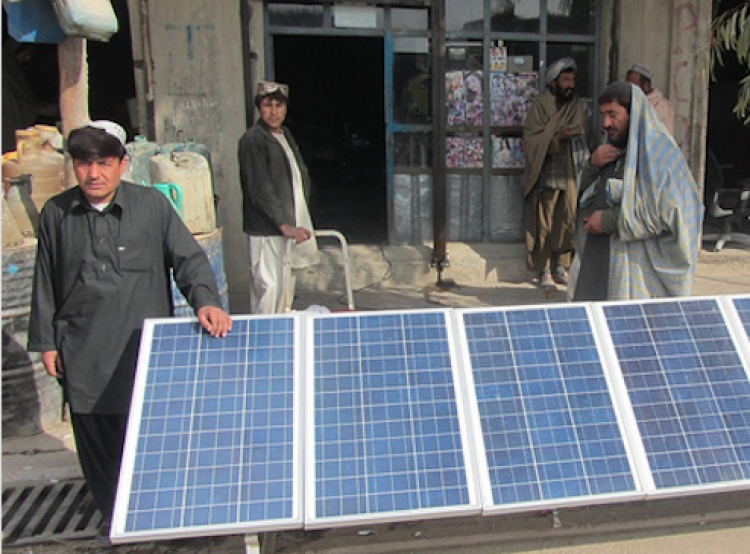
Homeowners across Afghanistan are set to benefit from the country’s first pay-as-you-go (PAYG) home solar systems combined with energy storage batteries, being delivered in a pioneering new programme.
The International Finance Corporation, part of the World Bank, wants the initiative to help provide electricity to the nearly 20 million Afghans – 60% of the country – who are not connected to the national grid. Despite government attempts to expand the reach of the grid, its plans have been hindered by extreme terrain and difficult security situations and this is where solar home systems can step in.
Traditionally the key barrier to uptake of household solar is the high upfront cost of a solar system, but the PAYG model will allow homeowners in this extremely poor Central Asian country to pay in small monthly installments. The IFC-led programme will start with solar systems, manufactured by California-based off-grid home solar specialist d.Light, being provided to homeowners in the Eastern and Southern provinces of Nangarhar and Kandahar. After this pilot phase, PV systems will be offered across Afghanistan.
The initiative is a collaboration between IFC’s Lighting Afghanistan program, the Afghan Wireless Communications Company (AWCC), which leads mobile payments in Afghanistan, the Global System for Mobile Communications (GSMA), and d.Light, which claims on its website to have electrified 91 million people to date mainly through its off-grid activity in Asia and Africa.
Try Premium for just $1
- Full premium access for the first month at only $1
- Converts to an annual rate after 30 days unless cancelled
- Cancel anytime during the trial period
Premium Benefits
- Expert industry analysis and interviews
- Digital access to PV Tech Power journal
- Exclusive event discounts
Or get the full Premium subscription right away
Or continue reading this article for free
GSMA hosts the ‘Mobile for Development’ platform, through which it granted seed funds to AWCC and d.Light to launch the mobile-money enabled lease-to-own solar home systems in Afghanistan. No further details were given on the battery technology to be used on the scheme.
“With help from our strategic partners, our PAYG service—this gift of light—will provide thousands of Afghans access to safe, clean and affordable electric lighting and power,” said Amin Ramin, MD of Afghan Wireless.”
“In Afghanistan, difficult terrain, the dispersed nature of rural communities, and a precarious security situation make it extremely difficult to expand the national power grid,” said Marco Indelicato, IFC program manager of Lighting Afghanistan. “Solar home systems, however, can provide Afghans with a reliable, cost-effective source of electricity, which is a crucial first step in fighting poverty and creating economic opportunities.”
Noting the prominent worldwide uptake of home solar of late, IFC claimed that 800,000 households globally were electrified by pay-as-you-go solar companies in the first quarter of 2018 alone.
Research firm Infinergia reported that Afghanistan was actually a leading country for distributed PV tenders in 2017, since international help is trying to reconstruct the electricity supply through decentralized installations.
On the large-scale PV side, the government of Afghanistan has invited expressions of interest from developers to bid for up to 2GW of solar and the IFC has backed a 40MW solar plant that will set a new model for subsequent projects and support the country’s 2GW of PV goal.