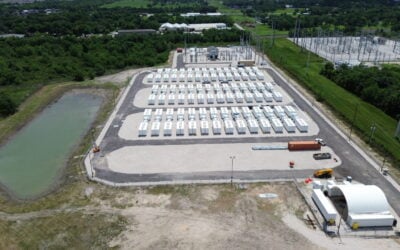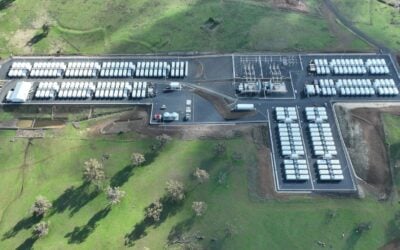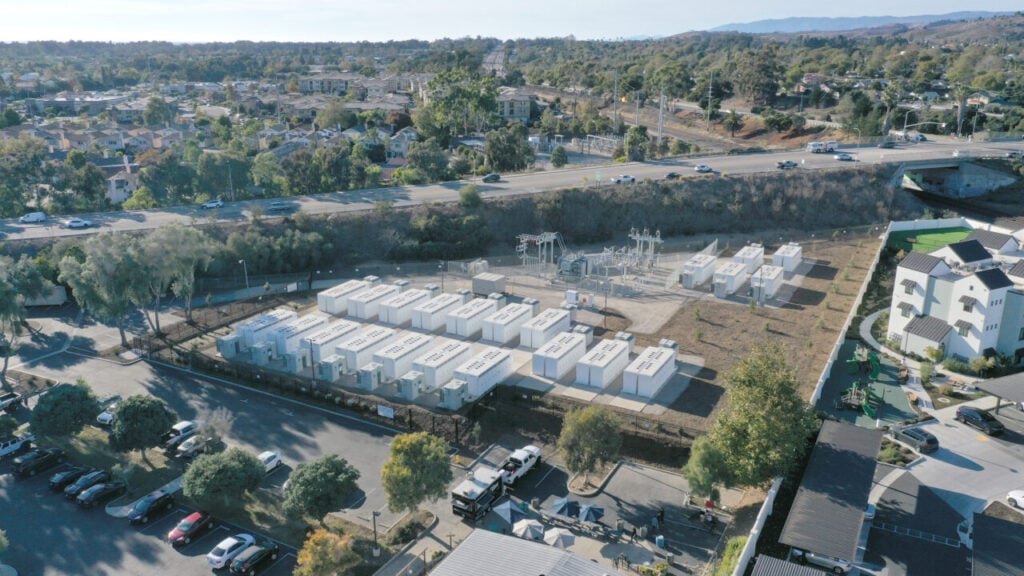
Gridstor, a US-based developer and operator of grid-scale battery storage systems and Switzerland-based renewable energy firm Axpo have executed an energy storage revenue swap agreement for the 220MW/440MWh Hidden Lakes Reliability Project in Galveston County, Texas.
According to Axpo, the 100MW agreement backed by Hidden Lakes will enable it to “pass price predictability through to Houston retail customers.” The two parties described it as a battery swap deal that is an innovative and financeable solution for battery storage companies and energy storage operators.
In the BESS market, a battery swap deal, also called a battery revenue swap, is essentially an offtake agreement that swaps volatile merchant power for a fixed, guaranteed payment via a financial contract. Texas’ ERCOT market is characterised as an energy-only market, where revenues for BESS depend on that volatility, without long-term capacity payments available.
Axpo will take on the trading of the asset’s dispatched power to capture the merchant upside, while Goldman Sachs Asset Management-backed project owner Gridstor de-risks its investment through a guaranteed revenue stream.
Try Premium for just $1
- Full premium access for the first month at only $1
- Converts to an annual rate after 30 days unless cancelled
- Cancel anytime during the trial period
Premium Benefits
- Expert industry analysis and interviews
- Digital access to PV Tech Power journal
- Exclusive event discounts
Or get the full Premium subscription right away
Or continue reading this article for free
Axpo is Switzerland’s largest energy firm and in 2025, it deployed two BESS projects in the country with utility and power firm energieUri, using technology from system integrator Fluence. Axpo’s US activities focus on supplying energy and risk management solutions to consumers, producers, and retailers of electricity and natural gas.
“Our platform is built to give our customers and industry partners direct access to our trading capabilities and resources,” Axpo’s US origination director, Shimon Schaff, said.
Gridstor CEO Chris Taylor said the revenue swap deal is a “bespoke transaction structure that unlocks financing for battery storage,” while also contributing to more stable electricity rates for customers.
The battery energy storage system (BESS) began operations in November 2025. GridStor stated at the time that the project would generate tens of millions of dollars in estimated sales and use tax revenue, including property taxes benefitting Galveston County and the Dickinson Independent School District.
In March 2024, GridStor acquired the Hidden Lakes project, initially named Evelyn Battery Energy Storage, from Balanced Rock Power, a developer of utility-scale solar PV and BESS. It began construction on Hidden Lakes in October 2024. The company was aiming for commercial operations in summer 2025.
A year after acquisition, in March 2025, the company secured a US$74 million financing led by First Citizens Bank for the BESS.
Established in 2022, GridStor is backed by Goldman Sachs via Horizon Energy Storage, an entity focused on sustainable infrastructure. According to its 2022 sustainability report, the company’s primary objective is to mitigate power intermittency, a key hurdle for renewable energy expansion.
GridStor’s inaugural project, a 60MW/160MWh system in Goleta, currently stands as the largest battery energy storage facility in Santa Barbara County.
In an interview with Energy-Storage.news Premium, Daniel Dedrick, GridStor’s CTO, noted about BESS procurement and how its changed since the introduced foreign entity of concern (FEOC) restrictions and Section 301 tariffs:
“We have maintained a flexible a forward-looking approach to procurement, as opposed to locking in large multi-year orders from a single supplier like some of our peers. As a result, we pre-qualified vendors and re-assessed supply options during the second half of 2025 in anticipation of new restrictions on Sec 48E tax credits.”
Additional reporting by Andy Colthorpe.