
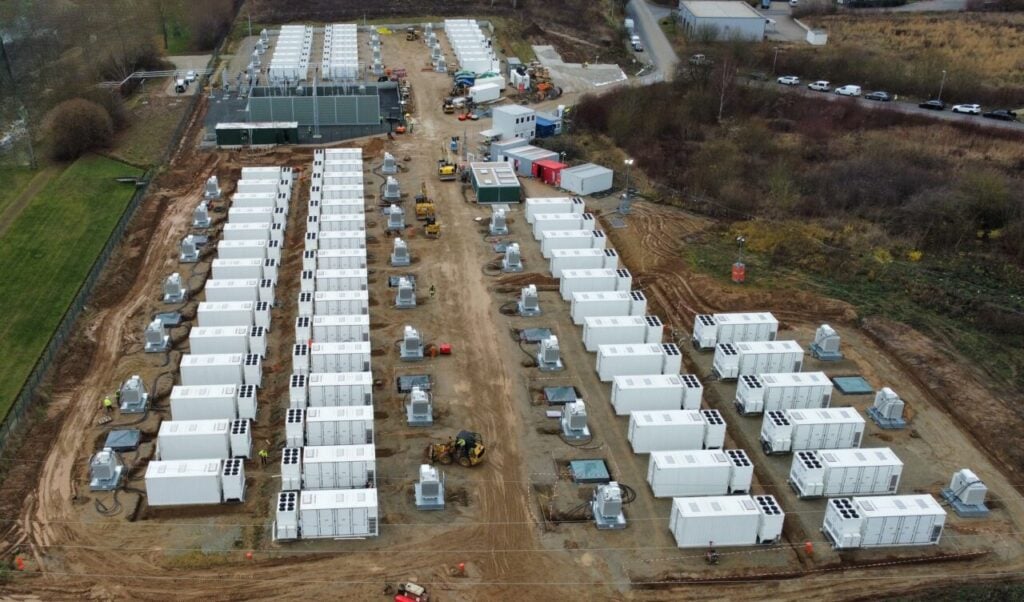
If BESS are to be given restricted grid access, they should be given a commensurate reduction in the BKZ fee, Marie-Sophie Braun, head of markets & regulatory affairs for developer Kyon Energy, said.
The BKZ fee is a one-off fee that all projects in Germany connecting to the grid pay for grid infrastructure upgrades and construction. Flexible connection agreements (FCAs) are a means by which system operators restrict the grid import/export activity of energy assets, including battery energy storage systems (BESS), once connected, to mitigate the grid congestion risks they see.
FCAs are much more controversial in the battery energy storage system (BESS) community in Germany, and Braun argues in this Q&A that if they are applied, a reduction in the BKZ is appropriate.
Braun will be speaking on one of the opening panels of the Energy Storage Summit Germany 2026, which runs on 15-16 September 2026 in Berlin (use our code ESN20 for a 20% discount on tickets). She will be joined by other BESS developers and operators on the ‘Developing a Bankable German BESS Project in 2027 and Beyond’ keynote discussion.
Try Premium for just $1
- Full premium access for the first month at only $1
- Converts to an annual rate after 30 days unless cancelled
- Cancel anytime during the trial period
Premium Benefits
- Expert industry analysis and interviews
- Digital access to PV Tech Power journal
- Exclusive event discounts
Or get the full Premium subscription right away
Or continue reading this article for free
Kyon Energy is owned by oil and gas major TotalEnergies, which is financing and building out the company’s pipeline developed over the past few years.
Ahead of the event in September, we’ve been hearing from other event speakers on the big topics in the German market, including executives from consultancy Neon, research firm Aurora, developer 8Energies and IPP Grenergy.
Energy-Storage.news: How would you characterise the current state of the German energy storage market, in terms of the key trends, major successes and achievements, and challenges still to be overcome?
Marie-Sophie Braun: The BESS market in Germany has entered a new era, evolving from a niche technology to an undisputed key asset class for the energy transition. However, the pace of growth is creating new challenges. Asset operators, marketers, grid operators, and regulators are gaining experience with the operation and integration of storage systems. Adding operational flexibility assets to energy markets and networks will require a steep learning curve for a variety of stakeholders. Nevertheless, we see a strong momentum across the industry to overcome remaining barriers.
Is there any clarity on what grid fees/network charges will look like for BESS coming online after 4 August 2029?
We know that capacity-based grid charges will be established for assets with a COD after 4 August 2029. This can be incorporated into revenue modelling and investment assumptions. Additionally, we expect dynamic grid fees to be introduced in the future. These charges are expected to vary by location and time and are harder to quantify at this stage. Nevertheless, the BESS will then be enabled to proactively respond to grid needs, which Kyon Energy considers as a significant improvement.
What are the other key policy questions and grey areas which German industry and government still need to find solutions for, to unlock storage’s full potential for the grid?
- FCAs: Clear guidelines on the roll-out of FCAs are still missing. We see that FCAs are often not tailored to a specific grid connection point, but are instead static. This results in a loss of welfare.
- BKZ fees: In our view, BKZ should only be paid in full by BESS with unrestricted grid access. As soon as an FCA is applied, a partial reduction would seem reasonable.
- Grid connection backlog: German regulations are changing at a fast pace. Grid connection processes are moving away from the ‘first come, first served’ principle towards a ‘maturity-based’ approach, as performed by the TSOs for the first time since April of this year. However, this addresses only part of the challenge: already approved grid connection requests take a long time to reach RTB, while grid usage conditions are not defined, creating more uncertainty for developers waiting for their contracts.
How is the financing of BESS projects evolving?
As projects grow in size and number, we see a more diverse range of stakeholders entering the BESS sphere in Germany. Alongside this, we are seeing financing evolve into different models (merchant, tolling, floor, mixed models, etc.). This diversification reflects growing confidence in the asset class.
How is the balance between merchant and tolling/fixed revenue schemes changing? In other words, to what extent are offtake and contracted revenues key to getting project finance?
Although fixed revenues can ease the financing process, we also acknowledge the success of financing without such a structure.
How is the role of TSOs and DSOs in the German energy storage market evolving?
Integrating storage into the German energy system has been a learning process for everyone involved. As the grid typology and scope of responsibility differ between DSOs and TSOs, their view on BESS differs too. This is not an issue as long as a trade-off can be made between the welfare that storage can bring through grid-centred optimisation and the systemic needs and market signals. At Kyon Energy, we believe that the most efficient way to accomplish this task would be to use a price signal that reflects these needs.
