
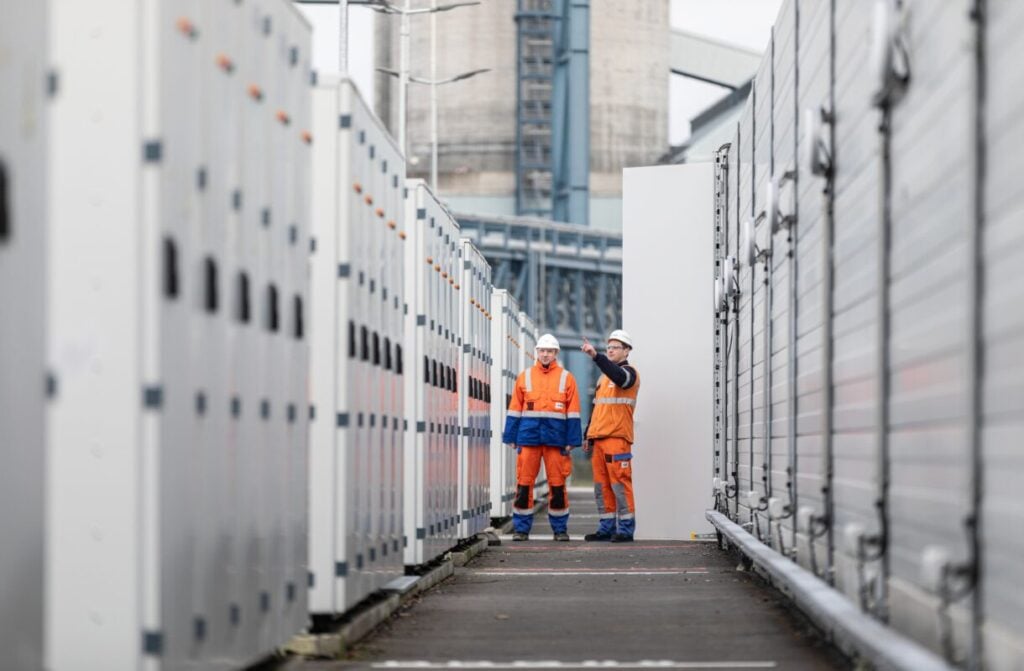
We hear from the BESS lead at RWE Renewables Europe & Australia ahead of the Energy Storage Summit Germany 2026, discussing the major trends, challenges and opportunities in the country’s grid-scale storage market.
Dr. Amir José Daou Pulido, battery energy storage system (BESS) team lead at RWE Renewables Europe & Australia, the clean energy arm of the large Germany-headquartered power group RWE.
Pulido will be speaking at the Energy Storage Summit Germany 2026, which kicks off tomorrow and runs for two days, on 15-16 September in Berlin. (Use our code ESN20 for a 20% discount on tickets.)
In this Q&A, he discusses grid fees, FCAs, procurement and more. See other Energy Storage Summit Germany speaker Q&As and major Germany energy storage news here.
Try Premium for just $1
- Full premium access for the first month at only $1
- Converts to an annual rate after 30 days unless cancelled
- Cancel anytime during the trial period
Premium Benefits
- Expert industry analysis and interviews
- Digital access to PV Tech Power journal
- Exclusive event discounts
Or get the full Premium subscription right away
Or continue reading this article for free
Energy-Storage.new: How would you characterise the current state of the German energy storage market, in terms of the key trends, major successes and achievements, and challenges still to be overcome?
Dr. Amir José Daou Pulido: Germany has transitioned from a promising niche to Europe’s most dynamic utility-scale storage market, with an installed base of around 2.5GW in 2025, which is projected to double to 5GW by the end of 2026, according to the German Energy Storage Systems Association (BVES).
The merchant business case has become increasingly robust and has demonstrated its viability under current market conditions, driven by soaring negative price hours and wide intraday spreads. However, project development faces execution risks due to grid connection delays and highly restrictive Flexible Connection Agreements (FCAs).
Is there any clarity on what grid fees/network charges will look like for BESS coming online after 4 August 2029?
Yes. Projects reaching Final Investment Decision (FID) before new regulations take effect in 2027 and commissioning before August 2029 can qualify for the 20-year exemption. BESS coming online after August 2029, or not complying with these conditions, will face a uniform capacity-based feed-in charge of approximately €4–7/kW/year (US$4.61–US$8.08/kW/year). Additionally, between 2030 and 2033, the BNetzA (federal network regulator) plans to introduce location-variable dynamic grid fees that can be positive or negative.
What are the other key policy questions and grey areas which German industry and government still need to find solutions for, to unlock storage’s full potential for the grid?
Flexible Connection Agreements (FCAs): While FCAs should never be the only option for a developer to secure a grid connection, they allow developers to bypass grid bottlenecks by agreeing to curtailment. The challenge lies in ensuring these agreements remain bankable; curtailment limits must be contractually capped and transparent to keep capital flowing into the sector.
Baukostenzuschuss (BKZ): The Federal Court of Justice (Bundesgerichtshof) ruled that grid operators can legally charge BESS the one-off BKZ capacity fee. The BNetzA intends to regulate this further by 2027, introducing regional differentiation to steer storage to high-value grid nodes. It is crucial that this differentiation is implemented in a way that creates clarity for project development.
Grid Connection Backlog: The grid queue is highly congested. Grid operators are shifting from “first-come, first-served” to allocation procedures, which include designating capacity-limited areas and introducing strict “use-it-or-lose-it” clauses for capacity unused for over three years. While this approach is welcome to increase system efficiency, the lack of standardisation poses a significant challenge, as each system operator creates its own processes.
What is the current mix of ‘full wrap’ and ‘multi-contracting’ for BESS project delivery, and is this/how is this expected to change going forward?
For large utilities with a global presence, this is typically decided on a project-by-project or market-by-market basis. For other players, multi-contracting only makes sense if they possess high internal engineering capabilities to manage integration risks. Currently, the BESS learning curves and the economies of scale are making full-wrap contracts highly attractive for many market players.
What are the factors and strategies that are determining which BESS suppliers succeed in the German energy storage market?
Key success factors for BESS suppliers include:
- Product offerings characterised by high performance and a competitive total cost of ownership (TCO).
- Complete and highly detailed product documentation.
- A strong local presence for technical teams in Germany, ensuring service teams can react quickly.
- For new market participants: Rapidly securing the necessary technical certifications to comply with the German grid code.
How is the role of TSOs and DSOs in the German energy storage market evolving?
TSOs and DSOs are fundamentally shifting from passive infrastructure managers to active procurers of flexibility.
Overall, grid capacity increases must be accelerated in Germany to secure the further integration of renewables, and energy storage is critical to supporting this expansion and maximising grid capacity.
The Energy Storage Summit Germany 2026 runs this week on the 15-16th September in Berlin. (Use our code ESN20 for a 20% discount on tickets.)
In the lead-up to the event we’ve also heard from event speakers from:
