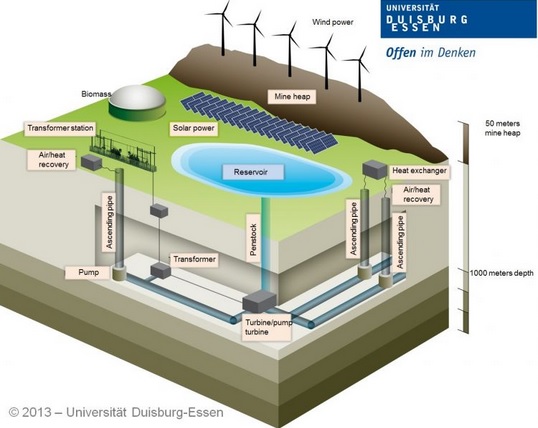
The German state of North-Rhine Westphalia looks set to go ahead with a 200MW pumped hydro energy storage project in a coal mine, as well as a smaller energy storage demonstration project which includes a flywheel from Stornetic.
The most populous of the country’s states with 18 million people and including major cities Cologne and Dusseldorf, regional governor Hannelore Kraft was quoted by sources including Bloomberg as having said the project at Prosper-Haniel coal mine will go ahead.
A website set up for the project’s concept appears to have been running since 2013, with several other possible sites referred to by partners that include mine operator RAG AG, mining service provider DMT and the University of Duisberg-Essen. Kraft, who spoke at the opening address at last week’s Energy Storage Europe event in Dusseldorf, now appears to have given the strongest indication yet that the project is going ahead.
The project would use some of the 26 kilometres of mine shafts at Prosper-Haniel to store as much as one million cubic metres of water to store excess solar and wind energy generated nearby. Pumped hydro storage works by dropping huge amounts of water downstream to drive turbines and generate electricity, with the power required to pump the water back uphill again easily provided by the turbines. Due to the scale required for them to be effective, new pumped storage sites have been difficult to find and announcements of new projects have been rare – with one recent exception being a planned 250MW site co-located with 320MW of solar in Australia. Germany is set to close many of its coal mines by 2018 in a widespread phasing out, meaning such projects could be economically valuable to local communities as well as for the country’s Energiewende (‘energy transition’).
Try Premium for just $1
- Full premium access for the first month at only $1
- Converts to an annual rate after 30 days unless cancelled
- Cancel anytime during the trial period
Premium Benefits
- Expert industry analysis and interviews
- Digital access to PV Tech Power journal
- Exclusive event discounts
Or get the full Premium subscription right away
Or continue reading this article for free
Flywheel involved in demonstration project
Also announced in the past few days, a grant has been confirmed for project QUIRINUS, forthcoming from the North-Rhine Westphalia minister of the environment, Johannes Remmel. The project has been dubbed a ‘virtual power plant’ for bringing together disparate energy resources to form a larger generator and distributor, although in common usage to date the term has been more frequently used to describe the aggregation of behind-the-meter energy storage and other small-scale distributed resources including demand response and solar PV.
The QUIRINUS project’s participants include flywheel energy storage unit manufacturer Stornetic. It will again be used to smooth out the variable output of solar and wind on local networks, with the virtual power plant acting as a coordinator of supply and demand. At last week’s Energy Storage Europe event, Stornetic project manager Thilo Engelmann told Energy-Storage.News that “the storage will be connected up to four distribution grids for grid stabilisation”.
“This is a demonstration project to demonstrate how distribution grids can be stabilised and operated, for instance where large power generation, for instance with coal, is stopped,” Engelmann said.
Flywheels turn electrical energy into rotational energy to store for later use. The mechanical devices can typically withstand faster and more aggressive charge and discharge cycles than electrochemical storage with batteries, but generally only store energy for much shorter periods, up to around 15 minutes. This made the devices an interesting option for combining with batteries, Engelmann said.
“Flywheels are interesting for wind energy because wind energy is very volatile, and it’s providing very many cycles, operating day and night-time, so what’s also interesting is the combination of flywheel energy storage and for instance lithium-ion batteries or flow batteries.
“So if you think of hybrid systems, then the flywheel can take the role of responding quickly to take away the permanent fluctuations from the battery so that it can be operated smoothly to slow down the ageing process, while the flywheel operates like a high-pass filter and takes the frequent fluctuations from the application.”
The project is expected to cost around €6 million (US$6.49 million), with the North-Rhine Westphalia government and the EU’s European Regional Development Fund paying grants worth around €2.8 million toward that total sum.