Fluence revenue up 154% but margin halves in last three months of 2025

LinkedIn
Twitter
Reddit
Facebook
Email

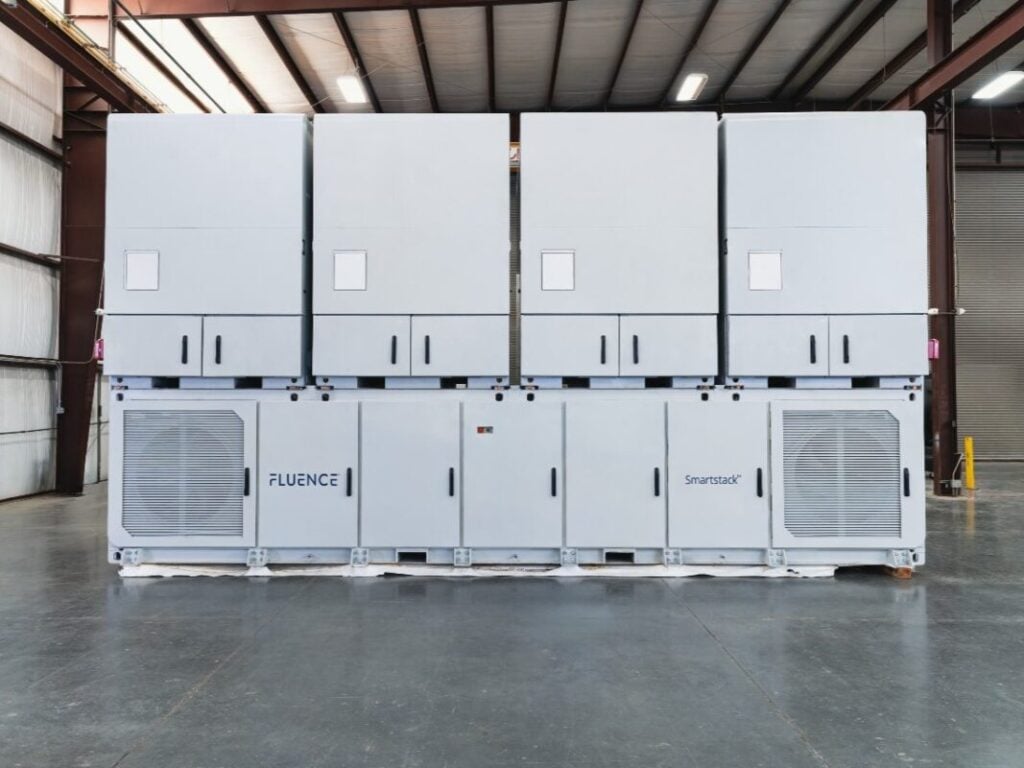
System integrator Fluence saw revenue of US$475.2 million in the last quarter of 2025, while its net loss grew around 10% to US$62.6 million.

The battery energy storage system (BESS) technology and services firm released its results yesterday (4 February), covering the three months ending 31 December, 2025. That period is Fluence’s Q1 2026 because its financial year runs to 30 September.

Revenue was up 154.4% year-on-year though its GAAP-adjusted gross profit margin halved, from 12.5% in Q1 2025 to 4.9% in Q1 2026 (5.6% adjusted gross profit margin). It said there were additional estimated costs on two projects, totalling US$20 million, which it mostly expects to recover over the year.

Net loss subsequently grew, up around 10% to US$62.6 million, while its EBITDA loss increased by around 5% to US$52.1 million.

This article requires Premium SubscriptionBasic (FREE) Subscription

Try Premium for just $1

  • Full premium access for the first month at only $1
  • Converts to an annual rate after 30 days unless cancelled
  • Cancel anytime during the trial period

Premium Benefits

  • Expert industry analysis and interviews
  • Digital access to PV Tech Power journal
  • Exclusive event discounts

Or get the full Premium subscription right away

Or continue reading this article for free

The firm’s backlog has reached US$5.5 billion, a record, with US$750 million of orders. It highlighted data centre-related and long-duration energy storage (LDES) projects as key future revenue drivers with around 35GWh of each in the pipeline or as leads.

Fluence is guiding for US$3.2-3.6 billion in revenues and an adjusted EBITDA of approximately US$40-60 million.

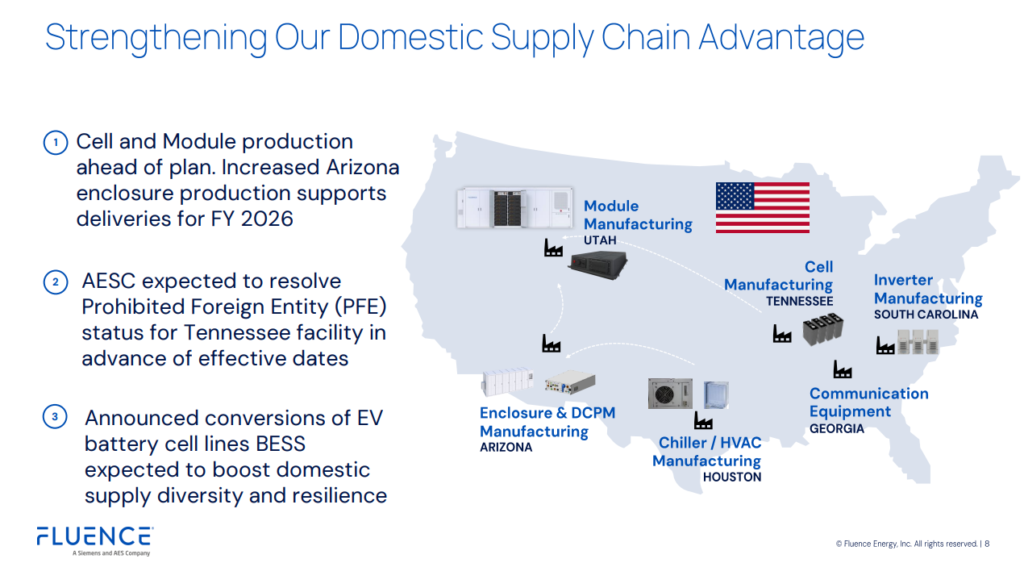
It recently said that the US would be its largest source of revenue, and expected to be able to offer BESS products that are compliant with new FEOC restrictions on tax credits for clean energy projects. Its US domestic manufacturing roadmap was outlined in the earnings presentation slide below.

Major recent contract wins for the company include project orders in Arizona for BrightNight/Cordelio Power and Greenflash, as well as a huge 1GW/4GWh BESS in Germany for LEAG.
2 December 2026
Italy
Battery Asset Management Summit Europe is the annual meeting for owners, operators, investors, and optimisation specialists working with operational BESS assets across the continent. The Summit focuses on how to maximise performance and revenue, manage degradation, integrate advanced optimisation software, navigate evolving market and regulatory frameworks, and plan for repowering or end-of-life strategies. With insights from Europe’s most active storage markets, it equips attendees with practical guidance to run resilient, profitable battery portfolios as the sector scales.
22 February 2027
InterContinental London - The O2, London, UK
The Future of Energy Storage Starts Here Three days in London where developers, IPPs, investors, utilities and the manufacturers building the technology come to close deals, not swap business cards. If you need to be in the room with the people deploying capital into European storage, this is that room.

Read Next

November 11, 2026
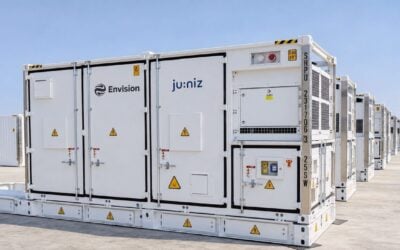
Envision Energy will supply its Gen 8 BESS platform for ju:niz Energy’s 442MWh Smareg 13 project in Bavaria, Germany.
November 10, 2026
Power firms RWE and BNZ have both announced construction on large-scale BESS projects in Italy, all-in-all totalling nearly 500MWh of capacity.
Premium
November 5, 2026
We catch up with the CEO of Netherlands-headquartered system integrator Alfen to discuss its sodium-ion BESS partnership with CATL and plans for the technology in Europe.
November 4, 2026
The Democrats have won the House and the Senate in the US Midterm elections, dealing a blow to the Trump administration and sending Chinese and Korean battery share prices upwards.
November 3, 2026
Battery storage projects have won nearly 40% of the capacity in Belgium’s latest capacity market (CM) auction results, while Germany’s first has all gone to gas, paying nearly eight times more than Belgium in the process.