Fire and Rescue NSW (FRNSW) in Australia has set out its requirements for lithium-ion battery storage rooms and diesel generator structures in data centres.
The state fire agency for New South Wales cited concerns about the adequacy of existing fire testing standards for batteries installed in enclosed compartments.
The statement, authorised by the FRNSW chief superintendent of fire safety, addresses two major fire risks that have emerged as data centre construction accelerates across New South Wales.
These risks include the increasing use of lithium-ion battery energy storage systems (BESS) for uninterruptible power supplies and the fire hazards posed by multi-storey diesel generator and fuel tank structures used as backup power sources.
Try Premium for just $1
- Full premium access for the first month at only $1
- Converts to an annual rate after 30 days unless cancelled
- Cancel anytime during the trial period
Premium Benefits
- Expert industry analysis and interviews
- Digital access to PV Tech Power journal
- Exclusive event discounts
Or get the full Premium subscription right away
Or continue reading this article for free
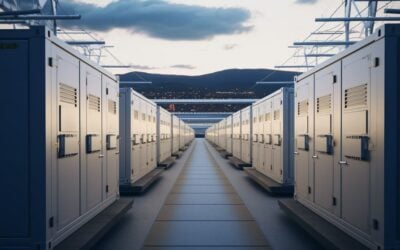
For battery storage rooms, FRNSW’s position is that the bounding construction, the walls, floors and ceilings that enclose the room, should achieve a Fire Resistance Level of 240/240/240 for load-bearing elements and a corresponding level for non-load-bearing elements.
These ratings refer to the number of minutes the construction must maintain structural adequacy, integrity and insulation, respectively, in a standard fire test.
FRNSW explicitly states that it does not support any reduction in fire resistance levels for such rooms, a position that may constrain developers seeking to reduce construction costs through lower-rated separations.
The technical basis for the requirement goes to a gap FRNSW has identified in the current testing framework. The group notes that UL 9540A cell, module and unit-level tests, the most commonly referenced testing standard for battery fire safety, do not in isolation represent the credible fire scenario for a BESS installed within an enclosed room.
FRNSW observes that most large-scale fire testing has been conducted in open-air conditions, and that the behaviour of batteries within a compartment, where radiative heat feedback from hot gas layers and surrounding surfaces can accelerate fire growth, may differ materially from what open-air tests predict.
As a result, FRNSW states that the performance of fire-resisting construction exposed to lithium-ion battery fires is “relatively unknown,” as temperatures generated in such fires may exceed those anticipated under the Australian standard AS1530.4 used to rate construction materials.
Sprinkler requirements and diesel generator structures
For sprinkler systems protecting rooms containing lithium-ion batteries, FRNSW has aligned its position with NFPA 855:2026, the US National Fire Protection Association’s standard for stationary energy storage systems.
For energy storage system (ESS) groups exceeding 50kWh in capacity, a threshold that encompasses virtually all data centre UPS battery installations, FRNSW recommends that the sprinkler system design be validated by representative large-scale fire test (LSFT) data.
Where such testing is not available, international standards and guidelines applicable to the specific battery chemistry, capacity, configuration and installation arrangement should be used to determine the required sprinkler design criteria.
The inclusion of diesel generators in the position statement reflects FRNSW’s view that structures housing vertically stacked diesel generators and diesel tanks present a fire load beyond what is typically assumed for a Class 10 structure.
This is the building classification that covers non-habitable structures such as garages and sheds, which is how some data centre auxiliary structures have previously been classified for planning and fire safety purposes.
FRNSW’s position is that such structures more closely resemble a Class 8 use, the classification for factories, workshops and industrial processes, and should be subject to corresponding fire safety measures, including fire-resistant construction, fire separation, active suppression and equipment to support firefighter intervention.
Implications for the data centre sector
The position statement arrives as New South Wales has become the primary concentration point for data centre investment in Australia.
The NSW government’s Investment Delivery Authority has endorsed 15 data centre projects worth AU$51.9 billion (US$36.41 billion) for prioritised approvals support, and the state’s energy regulator has flagged that data centre electricity consumption could reach 12% of NEM demand by 2030.
Battery storage systems are increasingly central to data centre infrastructure planning, both as replacements for traditional lead-acid uninterruptible power supply systems and as longer-duration backup capable of bridging extended grid outages.
APAC data centres risk a fossil fuel dependency that long-duration energy storage can help end, according to analysis from ArkTerra Partners on Energy-Storage.news, which found that the region’s data centre buildout is currently on course to lock in coal and gas dependence unless storage deployment accelerates alongside renewable energy procurement.
Wärtsilä has also argued for the role of BESS in managing the specific power quality challenges that AI compute workloads create.
In a recent interview with ESN Premium, Wärtsilä GM of software operational technology Scott Blalock said that AI data centres need BESS to smooth demand fluctuations that would otherwise create grid stability problems, as the rapid, unpredictable power draw of large GPU clusters requires fast-response storage that diesel generators cannot provide.
The FRNSW statement does not oppose the use of lithium-ion batteries in data centres. Instead, it sets out the fire safety conditions under which their use is acceptable, a regulatory posture meaningfully different from prohibition.
You can find out more about energy storage and its use within data centres on Energy-Storage.news.