Europe needs to act now to prevent an outflow of investment from its burgeoning battery manufacturing ecosystem in light of the US’ Inflation Reduction Act, the EU-founded European Battery Alliance (EBA) has said.
A joint statement by the EBA, an industrial stakeholder organisation with around 800 members launched by the European Commission in 2017, and Commission Vice-President Maroš Šefčovič was made after a ‘high-level industrial meeting’ last week (14 December).
The meeting was held to, the statement read, “…discuss how to best address the impact of the US Inflation Reduction Act (IRA) on the European battery ecosystem,” representing the starkest acknowledgement of a trend Energy-Storage.news has reported on extensively recently.
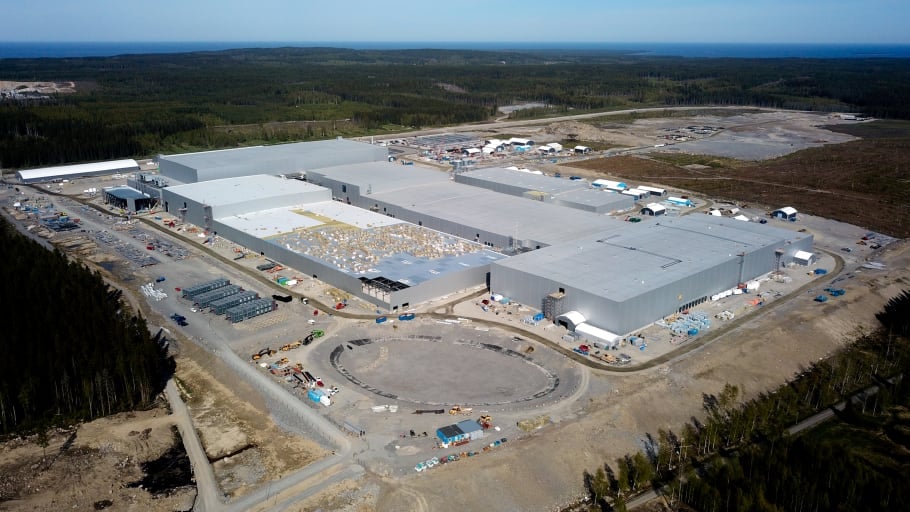
Since the US passed the Act, which provides generous tax credits for both the upstream and downstream segments of the battery value chain, its annual growth in planned lithium-ion gigafactory capacity has been around 35%, twice that of Europe’s, according to research firm Benchmark Mineral Intelligence. Prior to August, the US’ growth was ‘minimal’, Benchmark analyst Evan Hartley told this site.
Try Premium for just $1
- Full premium access for the first month at only $1
- Converts to an annual rate after 30 days unless cancelled
- Cancel anytime during the trial period
Premium Benefits
- Expert industry analysis and interviews
- Digital access to PV Tech Power journal
- Exclusive event discounts
Or get the full Premium subscription right away
Or continue reading this article for free
Although Hartley added the firm was not yet seeing producers shifting plans westwards, last week’s statement suggests this is a looming possibility. A raft of proposals for EU, state and local-level measures and an emergency package to “…keep over €100 billion (US$106.31 billion) of investments in Europe” was recommended by Šefčovič and the EBA, an industrial stakeholder-led organisation with around 800 members.
It comes a few weeks after the EU parliament’s trade committee Bernd Lange was quoted saying the bloc should file a complaint about the IRA with the World Trade Organization (WTO) on the basis that is incompatible with its rules.
Measures proposed by European Battery Alliance and Šefčovič
Firstly, the co-signees proposed a set of emergency financial incentives to accelerate investments in the EU’s battery ecosystem.
This includes accelerating, reprioritising and reallocating existing EU funds like Recovery and Resilience and REPowerEU towards strategic projects and capacity scale-ups in the battery value chain.
They also suggested making the battery value chain a priority for the new EU Sovereignty fund which will be proposed in summer 2023 and is aimed at supporting the continent’s green and digital transition.
Extending battery IPCEIs (Important Projects of Common European Interest) in Q1 2023 and reducing the complexity of IPCEI funding applications would also improve EU competitiveness, as would bringing in temporary rules for state aid to allow member states to provide capex and opex support to strategic projects.
The joint statement also proposed emergency measures to ease permitting for raw material and industrial projects to bolster the EU supply chains across the battery value chain. The second emergency measure would be ‘exceptional financial and administrative support’ to permitting authorities to accelerate permitting procedures.
A third set of measures was titled ‘Additional actions to boost the global leadership and long-term competitiveness of the EU battery value chain,’ a section in which it mentioned the US several times. Several suggestions specifically mentioning the US came under the title of ‘Ensure just competition to support the growth of the EU battery eco system’.
One of these is to “create a level playing field where battery manufacturers producing in Europe compete on equal terms, independent of higher subsidies or lower sustainability standards in Asia and the US.”
The idea of a “Buy European Act” which introduces high demands on local production and sustainability was floated alongside a review of “…EU trade measures, including duties for EV components and
EVs, from third countries with different regulatory requirements and incentive schemes”, in light of the Inflation Reduction Act.
The day after the joint statement (15 December), the new chair of Sweden-based gigafactory company Northvolt, Jim Hagemann Snabe, told the Financial Times that Europe needs to do something similar to the US’ IRA to succeed in building up a strong battery ecosystem.
The company has reached a valuation of around US$12 billion and has around US$55 billion of orders for its Europe-made batteries but recently revealed it was considering delaying the 2025 start of its third battery cell manufacturing facility in Germany, citing the sharp rise in energy prices.
Energy-Storage.news first reported on widespread delays for lithium-ion gigafactory projects in Europe back in July this year, although research firm Delta-EE’s head of flexibility and storage cited lithium carbonate concerns as the key factor then.
Read all our previous coverage of gigafactory projects both in the US and Europe here.
Read the full joint statement from the EBA and Šefčovič in its original form below.
Energy-Storage.news’ publisher Solar Media will host the eighth annual Energy Storage Summit EU in London, 22-23 February 2023. This year it is moving to a larger venue, bringing together Europe’s leading investors, policymakers, developers, utilities, energy buyers and service providers all in one place. Visit the official site for more info.