Having previously said that the coronavirus pandemic had badly impacted its financial performance during 2020, a rebound is expected this year and next, ENGIE EPS, the energy storage and e-mobility subsidiary of European utility ENGIE has said.
ENGIE EPS reported its full-year financial results for 2020 at the end of March and said that revenues and other income of €11.1 million (US$13.19 million) for the year represented a decrease of 45% compared to 2019. The company said this was “mainly as a consequence of global restrictions for COVID-19 and the related strong delays in both project development and execution”.
However, the company said its Giga Storage and Industrial Solutions business lines, through which it delivers its stationary energy storage solutions, reached a backlog and contracted business volume of 700MWh and a value of US$173 million for energy storage and microgrid projects that it said are mainly in the US and in Europe. Project pipeline has increased to more than €1 billion in value.
In a presentation to investors, company CEO Carlalberto Guglielminotti said that the Giga Storage and Industrial Solutions business has “set a clear trajectory towards a strong rebound in 2021” as well as the achievement of its targets for 2022.
Try Premium for just $1
- Full premium access for the first month at only $1
- Converts to an annual rate after 30 days unless cancelled
- Cancel anytime during the trial period
Premium Benefits
- Expert industry analysis and interviews
- Digital access to PV Tech Power journal
- Exclusive event discounts
Or get the full Premium subscription right away
Or continue reading this article for free
Guglielminotti noted that its pipeline, which is 46% up on 2019’s equivalent, is made up almost exclusively of projects that originated outside of parent company ENGIE’s development activities. The company said in an accompanying press release that there has been “rapid market acceleration” across key territories including North America, Europe and Australia and it has received an “increasing flow” of requests for proposals.
Meanwhile its production facility in Cosio Valtellino, Italy has been expanded to 2.5GWh of annual capacity during 2020 and despite those aforementioned delays and other challenges, ENGIE EPS was able to complete a number of key projects including a solar-plus-storage plant in Mexico, a hydrogen project in Greece as well as microgrid projects in California and Comoros, East Africa.
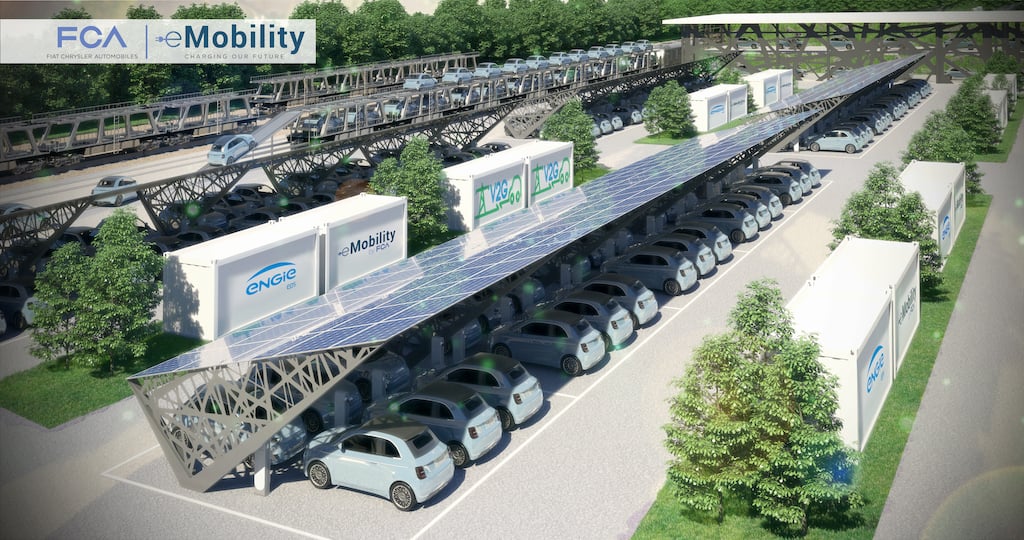
During 2020 it won significant project contracts including a 240MWh battery storage system in Hawaii that it won as part of a massive tender by utility Hawaiian Electric and it has other large-scale projects under development in Guam and New England. It also announced Europe’s largest vehicle-to-grid project a few months ago which will play into a new fast reserve frequency regulation opportunity for Italian grid operator TERNA while it is also doubling production of its residential electric vehicle (EV) charging solution easyWallbox from 500 units per week to 1,000 by the beginning of May.
Company repositioned itself to meet rising demand from key markets
With the company previously alluding to its difficulties during the coronavirus crisis and announcing that a strategic review is underway of its operations by parent company ENGIE — including the possibility that the subsidiary which was known as Electro Power Systems before its acquisition of a majority stake in 2018 could be sold again — ENGIE EPS said it had successfully repositioned itself to target key market segments and geographies.
It has been able to do so “riding on the explosive growth of the energy storage and electric mobility markets over the past few months”, and the €200 million growth in its pipeline since the strategic review was announced in September 2020 is testament to the success of that process, the company said.
Nonetheless, the difficult conditions it faced in 2020 left its net financial position at €-21.3 million on 31 December 2020, down from €-8.1 million by the end of 2019. EBITDA for 2020 was a loss of €8.4 million compared to a €5.7 million loss in 2019. This was partly due to costs incurred by investing in personnel, R&D and production facilities to be able to meet targets over the next two years and execute a Long-Term Strategic Plan.