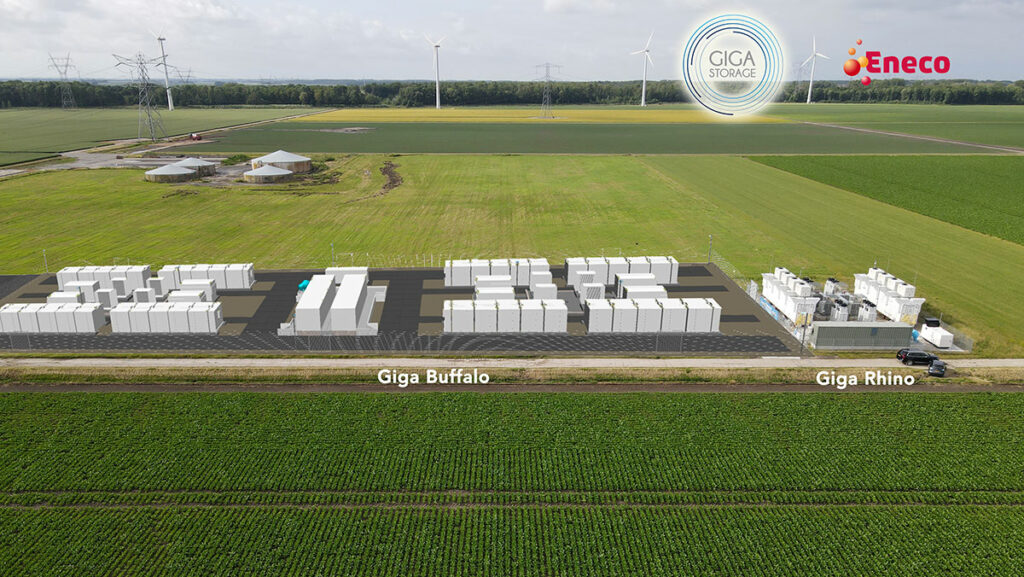
Developer Giga Storage has acquired a closed distribution grid in Groningen, the Netherlands, with the aim of deploying large-scale battery storage projects at the site.
The deal sees Giga Storage buy the distribution grid in the Delfzijl region which has a connection to the high-voltage network of the Netherlands. Groningen Seaports, which manages industrial areas in the region, has signed a new lease agreement with the developer for a period of 50 years.
Giga acquired the grid from the assets of DAMCO Aluminum Delfzijl Coöperatie UA out of bankruptcy, after the aluminium producer went under late last year due to high energy prices. Energy prices spiked in Europe after Russia’s invasion of Ukraine severely compounded existing imbalances in the supply and demand of natural gas.
Giga said that a large amount of renewable energy is generated in Delfzijl and that the energy storage projects it builds there will solve local congestion and provide grid balancing services to grid operator TenneT.
Try Premium for just $1
- Full premium access for the first month at only $1
- Converts to an annual rate after 30 days unless cancelled
- Cancel anytime during the trial period
Premium Benefits
- Expert industry analysis and interviews
- Digital access to PV Tech Power journal
- Exclusive event discounts
Or get the full Premium subscription right away
Or continue reading this article for free
“As unfortunate as it is that this industrial beacon of Delfzijl had to stop, we are very pleased that we
have the opportunity to replace a large industrial energy consumer and thus give a sustainable interpretation to the location”, said Ruud Nijs, CEO of Giga who wrote a guest blog for Energy-Storage.news in January 2022.
Cas König, CEO of Groningen Seaports, added: “For Groningen Seaports, this is an additional and logical step in the energy transition. Originally, several fossil power plants were housed at our locations. By facilitating large-scale energy storage in addition to wind turbines and solar parks, we show that we consider sustainable energy important.”
The Netherlands suffers from significant grid congestion and developers are looking at novel ways to get around this. Some have opted to deploy co-located projects which share capacity while others have looked to formulate time-limited interconnection deals where battery storage can only discharge or charge from the grid at certain times.
Giga Storage is one of the most active battery storage developers in the Netherlands with the country’s largest project, the 48MWh Giga Buffalo, commissioned in October 2022.
Another developer, Lion Storage, recently told Energy-Storage.news in an interview at Energy Storage Summit in February that the high grid charges in the market need to change for the market to kick on.