
To avoid pitfalls that can begin on the factory floor and extend well into operational lifetime, developers must sign well-structured guarantees and contracts to protect their BESS investments, writes Intertek CEA senior energy storage engineer Yilin Huang.
Part 1 of this Guest Blog, published last week, focused on the complexities of BESS performance guarantees that developers may overlook.
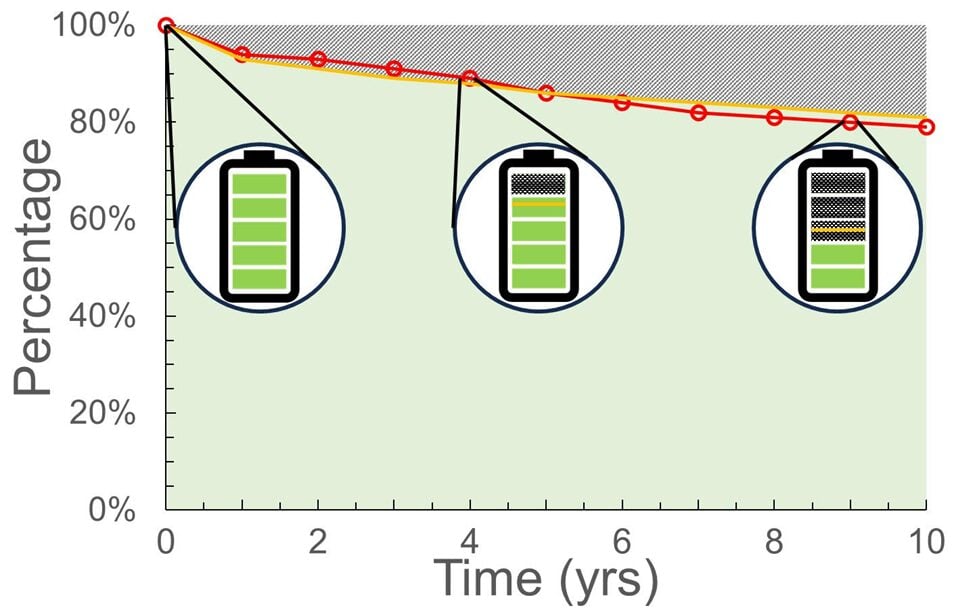
A battery energy storage system (BESS) is a 20-year commitment built on projections. The degradation model, the cycling assumptions, environmental conditions, and the efficiency figures all represent a supplier’s best estimate of how the system will perform under generalised conditions.
The further a project’s actual operating profile diverges from those conditions, the wider the gap between projected and delivered performance.
Try Premium for just $1
- Full premium access for the first month at only $1
- Converts to an annual rate after 30 days unless cancelled
- Cancel anytime during the trial period
Premium Benefits
- Expert industry analysis and interviews
- Digital access to PV Tech Power journal
- Exclusive event discounts
Or get the full Premium subscription right away
Or continue reading this article for free
That gap decides whether a BESS investment succeeds or fails. And the contract, the quality assurance process, and the performance agreements almost entirely determine it, even before the system ships.
Examining oversizing strategy and use cases
BESS are typically oversized at the beginning of life to offset degradation and meet specified MW/MWh deliverables over the project term. This reduces effective cycling intensity, which can slow degradation, but it also means buyers fund excess capacity that may sit idle under typical operating conditions.
Press every technical parameter, because each one shapes the final contractual deliverables. Ask about nominal and actual deliverable AC energy. Ask about the depth of discharge (DoD) limitation in the degradation model and the capacity assumption.
Where a project runs to 25 years with a 60% end-of-life state of health (SoH) threshold, press further. Field experience at 60% SoH is newer and more sparse than at 70%. Ask how the supplier validated their projections at that lower range, what empirical data supports those predictions, and what the disclaimers actually limit.
A supplier who cannot answer that question clearly expects the developer to absorb undisclosed modelling uncertainty.
Verify that the operating profile fits the guarantee’s cycling assumptions
Suppliers typically anchor performance guarantees to a baseline cycling assumption, such as one full cycle per day. Before signing, confirm that the project’s intended operating profile—including any future shift between applications such as energy shifting and frequency regulation—matches the parameters of the guarantee. A developer who discovers a mismatch after commissioning has limited options.
Where the future operating profile carries uncertainty, negotiate explicitly for how that flexibility affects the degradation guarantee. The contract should reflect the actual planned use case, not only generic throughput assumptions.
A flexible throughput framework is often the most practical way for suppliers to provide performance guarantees. The key is defining the project’s expected operating profile in a way that meaningfully represents the total throughput over the system life.
Define the point of measurement at the interconnection
The single most consequential decision in a BESS procurement is where performance is measured. As Part 1 detailed, suppliers guarantee at the DC battery terminals, but project revenue depends on energy delivered at the point of interconnection, after cumulative conversion losses through the power conversion system (PCS), transformers, and site cabling.
Negotiate for guarantees measured at the point of interconnection. Turnkey solutions from a single system integrator offer the clearest path to this outcome, with one party accountable for performance across the full system boundary, but this comes with a higher price.
Where that structure is not available, the contract must define which party is responsible for each step in the conversion chain and what happens if cumulative losses exceed the project’s financial assumptions.
Align the MSA and LTSA on the same measurement point
Two legal agreements govern a BESS investment. The master supply agreement (MSA) governs the physical handover and beginning-of-life specifications. The long-term service agreement (LTSA) governs the ongoing state of health, round-trip efficiency (RTE), and availability over the project’s full lifespan.
Both must use the same measurement point and the same testing protocols, or the developer cannot establish a credible beginning-of-life baseline.
A common failure: the MSA tests performance at the DC battery terminals, while the LTSA requires reporting at the medium- or high-voltage interconnection. The developer cannot track the degradation curve from beginning to end of life, cannot demonstrate that the system has underperformed, and cannot trigger liquidated damages on solid contractual footing. Third-party verification of the handover tests ensures the baseline is technically sound before the LTSA clock starts ticking.
Define the scope of the efficiency guarantee explicitly
The round-trip efficiency guarantee requires the same scrutiny as the degradation model. As Part 1 described, efficiency declines as cells age and internal resistance rises, so the contract must define how efficiency is expected to change over the project life, not treat it as a static figure.
Confirm also at what C-rate the efficiency figure applies. A guarantee derived from moderate discharge conditions may not hold under the high-power cycling of a frequency regulation application.
Clarify also how auxiliary loads count against the efficiency calculation. This should be defined in the contract, not resolved in a dispute.
Use independent factory audits before the hardware ships
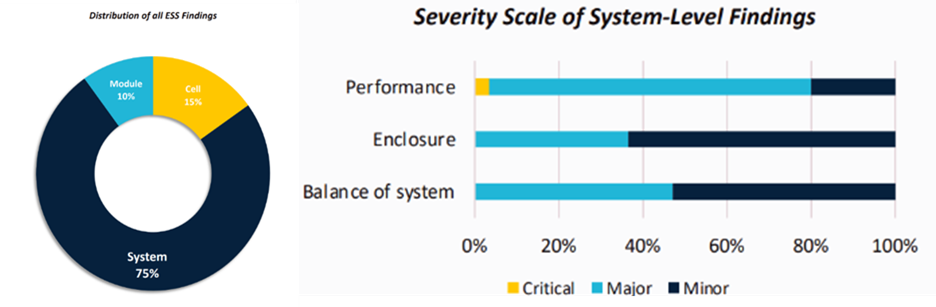
Intertek CEA factory inspection data shows that 6% of battery energy storage systems initially fail their capacity test at the factory. One example involves electrical connections: poor busbar welds and loose bolted joints that increase internal resistance and create abnormally large temperature and voltage variations among battery cells within a module.
Left undetected, these defects compound over time, degrading both capacity and efficiency from the first day of operation.
Thermal management presents another risk: 15% of inspected BESS units show defects such as coolant leakage or loose pipe connections that compromise temperature regulation. In practice, inadequate thermal control can lead to elevated operating temperatures, accelerating cell degradation and reducing overall system lifespan.
An independent factory acceptance test catches these failures before shipment and confirms that the system arriving on site matches the specifications it was sold against.
Identifying and resolving defects at the factory is far less costly and time-consuming than addressing them in the field, where the same fault may have already affected neighbouring components or triggered warranty disputes.
Assign responsibility for storage and staging conditions
As Part 1 noted, calendar ageing begins at manufacture, and temperature exceedances can void the cell warranty entirely. The contract must assign explicit responsibility for environmental control from manufacture through commissioning — and must specify precisely when that responsibility transfers from the manufacturer to the engineering, procurement and construction (EPC) partner or contractor.
If commissioning delays extend the staging period, the contract should define what environmental standards apply and who bears the cost of maintaining them. Any temperature event that could affect the cell warranty must be documented and resolved before the system is energised.
From guarantee to governance
A liquidated damages (LD) clause is a remedy of last resort. By the time it triggers, the project has already underperformed and the claim process that follows consumes time, legal fees, and management attention that no developer budgets for.
The strategies above are not alternatives to a strong LD clause. They are what makes triggering a guarantee unlikely.
A well-governed BESS investment surfaces risk before it is locked into a contract, assigns accountability at every system boundary, and verifies hardware quality before it reaches the site. The performance guarantee then does what it was always meant to do: confirm that a system built and operated correctly delivers what it promised.
About the Author
Yilin Huang is a senior energy storage engineer at market intelligence and technical advisory firm Intertek CEA. With more than 20 years of experience in renewable energy technology development, including advanced batteries and fuel cells, his work spans R&D, commercialisation, energy storage system integration, and technical consultancy on real-world project risks and performance. Before joining Intertek CEA, he worked for a system integrator and spent part of his early career in academia at the University of Maryland as a research professor. He holds a PhD in engineering.
