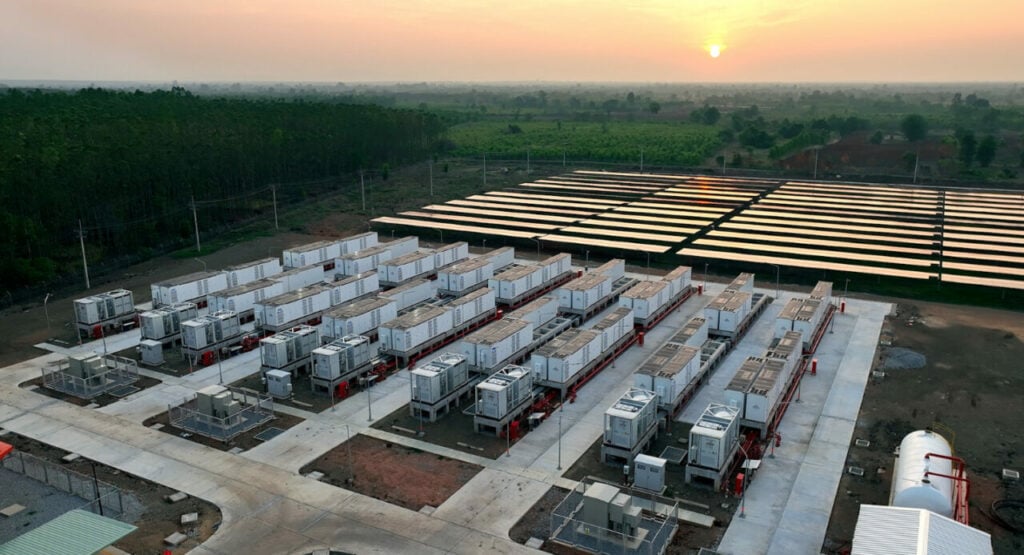
The BESS ‘land grab’ looks set to continue as Tier 2 companies vie for market share before countries potentially curb imports from China, with one developer suggesting the recent CATL-Duke Energy case will “not be unique”.
That was the message from conversations with some delegates at Solar Media’s Energy Storage Summit (ESS) USA 2024 last month.
The global average price of BESS for US deployment has been falling since peaking in 2022, as consultancy Clean Energy Associates’ (CEA) VP market intelligence Dan Shreve detailed in an article for the most recent edition of Solar Media’s quarterly journal PV Tech Power.
Discussing the dynamics in more detail at the two-day event, Shreve told Energy-Storage.news: “The BESS market land grab is primarily coming from Tier 2 providers sitting behind CATL, which has a massive market share currently.”
Try Premium for just $1
- Full premium access for the first month at only $1
- Converts to an annual rate after 30 days unless cancelled
- Cancel anytime during the trial period
Premium Benefits
- Expert industry analysis and interviews
- Digital access to PV Tech Power journal
- Exclusive event discounts
Or get the full Premium subscription right away
Or continue reading this article for free
“Companies like EVE, REPT and Hithium are working aggressively to capture as much global market share as possible, growing their shipments 100%-plus annually, while CATL is a more moderate, but still impressive, 40%.”
(China-based CATL, Contemporary Amperex Technology Co., Limited, is the world’s largest lithium-ion battery cell manufacturer and a major supplier of BESS too.)
Some companies – not necessarily those listed above – are going as low as US$110 per KWh for 20-foot DC BESS units, Shreve added. New players from China have emerged on the global scene due to fierce domestic competition and oversupply there, including Hyperstrong, a sponsor and speaker at the Summit.
Part of the growth in Tier 2 (and 3) providers is being driven by a desire from diversification from the buyer side. That was something alluded to by developer Available Power’s president Ben Gregory in an interview, also at the event, where he suggested that other projects may go the way of a Duke Energy-CATL unit at a US military base and see their BESS equipment from China removed because of political pressure.
“The pricing is attractive from China, but other countries are nearing price parity. China will likely continue to dominate the market right now, but there’s going to be a lot more political pressure, like we saw with the Duke-CATL project,” Gregory said.
“I don’t think that case will be unique, so we are diversifying our supply chain to mitigate political risk.”
CATL called the accusations underlying the decision “false and misleading” in a statement shortly after the BESS unit was turned off, in December 2023. February 2024 saw the decision taken by Duke, under pressure from the US Congress, to remove the units entirely.
In the rest of the interview, Gregory discussed the positive impact that the falling price of BESS is having on downstream deployments and M&A activity.
The growing potential of trade rules to the detriment of BESS products from China, as well as the size of the US market, are also leading to “aggressive” moves to gain a foothold there and abroad.
“There are some companies working very aggressively to gain a toehold in the US. By global deployments, its China, the US and then everybody else, so it is enormously important to establish a toehold here, especially in the light of massive oversupply in China,” Shreve said.
“In addition to the US, you may see other markets work to curb imports from China, so whatever market relationships can be developed before that happens is very important.”
The US already applies a 10.89% Section 301 tariff to BESS from China. This, combined with incentives from the Inflation Reduction Act, could make US-made BESS cost-competitive with those from China, CEA said in October.
The US could theoretically apply additional duties under separate protocols. For solar PV modules, it applies additional tariffs through the antidumping and countervailing duty (AD/CVD) scheme. The long and complicated recent history of that has been covered extensively by our sister site PV Tech.