Update 8 August 2025: Energy Vault responded to Energy-Storage.news’ enquiries below regarding the ability of the hydrogen cells to participate in the market. Below are comments from a company representative.
“Ultimately, the system will need to be approved for market participation by CAISO itself, but the CPUC clearance is a key milestone toward that goal. That being said, the system’s operation relies on a hybrid combination of lithium-ion battery and hydrogen fuel cell technologies, so there is no distinction to be made in terms of which technology will be considered for CAISO market participation.“
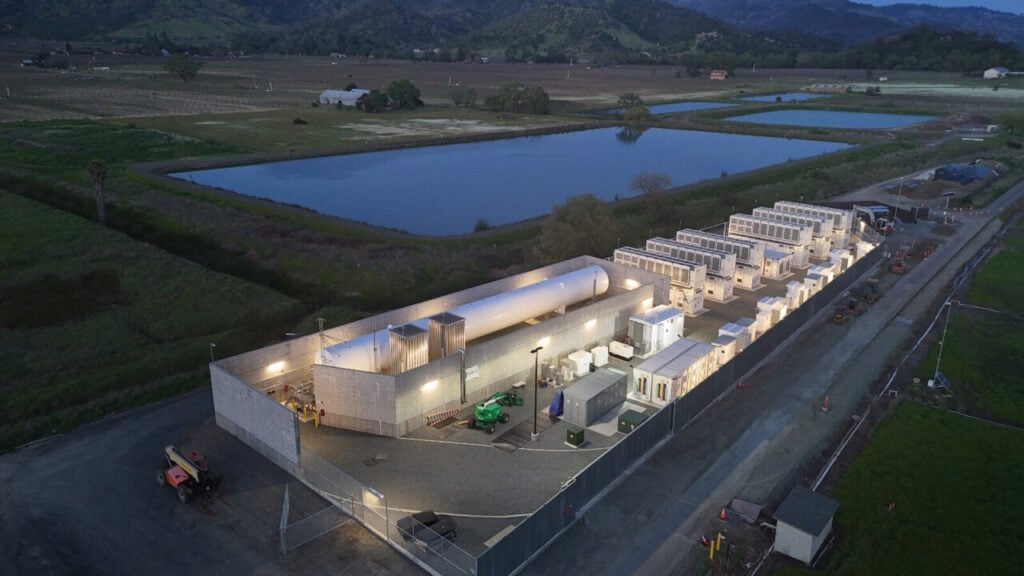
Energy storage developer and system integrator Energy Vault has received approval to pursue market-based participation in the California Independent System Operator (CAISO) with the Calistoga Resiliency Centre (CRC).
The company received approval for its 293MWh system from the California Public Utilities Commission (CPUC), which is located in Northern California’s Napa Valley.
Try Premium for just $1
- Full premium access for the first month at only $1
- Converts to an annual rate after 30 days unless cancelled
- Cancel anytime during the trial period
Premium Benefits
- Expert industry analysis and interviews
- Digital access to PV Tech Power journal
- Exclusive event discounts
Or get the full Premium subscription right away
Or continue reading this article for free
CRC integrates hydrogen fuel cells with a lithium-ion battery energy storage system (BESS) and is specially engineered to ensure power resilience during grid disconnections caused by wildfires or other natural disasters.
Energy-Storage.news reached out to Energy Vault for comment on whether the hydrogen cells can also participate in the market or if the approval only extends to the lithium-ion BESS, but did not receive a response prior to publication.
Energy Vault states that this approval, along with the recent signing of a Large Generator Interconnection Agreement (LGIA), confirms the CRC’s ability to provide grid services to the wider grid once distribution upgrades are finished.
In April, Energy Vault closed on US$28 million in project financing for the CRC, including the sale of an investment tax credit (ITC) associated with the project.
According to Energy Vault, the CRC enables the Calistoga community microgrid to keep power on during shutoffs or disconnections. The system provides around 48 hours of continuous energy and a peak output of 8.5MW during public safety power shutoff (PSPS) events.
Permitting the project to engage in CAISO’s energy and ancillary markets increases its financial benefits by enabling it to generate revenue when it is not required for PSPS events.
The project employs Energy Vault’s AI-driven BESS optimisation software, Vault-Bidder, to provide market services like energy shifting, regulation, and spinning reserve, which deliver vital grid support while increasing revenue.
Energy Vault held a ribbon-cutting event at the project on 1 August to celebrate the CPUC’s approval, which was attended by local government officials, technology partners, and energy stakeholders.
Energy Vault supplies two BESS for Consumers Energy in Michigan
Energy Vault has also been active in Michigan, agreeing to supply two BESS totalling 75MW/300MWh in the state for utility Consumers Energy.
The 45MW/180MWh Weadock BESS will be located in Hampton Township, at the site of the now-retired John C. Weadock Power Plant.
The 30MW/120MWh Iosco County BESS will be located in Oscoda Township.
Battery deliveries are expected to commence in Q4 2025, construction is expected to begin in Q1 2026 and commercial operation is expected by Q4 2026.
Local permitting processes are currently in progress with township officials to facilitate project development. Both BESS systems will be charged and discharged daily, designed to release stored renewable energy during peak consumption times to support Michigan’s energy needs.
In 2023, Michigan Governor Gretchen Whitmer approved legislation aiming for a 100% clean energy standard by 2040, along with a goal to have 2,500MW of energy storage operational by 2030.
In June 2024, Consumers Energy signed a 100MW battery storage contract with Jupiter Power for a project located in Coldwater, Michigan.
Marco Terruzzin, Chief Revenue Officer of Energy Vault, said of the two newly announced BESS projects:
“As the energy transition accelerates, utilities like Consumers Energy are stepping up to ensure grid reliability while integrating more renewable energy. We are proud to partner with Michigan’s largest energy provider on these critical projects, which will not only help meet peak demand with energy but also exemplify how advanced storage technologies can support grid resilience at scale.”
Energy Vault, meanwhile, recently closed a US$18 million financing for its Cross Trails BESS in Scurry County, Texas.
The company has been active in recent weeks and is releasing its earnings results for Q2 on 7 August 2025.