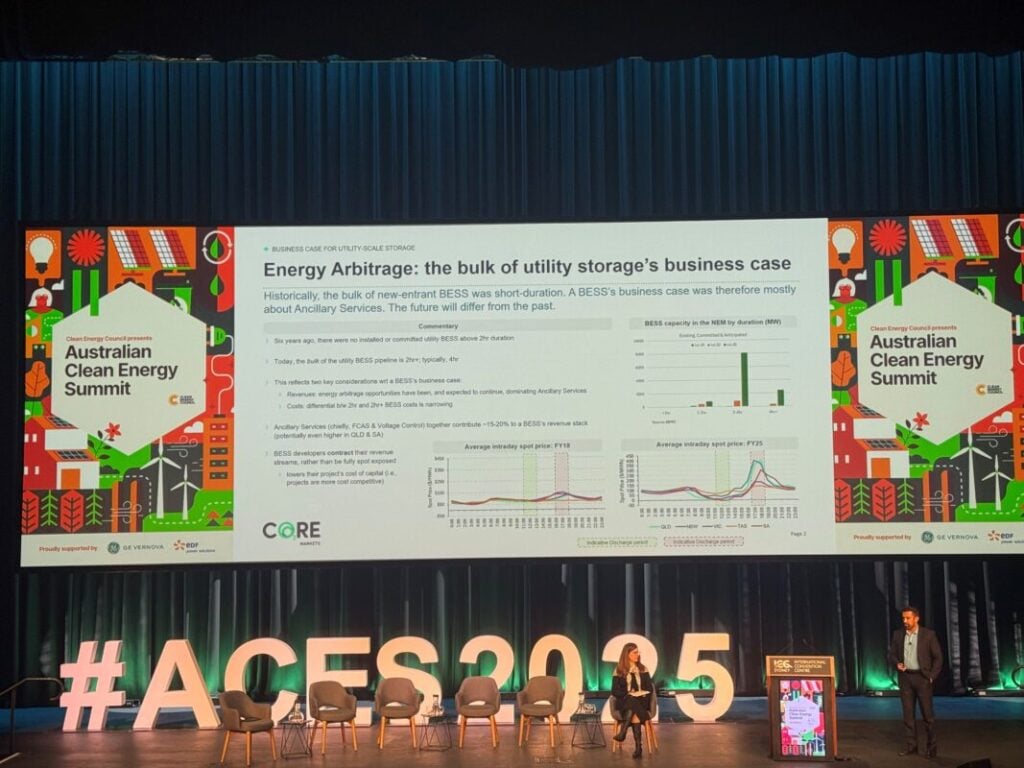
“I don’t think we’re going to sell another battery in Australia that’s not grid-forming,” said Shane Bannister, head of business development and sales, Megapack APAC, at Tesla, at the Clean Energy Council’s Australian Clean Energy Summit 2025 in Sydney.
Speaking on the morning of the second day of the summit, Bannister emphasised the shift in the Australian energy storage market from grid-following battery energy storage systems (BESS) towards grid-forming.
“I think if you are developing a BESS that is not grid-forming, then you should probably think about it,” Bannister added.
Interest in grid-forming inverters has continued to grow in Australia. This recently saw Fluence’s Rob Hills, APAC vice president of engineering and commissioning, and Sam Markham, growth manager, Australia and New Zealand, deem the technology a trend in the NEM for the foreseeable future.
Try Premium for just $1
- Full premium access for the first month at only $1
- Converts to an annual rate after 30 days unless cancelled
- Cancel anytime during the trial period
Premium Benefits
- Expert industry analysis and interviews
- Digital access to PV Tech Power journal
- Exclusive event discounts
Or get the full Premium subscription right away
Or continue reading this article for free
The topic is set to be explored at the upcoming Battery Asset Management Summit Australia 2025, which is set to take place on 26-27 August in Sydney.
Markham was another speaker on the ‘The business case for large-scale storage’ panel discussion and was keen to stress that, although grid-forming BESS and synchronous condensers both provide stability to the grid, the solution should not be one or the other, but a mix of both technologies tailored to the system’s needs.
“We have fallen guilty of it in this conversation, where it becomes a matter of synchronous condensers versus grid-forming. We should be asking what the problem we’re trying to solve is from a technical perspective,” Markham explained.
What makes grid-forming BESS unique?
Grid-forming BESS differs from traditional battery storage systems in its ability to actively stabilise the grid by mimicking the behaviour of synchronous generators.
These systems are designed to support the grid’s operational continuity and ensure uninterrupted power supply, even during grid outages.
They often set their own internal voltage waveform reference and can synchronise with the grid or operate independently of other generation sources. This makes them ideal for maintaining system strength in a renewables-dominated grid.
One key aspect of a grid-forming BESS is its ability to provide synthetic inertia to maintain the grid’s frequency. Coal, gas, and hydropower plants have traditionally provided this inertia to the grid.
However, with the impending withdrawal of coal-fired power, attention has been diverted to emerging technologies that could replace this, such as grid-forming battery storage or synchronous condensers.
Grid-forming with advanced inverters is a big topic for the Australian battery storage market. The Australian Renewable Energy Agency (ARENA) is providing funding support for a wave of large-scale BESS projects that include smart power electronics equipment, including new builds and retrofitting them to existing projects.
Australian transmission system operator Transgrid recently announced that grid-forming BESS and synchronous condensers will form the ‘heartbeat’ of the New South Wales power system, with a view to delivering 5GW by 2032/33.
Our publisher, Solar Media, will host the Battery Asset Management Summit Australia 2025 on 26-27 August in Sydney. You can get 20% off your ticket using the code ESN20 at checkout.