Standalone storage, demand from commercial and industrial (C&I) customers and new types of grid services will increasingly help drive growth in energy storage in the coming years, but the future mix between battery-based and alternative storage types is still unclear.
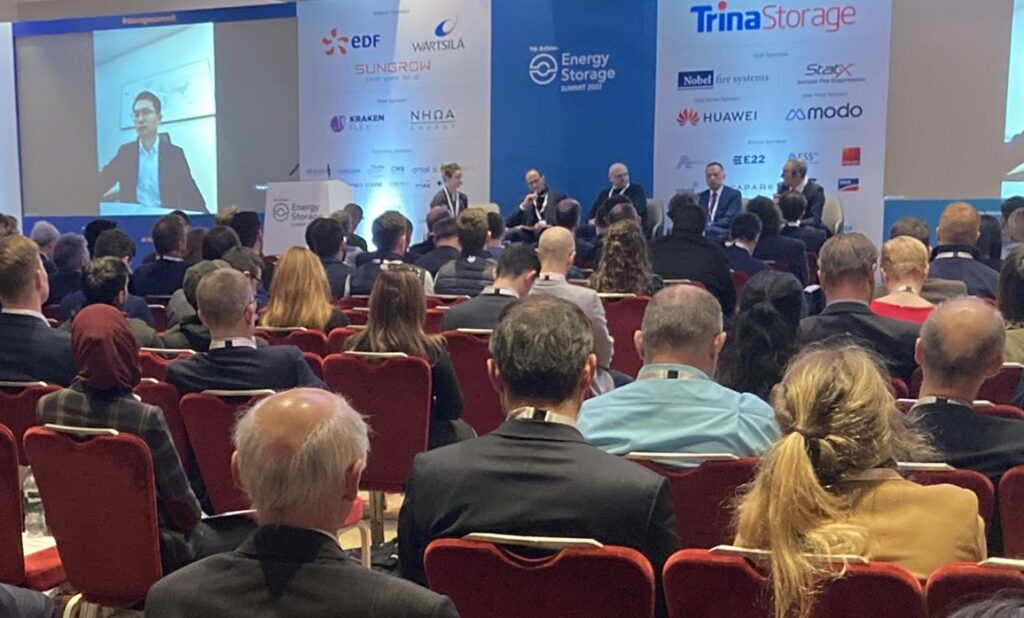
That is according to speakers at the Energy Storage Summit 2022 in London, speaking on the ‘What Role Will Storage Play in Filling the Fossil Fuel Retirement Gap?’ panel this morning, chaired by Molly Lempriere, deputy editor of Solar Media titles Current± and Solar Power Portal.
David Post, Head of e-Storage Solutions for the energy transition arm of Italian Enel Group, Enel X, alluding to its recent project with a large oil refinery in Ontario, Canada, said:
“Industrial customers are very interested in how they can become more sustainable, especially in jurisdictions which have a tariff structure to allow you to optimise your energy bill,” he said, adding that energy storage projects for reducing peak charges could have a payback time of just four to five years.
Try Premium for just $1
- Full premium access for the first month at only $1
- Converts to an annual rate after 30 days unless cancelled
- Cancel anytime during the trial period
Premium Benefits
- Expert industry analysis and interviews
- Digital access to PV Tech Power journal
- Exclusive event discounts
Or get the full Premium subscription right away
Or continue reading this article for free
James Li, technical lead for energy storage systems (ESS), at solar inverter manufacturer and energy storage system integrator Sungrow, said that the growing realisation that batteries have numerous roles other than backup power was particularly helping drive demand. He says colocation with solar is a big driver in both Sungrow’s grid-scale and residential segments.
Terry Chen, Head of Overseas Energy Storage Business for Trina Storage agreed, saying that 60% of its market in China and the US is from solar-plus-storage, which he said is more economical than pure solar.
But it is changing, he said: “In the future, we see the standalone storage format as the main one in China and the US as well. People are learning more and more about what they can do with standalone energy storage.”
“But right now, in China energy storage is not cost-competitive compared with other energy sources. We’re aiming for it to be by the end of 2023.”
Dispatchable energy storage = fewer fossil fuel resource requirements
Broadening the discussion around cost performance, Ben Guest, Managing Director at Gresham House said that energy storage needs to be compared with the flexibility provided by other assets like natural gas.
“The evidence is strong that the ability to have dispatchable energy storage that doesn’t require bringing on fossil fuel generation is a pretty important driver and cost driver for the energy storage business case,” he said.
Dr. Neville Towers, Director of Wholesale Markets Optimisation for EDF, said: “There’s a lot of new assets entering the market and making great returns. Dynamic Containment has been great and it’s evolved over time. Initially you committed to a day but now it’s four-hour chunks.”
However, Guest added, there was a clear limit to the depth of the Dynamic Containment market.
The discussion moved on to longer duration storage including non-battery-based technologies.
Enel X’s David Post was sceptical of the business case of pumped hydro (PHES) in most cases while EDF’s Neville Towers called for new thinking around supporting longer duration battery assets that system operators will increasingly need.
Post added that he wished to see more international norms for energy storage, which would help foster communications between different stakeholders along the value chain. He also raised the potential of e-mobility and storage converging to the point where electric vehicles could provide flexibility to the market when not being used for transport.
Guest commented: “Battery energy storage does not solve the whole problem. There will be multiple 100 hour events where batteries can’t run. I think in the future we’ll have natural gas and carbon capture, utilisation and storage (CCUS). Unsure about hydrogen. Scrubbing emissions from gas is quite proven, for example.”