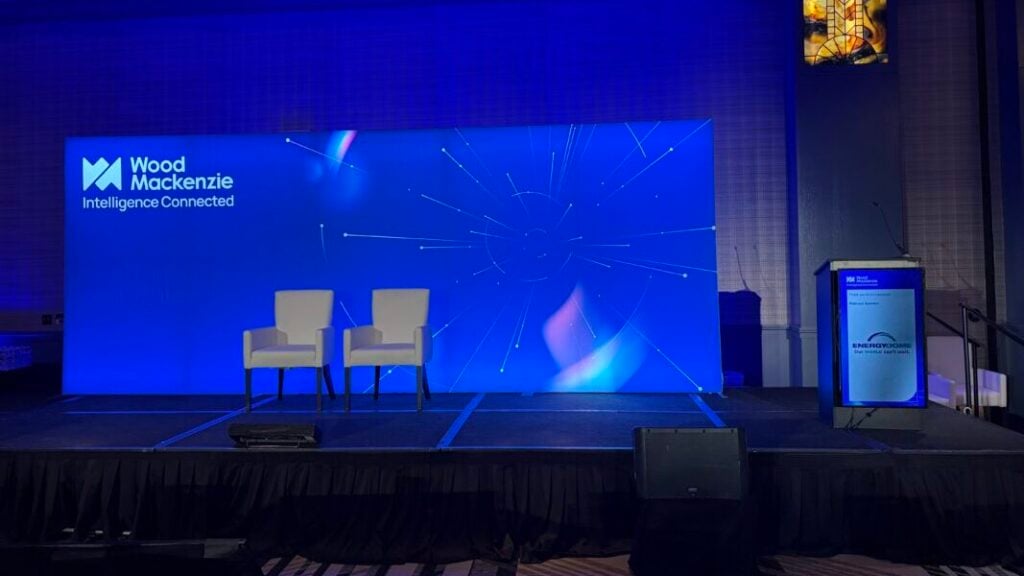
Carl Coe, chief of staff at the US Department of Energy (DOE) stated that the Department cares about “affordable, reliable, available energy, regardless of source.”
The remarks were delivered 29 April, at market research firm Wood Mackenzie Power and Renewables’ Solar & Energy Storage Summit, in Colorado, US.
Despite complicated communication from the federal government, the firm’s Q1 2026 and full year 2025 US Energy Storage Monitor did forecast that the energy storage industry will install approximately half a terrawatt-hour of new capacity over the next five years.
Additionally, both full-year and Q1 totals were the highest to date, with 18.9GW/51GWh of battery energy storage systems (BESS) recorded across utility-scale, residential and community, and commercial and industrial sectors.
Try Premium for just $1
- Full premium access for the first month at only $1
- Converts to an annual rate after 30 days unless cancelled
- Cancel anytime during the trial period
Premium Benefits
- Expert industry analysis and interviews
- Digital access to PV Tech Power journal
- Exclusive event discounts
Or get the full Premium subscription right away
Or continue reading this article for free
A record amount of projects began construction late last year in order to obtain the investment tax credit (ITC), which made up for a shortfall as activity slowed in the middle year.
The ‘One Big Beautiful Bill’ Act’s (OBBBA’s) foreign entity of concern (FEOC) restrictions do not allow energy storage projects to qualify for the ITC if the developers or owners of the project receive significant aid from a FEOC-designated country, including the lead exporter of battery products, China.
The OBBBA largely impacted solar and wind, and aside from the admittedly significant FEOC changes, left energy storage otherwise largely unscathed, at least in the short term. The administration has also taken some steps to advance BESS deployment.
As Coe stated, “We cannot leave this term without making it easier to get things built. It cannot be government policies that are slowing all of you down, that would be a complete failure on our part.”
DOE’s BESS development assistance
In January, Secretary of Energy Chris Wright joined US president Donald Trump with a bipartisan group of governors from PJM, to urge the regional transmission organisation (RTO) to overhaul its market rules and hold an emergency procurement auction.
In February, the DOE closed a US$26.5 billion loan package with two subsidiaries of utility Southern Company, to develop or enhance more that 16GW of generating capacity, including 6GW of nuclear power improved via uprates and license renewals, hydropower upgrades, and BESS.
While there have been some commitments to BESS and renewables development, as seen in the Southern Company loan, the second iteration of the Trump administration’s DOE has largely been committing significant funds —billions of dollars — to loosening restrictions on coal plants and building out nuclear generation facilities.
Nuclear restart
In March, Secretary of Interior Doug Burgum announced a deal wherein the Trump administration would use US$1 billion of taxpayer money to pay energy company TotalEnergies to redirect capital from its offshore wind leases to natural gas projects.
Coe stated at the Wood Mackenize event, “If a source is appropriate to be natural gas in one region and appropriate to be solar in another, we don’t want to mandate the appropriate source for that particular geography.”
Notably, TotalEnergies’ wind projects were to be based off the coasts of North Carolina and New York. The natural gas projects will be based in Texas and the Gulf of Mexico.
In 2025, the DOE announced the cancellation of over US$7 billion of funding for wind and solar projects.
In January, as reported by our colleagues at PV Tech, the US District Court of the District of Columbia ruled that the DOE’s actions were a violation of the Fifth Amendment.
According to a report by The Alumni Network, a group of former DOE employees who are working to connect the awardees from the DOE with resources, as recently as March, projects that are and projects that are not on the cancellation lists have not received any updates from the Department.
Coe said of current resource building challenges, “Right now is a particularly acute problem to get things built in the county. It’s a long list, and we’ve got to make policy changes. We’ve got to find a way to get permitting done. We’ve got to find a way to get through all the regulation challenges, and then finally, we’ve got to find a way to change the hearts and minds of local jurisdictions.”
Recently, the DOE announced its intention to issue a loan guarantee to Holtec Palisades, to resume generation activities at the Palisades Nuclear Plant.
In 2025, the DOE had already disbursed more than US$100 million of the plant’s up to US$1.52 billion loan guarantee. The plant was set to restart in October 2025, but in March of this year, it was delayed again.
Coe said that in May, the DOE will announce a multi-billion dollar loan to utilities to purchase “long lead items for the large nuclear reactors.”
Coe emphasised the administration’s commitment to nuclear and coal. Currently, according to the DOE, multiple coal plants, previously planned to shutdown, are still in operation, and no closed nuclear plants have restarted operations.
The chief of staff’s comments on making it “easier to get things built” may inadvertently highlight energy storage’s competitive advantage over the generation resources the administration has prioritised.
While nuclear restarts face multi-year delays, and new coal capacity requires extensive environmental permitting, battery storage projects can move from planning to operation in 12-24 months.
That speed has made storage particularly attractive to utilities and grid operators facing immediate capacity needs driven by data centre load growth.