US investment group Pantheon Atlas LLC has claimed that power for a planned 1GW hyperscaler data centre campus in Croatia will be supplied entirely by renewables.
On Monday (28 April) the group, comprising institutional investors and high-net-worth individuals, announced the development of Pantheon AI in Topusko, Croatia, a municipality around 90km south of the capital, Zagreb.
The data centre campus will be designed for hyperscaler tenants in accordance with NVIDIA GW-Scale AI factory standards and operate with Tier IV availability—the highest standard (99.99999% uptime).
The campus, which Pantheon Atlas hopes to begin construction on in Q2 2027, will cost around €12 billion (US$14.03 billion) in initial investment. According to the company’s project website, commercial operations are expected to begin in Q1 2029. The company claimed that, including hyperscale tenants and equipment, the total investment value of Pantheon AI will exceed €50 billion.
Try Premium for just $1
- Full premium access for the first month at only $1
- Converts to an annual rate after 30 days unless cancelled
- Cancel anytime during the trial period
Premium Benefits
- Expert industry analysis and interviews
- Digital access to PV Tech Power journal
- Exclusive event discounts
Or get the full Premium subscription right away
Or continue reading this article for free
This will make it not only one of Europe’s largest data centres, but also among the most technologically advanced, Pantheon Atlas claimed. It will serve four independent fibre routes across three major corridors in the European Union (EU).
The site’s gigawatt capacity will include 800MW of usable IT load on a 310-acre campus sited on open land. While it is being designed to minimise disruption to local communities, it could later be expanded to 450 acres, the company said.
Pantheon AI managing partner Ryan Rich wrote in an OpEd for the Wall Street Journal this week that Croatia’s stable geopolitical environment, central location within Europe and high proportion (52%) of electricity generated from renewables, made it the ideal location for the campus.
“We have lined up the power, fibre, regulatory stability, and institutional support to solve that problem [‘enabling hyperscale operators to meet AI-driven demand at scale’] in Europe, and we will establish Croatia and Central Europe as a premier destination for world-class digital infrastructure.” Rich said at the announcement event.
500MW of solar, 8GWh BESS and new transmission lines
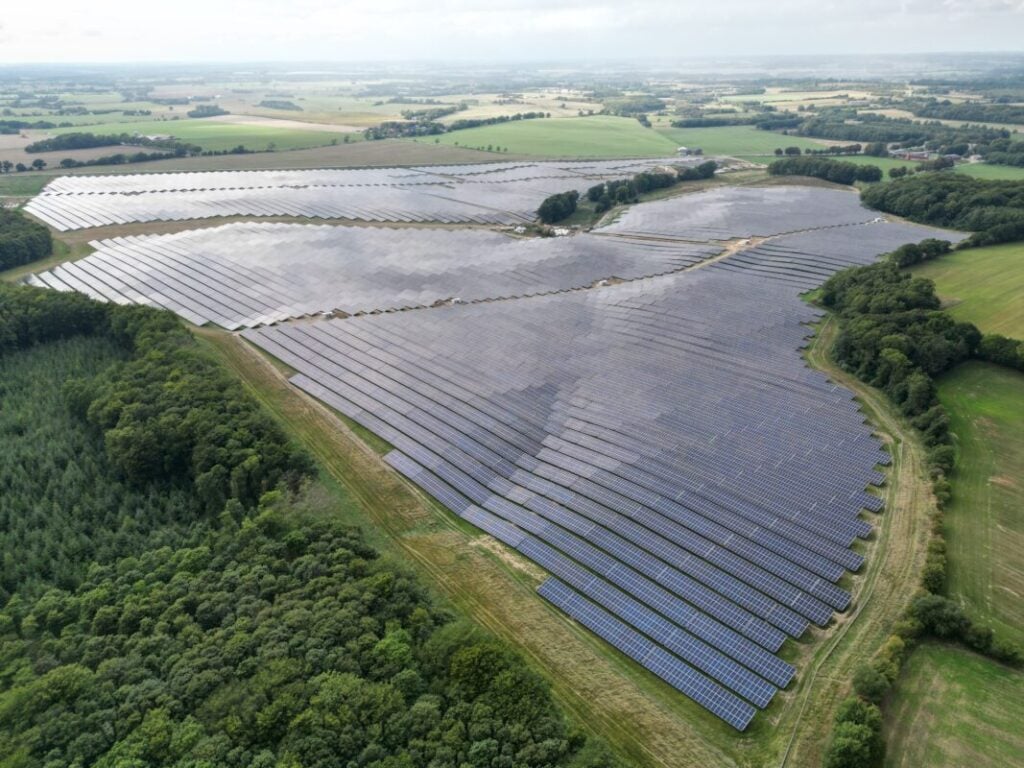
Pantheon AI’s energy infrastructure will include a 500MW solar PV system paired with 8,000MWh of battery energy storage systems (BESS). A letter of intent has been signed with Greenvolt, a European renewables developer owned by US investment firm KKR, to build the behind-the-meter solar-plus-storage plant.
“The race to lead in artificial intelligence is global, and we are pleased to see American capital and investment expertise like Pantheon AI anchoring that leadership in allied, democratic nations,” US Department of Energy (DOE) special envoy for global energy integration Joshua Volz said.
In the global AI race, speed-to-power is among data centre developers’ biggest priorities and the combination of renewable energy with battery storage is seen as the fastest way to get there. An investor presentation from battery company LG Energy Solution this morning cited the estimated lead time of a solar-plus-storage plant at 1-3 years, versus 5-7 years for gas or coal, or 10-15 years for nuclear.
The European Union (EU) also has emissions standards and renewable energy targets to meet, enhancing the competitiveness of the clean energy technologies.
Four 400kV transmission lines being built for the data centre project will also enable the integration of an additional 5.2GW of renewable energy onto Croatia’s grid, Pantheon Atlas claimed.
“Critical infrastructure of this scale, built by the private sector responding to real market demand, is exactly how US interests and European security advance together,” The US DOE’s Joshua Volz said.
It will be the first gigawatt-scale data centre campus in Central and Eastern Europe, which, according to the investment firm, is projected to see 3-4x growth in data centre electricity demand by 2035.
Within Europe more generally, Pantheon Atlas said established data centre hubs have a vacancy rate below 8%, while grid connection delays compound pressure to deliver more facilities.
The topic of data centre and BESS co-location was discussed by at the recent Energy Storage Summit USA 2026, with participants in consensus that, in the US at least, data centre developers are building behind-the-meter or completely off-grid energy infrastructure to get around the challenge of obtaining grid connections.
According to the panellists, however, in the US, there is still a big expectation that natural gas generation will play an extensive role.
From the technical side, batteries are also capable of responding to the rapid, megawatt-level swings in power demand that handling AI training loads can create; thermal generation assets are not.
The Pantheon AI announcement was made during the multilateral Three Seas Initiative summit in Dubrovnik, attended by guests including US Secretary of Energy Chris Wright.
The Three Seas Initiative comprises 13 countries in Central and Eastern Europe, with the US as a strategic partner. The US Department of State said its delegation advanced several major energy projects at the summit.
Energy-Storage.news publisher Solar Media (part of the Informa Group) will host the Energy Storage Summit Central and Eastern Europe on 6-7 October 2026 in Warsaw, Poland. The fourth edition of the summit, part of our global series, is expected to draw more than 400 attendees. See the website for more information.