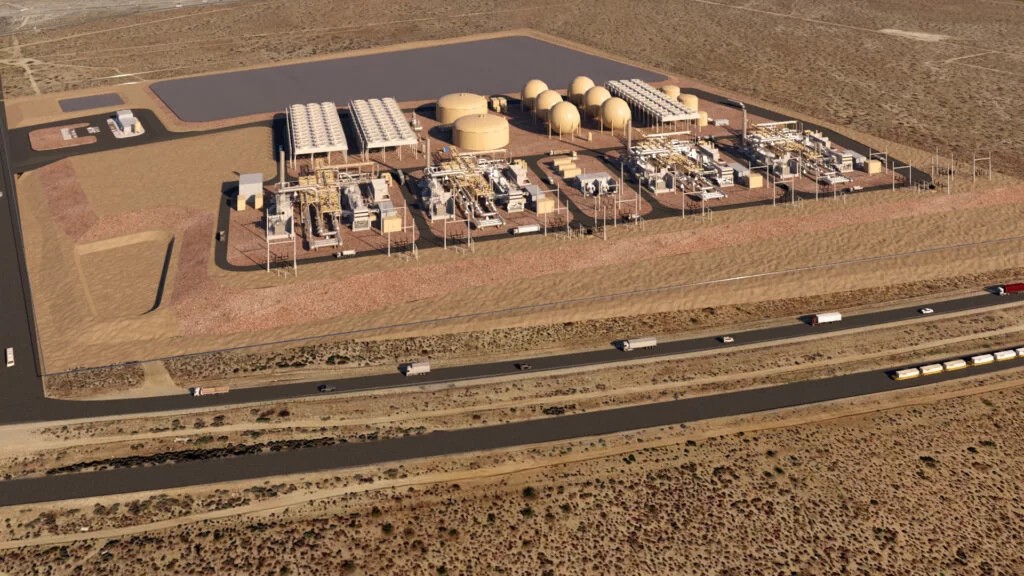
Compressed air energy storage holds much promise for large-scale, long-duration energy storage (LDES), but so far has struggled to really get off the ground outside of China. Will Hydrostor’s iteration on the technology finally take it to large-scale, commercially viable deployments?
CAES and A-CAES technology explained
Compressed air energy technology that delivers mechanical power has been around since the 19th century. Compressed air energy storage (CAES) is relatively newer, with the first utility-scale CAES project opening in 1978 at Huntorf in Germany. There have been other CAES projects commissioned since, with the largest to date coming online in Jiangsu Province, China. The Huai’an Salt Cavern CAES project in China has a 600MW power output and a 2,400MWh storage capacity.
Even though there are multiple CAES projects live, they are hard to deploy. Hydrostor has been developing a new type of CAES called advanced CAES (A-CAES), that they will hope will make CAES easier to deploy.
CAES works by pressurising and directing air into a storage medium. When there is an excess of electricity, be it from the grid or from renewable generation, the electricity is used to compress air. This air is then compressed in a cavern underground and acts as the stored energy (instead of traditional electrochemical stored energy). The heat captured during the compression process is released to the surrounding atmosphere. When the demand for energy is high, the compressed air is expanded and released through a natural gas combustion heating system to drive a turbine generator that produces electricity.
Try Premium for just $1
- Full premium access for the first month at only $1
- Converts to an annual rate after 30 days unless cancelled
- Cancel anytime during the trial period
Premium Benefits
- Expert industry analysis and interviews
- Digital access to PV Tech Power journal
- Exclusive event discounts
Or get the full Premium subscription right away
Or continue reading this article for free
The A-CAES technology being developed by Hydrostor is similar but uses thermal management and hydrostatic pressure to operate cleanly and flexibly, making it a lot more efficient than traditional CAES. A-CAES still compresses air to store energy and releases it via a heating medium, but the technology captures the heat generated during the charging process instead of venting it to the atmosphere. This heat is stored in overground thermal storage tanks and used as the fuel in the discharge heating process, eliminating the need for natural gas.
The air in A-CAES is stored slightly differently to CAES. Where CAES stores energy in natural rock salt caverns, A-CAES can store air in different hard rock caverns that have been artificially made into the rock body. Inside these caverns, a water head is used to enhance land density and maintain the system at a constant pressure.
When it’s time to discharge the energy, the water head weight is released, and the cavern is flooded with water. This pushes the air to the surface, and it is recombined with the stored heat, expanded, and sent through the turbine to create electricity.
When it’s time to charge, the introduction of compressed air to the cavern displaces the water upwards into a surface reservoir (ready for release again when there’s a need to discharge). In essence, the water acts as a kind of piston. So, while the technologies are similar in principle, they actual everyday function is different.
The cavern in A-CAES maintains a moderate pressure of 75bar, and the installation of one these systems require a one-time fill of water to create the water head. This requires 150 cubic meters per MWh. For a 500MW, 8-hour A-CAES system, this is about 50 Olympic sized swimming pools worth of water.
The other main difference is the cavern itself. CAES uses natural rock salt caverns whereas A-CAES requires the excavation of a cavern at a suitable geological site. Controlled detonations between 0-2,000ft provides the initial 4-foot diameter shaft down to the cavern, which eventually becomes the air shaft. A cavern is then excavated using mining equipment and a second 8-foot diameter shaft is made using a raise bore process back to the surface to act as the water shaft.
Why CAES is difficult to deploy
The invention of the newer A-CAES process has been driven by the inherent difficulty of developing CAES. Yes, there are some in use, including some that have been around for a long time, but there are also many projects that have been cancelled and companies that have folded because it has been too difficult. For example, Corre Energy developed CAES and has already been liquidated and Bedrock Energy has recently had its 382MW/3,056MWh CAES project in Huron County, Ontario, Canada rejected because it was planned to cover over 100 acres of ‘productive farmland’.
There are various technical, economic, and social challenges facing companies looking to deploy CAES. One of the main challenges is a low round-trip efficiency (RTE), as the RTE is often as low as 40% because the majority of the heat produced during air compression is lost.
This could make CAES a lot less favourable for grid operators, especially when they have a much lower RTE than BESS. There’s also the challenge of integrating and synchronising CAES technology with the power grid, as the power grid requires assets to be synchronised at specific grid frequency and voltage levels—and it requires a lot of extra ancillary equipment, such as grid-tied inverters, sensors, and smart controllers to connect CAES to the grid.
CAES also has slow ramp rates which makes it unsuitable for some energy deployment scenarios that require quicker and more responsive deployment of energy. The last major technical hurdle is that CAES require specific geological structures, such as salt domes, depleted aquifers, and hard rock caverns. These formations are not available everywhere, which limits where the energy storage systems can be sited. A-CAES gets around this challenge using the artificial caverns and long pipelines so that there’s not a reliance on natural cavern structures.
On the economic side, the upfront capital expenditure required is one of the biggest barriers that has stunted the wider adoption of CAES technology. CAES requires compressors, turbines, thermal energy management systems, and underground storage formations, all of which drive up the upfront costs. The technology has also been a lot less attractive for investors who might have the upfront capital to spend on a CAES installation because the payback periods (especially for large installations) are a lot longer than BESS technology. With investors not as interested, the other economic issue is that CAES is seen as an immature technology by other financiers, making it harder to get other forms of finance as it is seen as a higher risk technology.
On the social side, there is the issue of land-use conflicts. As traditional CAES projects are limited to where there are natural caverns, the ideal location from a technical standpoint might cause conflicts with local cultural spots, protected locations and sites of historical or scientific interest, land used for agriculture, or conservation plans. So, the ideal site is not always feasible and permits to use it can be blocked for a number of reasons, as noted above with the recent project involving Bedrock Energy.
How A-CAES improves on traditional CAES
While CAES projects are still managing to be deployed, Hydrostor has developed the A-CAES technology to try and circumvent some of the main challenges facing CAES deployment, namely the space required, location limitations, the creation of greenhouse gas (GHG) emissions, low RTE, high costs, and the release of lots of heat to the local atmosphere.
The latest A-CAES wouldn’t exist without the previous CAES technological developments that have been in action for decades, but the hope is that the new approach could take CAES technology into a new era that is more efficient, flexible, cheaper, zero emission, and more likely to be sited. Traditional CAES technology is a lot more expensive and less economical because the fuels and process required to reheat the air is less economical than a typical natural gas plant.
The A-CAES technology can deliver 500MW of power over 8+ hours on a much smaller footprint than CAES—with 500MW being installed over 100 acres—lowering the land size challenges; and because it doesn’t rely on natural caverns, the siting location is a lot more flexible to avoid pushback from regulators or the local population.
Because the A-CAES stores and uses the same heat, it has a much higher RTE of 65% compared to 40% of CAES. This is still much lower than Li-ion batteries which have an average RTE of 85-90%, but it is higher than iron-air batteries—roughly 40-50% being developed by Ore Energy and Form Energy—and is similar to the solid oxide fuel cell being developed by Noon Energy—although these other systems have much longer discharge times whereas lithium is closer in average discharge duration of the A-CAES.
Hydrostor has stated that A-CAES facilities will have a 50+ year life, so they will provide much longer storage times than BESS of all types, and because there is no need for a turbine, the cost is lower than CAES. Additionally, because no turbine is used, the A-CAES technology is emission free whereas traditional CAES release GHGs, as well as a lot of waste heat.
Hydrostor commercialising the technology
Hydrostor is at the forefront of commercialising A-CAES and has projects active and upcoming across the US, Canada, and Australia. However, it is not all smooth sailing.
Hydrostor installed the world’s first A-CAES system in Goderich, Ontario, Canada in 2019. This a 1.75MW/7MWh system that is still running today and being used for providing energy for both grid services and electricity markets. Hydrostor also has another installation under development in Ontario in Lennox and Addington County. The permit is currently being prepared for the project and will be a 500MW system once installed with an 8-hour discharge duration. There’s also the possibility to expand the capacity (MW) and storage volume (MWh) once operational. In Broken Hill, New South Wales, Australia, Hydrostor has the permit and interconnection for a 200MW/1600MWh 8-hour A-CAES approved in 2025. Hydrostor has recently secured funding to develop the site.
However, there has been some issues in the US. In Willow Rock, California, the energy storage agreement (ESA) for a 500MW/4000MWh 8-hour facility in conjunction with Central Coast Community Energy (3CE) has recently been amended for a third time. The parties first entered into the ESA in December 2022 with plans for the facility to be operational by June 2028.
The initial ESA entitled 3CE to resource adequacy and energy tolling revenues for a period of 25 years for an amount not to exceed US$775 million. However, in December 2023 3CE agreed to extend the contractual commercial operations date by 18 months while Hydrostor found more funding, and after project milestones were delayed in early 2024, the ESA was amended a second time in December 2024 and included pushing back Hydrostor’s finance deadline until November 2025. In April this year, Hydrostor notified 3CE that financing hadn’t been secured because of permitting, interconnection, and inflation challenges. This has put a 13-month delay on the commercial operating date and has caused a 15.5% contract price increase, resulting in an extra US$120 million in costs for 3CE over the contract period.
Hydrostor claims an active pipeline above 7GW.