
Energy-Storage.news Premium catches up with Giovanni Damato, US president of organic flow battery company CMBlu Energy about the company’s recent activity.
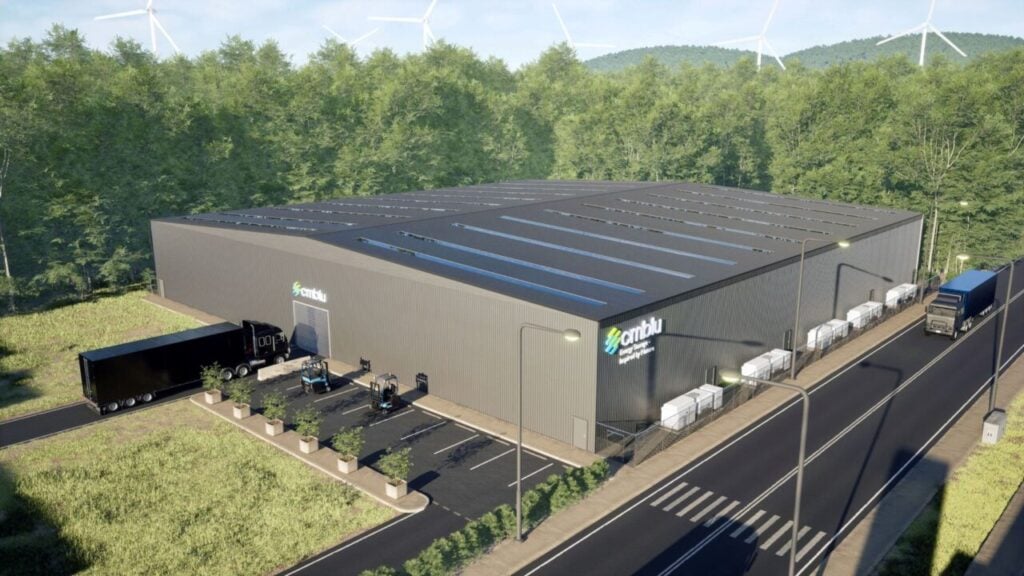
Flow battery developer CMBlu Energy is moving forward with plans to establish domestic manufacturing in the US within the next 12 to 18 months, according to Damato, who outlines the company’s strategic focus on bringing its organic flow battery technology to the US market. CMBlu is headquartered in Frankfurt, Germany, and expanded into the US in 2023.
In May, the company closed a €50 million (US$58.76 million) Series C financing with participation from Samsung Ventures, bringing its valuation to over US$1 billion. CMBlu’s SolidFlow battery energy storage system (BESS) is based on a patented combination of organic flow technology and solid-state storage materials.
CMBlu is targeting utility-scale projects, data centres, and commercial and industrial applications (C&I) with a focus on its 10-hour duration BESS.
Try Premium for just $1
- Full premium access for the first month at only $1
- Converts to an annual rate after 30 days unless cancelled
- Cancel anytime during the trial period
Premium Benefits
- Expert industry analysis and interviews
- Digital access to PV Tech Power journal
- Exclusive event discounts
Or get the full Premium subscription right away
Or continue reading this article for free
The company participated in the Department of Energy’s (DOE) Funding Opportunity Announcement (FOA) 3585 grant process through the manufacturing office, which focused on battery energy storage supply chains.
While Damato acknowledges the programme was “admittedly very focused on the lithium-ion (Li-ion) supply chain,” the application process proved valuable for engaging with DOE and advancing the company’s manufacturing plans.
The grant application identified a potential manufacturing site in Phoenix, Arizona, in partnership with contract manufacturer Benchmark. However, Damato clarifies that CMBlu is continuing to work with its contract manufacturers in the US to identify the best location strategically based on timing and available incentive or grant opportunities.
“We think a brownfield site is really our sweet spot. We don’t need some specialised facility, we just need a manufacturing space in an industrial zone, and put in our manufacturing equipment that is similar to the automotive production line,” Damato explains.
The company secured letters of support from potential customers demonstrating demand for “several megawatt-hours or gigawatt-hours” of non-lithium, 10-plus hour long-duration energy storage (LDES), helping justify the domestic manufacturing investment.
Feedstock and domestic content
Unlike technologies facing supply chain constraints, CMBlu’s organic flow battery uses materials that can be sourced domestically or through Europe, avoiding foreign entity of concern (FEOC) restrictions.
“For us, we don’t really have the FEOC concern. Our feedstock all can be supplied right now. It can all be supplied through Europe, so we can copy and paste that in the US and do the same thing and supply locally,” Damato says.
Beyond compliance, domestic manufacturing enables CMBlu to capture the 10% investment tax credit (ITC) adder for domestic content while improving project economics through local production.
The company has standardised a 10-hour duration system as its core commercial product, which Damato says aligns naturally with daily operational cycles and serves multiple market segments.
For utilities, the company is deploying a 10-hour system at Arizona utility Salt River Project’s (SRP) Desert Blume project, which will have a 5MW/50MWh capacity. In the independent power producer (IPP) market, CMBlu is in discussions with operators in the Northeast looking to improve capacity factors at existing gas-fired peaker plants.
“We’ve seen some of these IPPs say that their older plants can go from a 5% or 8% capacity factor up to an 80% capacity factor with our system in the Northeast, which would be a dramatic improvement,” Damato notes.
The data centre and hyperscaler market represents another significant opportunity. Damato explains that 10-hour duration storage can support 24-hour data centre operations when paired with solar, help flatten “spiky” AI workload profiles, and provide the capacity needed for “speed to power” requirements where grid connections are constrained.
“They (data centre developers) may want 200MW for their data centre. The utility says, ‘Well, we can give you 50,’ so, they have to bridge that gap of the other 150MW,” he explains. “That may only occur a couple times a month for their AI learning cycle, but they still need it, and they want it fast.”
While 10-hour systems are a primary focus, CMBlu has deployed 5-hour systems for C&I applications, such as its Mercedes project in Germany, where the system helps manage demand charges and time-of-use energy costs.
Safety as a competitive advantage
CMBlu’s aqueous-based electrolyte eliminates thermal runaway risks associated with Li-ion batteries, enabling deployment in locations where Li-ion would face restrictions.
Damato recounts a recent conversation with a hyperscaler about potentially locating CMBlu systems inside data halls alongside server racks, something “not very easy to do with Li-ion without immediately running into the thermal runaway risk.”
The company demonstrated this safety advantage early on, operating a prototype system within 100 feet of a boiler unit at a WEC Energy power plant in downtown Milwaukee in 2023.
“Safety definitely comes up. I think it’s part of our product strategy, it’s our competitive advantage, and I think that aspect is a premium product,” Damato says.
Near-term announcements
CMBlu certified its Uniper project in Germany at the end of last year to provide frequency regulation, spinning reserve, and wholesale energy time shift services on the German grid, demonstrating the technology’s ability to provide both short-duration ancillary services and longer-duration capacity.
Looking ahead, Damato indicates the company expects to announce new projects with IPPs in the Northeast and data centre customers in the near term, demonstrating market traction in the US.
“We’re really excited to continue to diversify and commercialise our product in the US,” he says. “We’re really focused on that, and then, of course, in parallel, bringing the manufacturing capacity to the US and taking advantage with any DOE potential incentives that there are to make that happen.”
