At the 11th Western Energy Storage Forum, Chen Haisheng, Chairman of the China Energy Storage Alliance (CNESA) and Director of the Institute of Engineering Thermophysics at the Chinese Academy of Sciences, unveiled CNESA DataLink’s H1 2026 energy storage dataset.
The report provides a comprehensive overview of China’s domestic energy storage sector in H1 2026 and outlines the industry outlook under the 15th Five-Year Plan.
According to preliminary data from CNESA DataLink, China’s cumulative installed capacity of power storage reached 237.7GW by the end of June 2026, a 41.7% year-on-year increase. Of this total, cumulative new storage deployments reached 168.3GW/448.7GWh, up 59%/71% year-on-year and 15% higher than the end of 2025.
New deployments: standalone ESS emerges as key growth driver
In H1 2026, China commissioned 21.81GW/58.60GWh of new storage capacity, down 18% in power terms and 16% in energy terms year-on-year. While cumulative capacity continues to expand, this cyclical dip in new deployments signals that China’s domestic storage sector is transitioning from a phase of rapid scale expansion to one focused on value restructuring.
Try Premium for just $1
- Full premium access for the first month at only $1
- Converts to an annual rate after 30 days unless cancelled
- Cancel anytime during the trial period
Premium Benefits
- Expert industry analysis and interviews
- Digital access to PV Tech Power journal
- Exclusive event discounts
Or get the full Premium subscription right away
Or continue reading this article for free
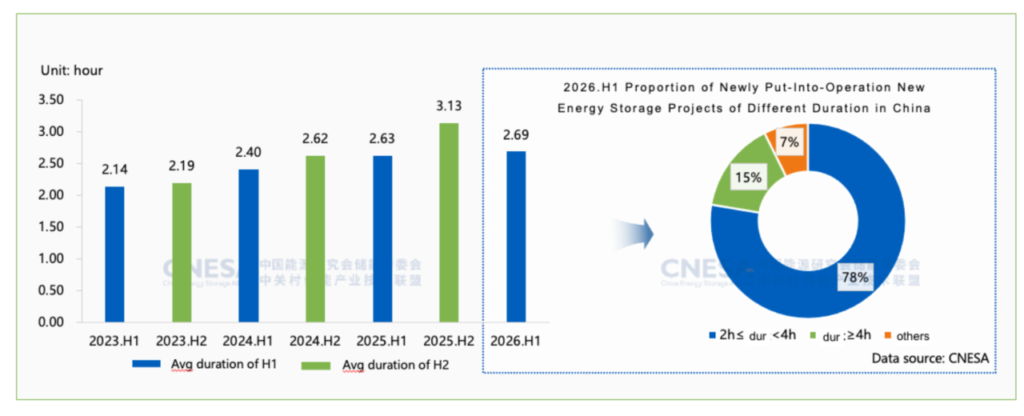
The market is clearly shifting toward larger projects and longer storage durations. The number of newly commissioned projects fell by 51% year-on-year, but the share of projects sized at 100MW or above increased by 8%. The average storage duration for new projects reached 2.69 hours, up 2.3% year-on-year, while the share of projects with a duration of four hours or more rose by 4.8%.
According to Chen, the market is moving away from pure volume growth toward optimising individual plant scale and storage duration profiles, with long-duration energy storage (LDES) continuing to gain ground.
Standalone storage has become the primary driver of domestic deployments. CNESA data shows that 15.1GW of standalone storage was commissioned in H1 2026, accounting for 69.3% of total new capacity—a year-on-year increase of 13.9%. Following the issuance of National Document No. 114 (establishing the first national capacity pricing mechanism for standalone energy storage), the value of new storage assets has received formal policy recognition.
Provinces including Gansu, Jilin, Shaanxi, Xinjiang, Hubei, Ningxia, and Qinghai have rolled out implementation rules for capacity tariffs, establishing a three-pillar revenue model for standalone storage: capacity tariffs, energy markets, and ancillary services.
Despite this progress, the industry still faces headwinds, including narrowing spot-market peak-to-valley price spreads and rising charging costs. Against this backdrop, robust project development, trading strategies, and full-lifecycle O&M capabilities are becoming increasingly critical to project viability.
Prices tick up as AIDC fuels demand growth
China’s domestic tender and procurement market saw robust activity in the first half of 2026. Both framework agreement volumes and product prices posted notable gains, reflecting a shift in corporate competition from pure price bidding toward comprehensive capabilities.
According to available data, centralised procurement and framework agreement volumes for storage systems totalled 80.16GWh in H1 2026, surging 95% year-on-year. Awarded EPC capacity reached 161.2GWh, a steep 112% year-on-year increase. The number of winning EPC bidders climbed to 580, up 88% year-on-year, further broadening the pool of market participants.
On the pricing front, average winning prices for storage systems moved higher across the board. The average winning price stood at RMB 599.3/kWh for 2-hour systems, up 8.3% year-on-year, and RMB 541.3/kWh for 4-hour systems, up 21.1% year-on-year.
Leveraging their deep power system expertise and extensive grid interconnection know-how, power generation and grid-affiliated enterprises have significantly strengthened their competitiveness in the centralised procurement market.
Along the industrial chain, Chinese manufacturers shipped 380GWh of lithium-ion storage cells globally in H1 2026, with domestic operational cell capacity standing at 809.5GWh. As new capacity expansion moderates, industry competition is shifting away from aggressive buildouts toward developing reliable, high-quality supply capabilities.
Technology roadmaps are diversifying, with AI data centres (AIDCs) emerging as a major new demand market. High-capacity lithium-ion battery products are ramping toward mass production, while long-duration technologies such as flow batteries and compressed air storage are being deployed at an accelerated pace. Meanwhile, sodium-ion batteries and flywheel storage are advancing in parallel.
AIDC is generating fresh and strong structural demand for storage. A flurry of new offerings—including high-rate cells, backup power systems, and integrated energy solutions—has entered the market. This is driving storage hardware toward faster, scenario-specific customisation and expanding industry boundaries beyond hardware into power electronics, energy management, and comprehensive end-to-end services.
International orders hit 298GWh, surging 83% year-on-year
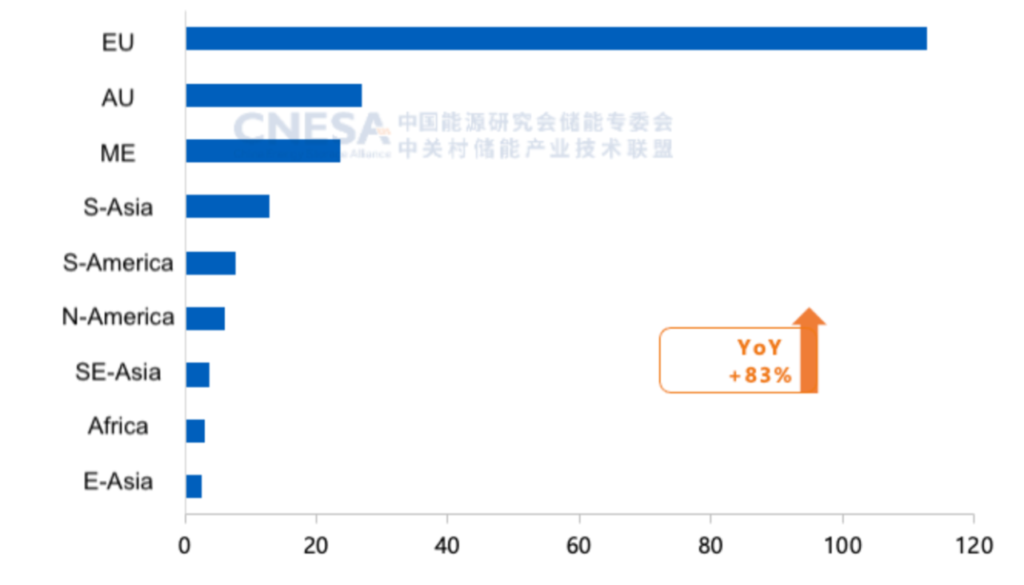
On the global front, Chinese storage firms posted rapid overseas growth as their business models evolved from pure product exports to comprehensive solution delivery. According to CNESA data, Chinese enterprises secured 298GWh in overseas contracts in H1 2026, an 83% year-on-year increase.
Europe remains a core market, while the Middle East, India, and Chile have emerged as fast-growing regions.
Going global now extends well beyond equipment supply. Companies are increasingly establishing overseas manufacturing bases, providing local O&M services, pursuing technical partnerships, and delivering end-to-end turnkey solutions. At the same time, trade barriers, supply chain safety, and local regulatory compliance remain key headwinds for cross-border expansion.
Outlook for the 15th Five-Year plan period
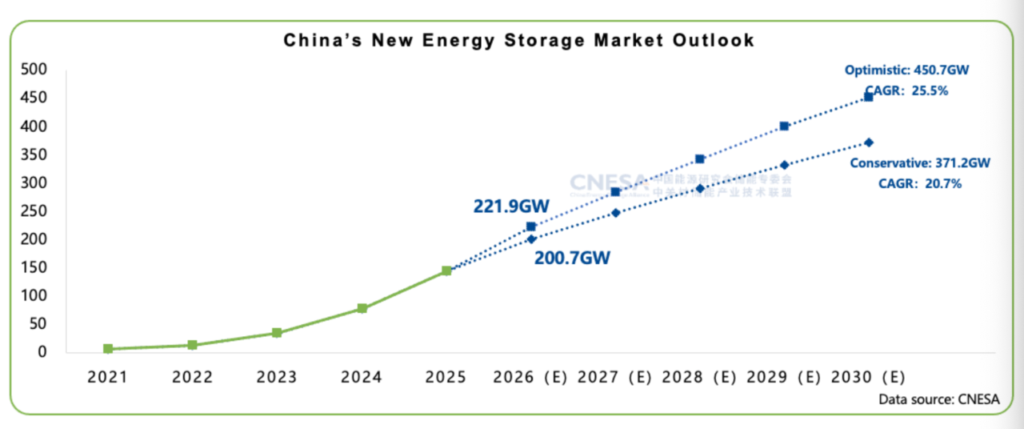
Looking ahead to the 15th Five-Year Plan period, CNESA projects that cumulative installed capacity will reach between 371GW and 451GW by 2030, representing a compound annual growth rate (CAGR) of 20.7% to 25.5%.
The report identifies two primary drivers for this growth. First, the market will continue to unlock diversified value streams as energy storage evolves from a supporting tool for renewable energy integration into a core building block of the new power system. Second, new technologies and use cases—including long-duration storage, grid-forming storage, and AI data centres (AIDC)—will continue to expand.
“While scale continues to expand, the underlying logic of the storage sector has shifted. This is the most critical signal the industry has sent in H1 2026,” Chen Haisheng said.