Alcemi, developer of some of the UK’s biggest projects, has entered the Romanian battery storage market, while Slovakia’s biggest project to date has gone into operation.
Alcemi expands from gigawatt-hour UK projects
London-headquartered battery energy storage system (BESS) developer Alcemi has acquired two development assets in Romania. The company said yesterday that it acquired majority stakes in two 4-hour duration projects.
They are a 300MW/1,200MWh project in Medgidia, in Constanța County, southeastern Romania and a 275MW/1,100MWh project in Șura Mare, central Romania.
Alcemi did not disclose many details in a brief announcement sent to the media, including Energy-Storage.news. The financial terms of the deal or the selling party were not mentioned, nor was an indication of the two projects’ current development stage, although the developer said it would work with local developers Emil Pop and Andrei Pop.
Try Premium for just $1
- Full premium access for the first month at only $1
- Converts to an annual rate after 30 days unless cancelled
- Cancel anytime during the trial period
Premium Benefits
- Expert industry analysis and interviews
- Digital access to PV Tech Power journal
- Exclusive event discounts
Or get the full Premium subscription right away
Or continue reading this article for free
Alcemi co-founder James Forster said the local partnership would give it “the on-the-ground expertise needed to navigate Romania’s regulatory and grid interconnection landscape effectively.”
“This collaboration allows us to move quickly while ensuring our projects are aligned with local market conditions and community priorities,” Forster said, adding that Alcemi saw Romania as a “key market for BESS development.”
As regular readers of Energy-Storage.news will be aware, Romania has rapidly become a leading destination for developers among the growing Central and Eastern European markets, along with Poland.
Along with macroeconomic trends such as falling BESS equipment costs and investors becoming more comfortable with the technology, Romania has country-specific drivers for BESS deployment.
These include a need to integrate growing shares of daytime solar PV generation, alongside numerous subsidy schemes for energy storage, including co-located projects and support programmes from the European Union (EU).
A big change occurred on the regulatory side in mid-2025, when Romania’s National Energy Regulatory Authority (ANRE) ended double taxation of energy storage assets for both charging from, and discharging to, the electricity grid.
This had been a major barrier to investment that many countries in Europe—and around the world—are yet to address, due to regulations that classify energy storage as both a generator and a consumer, as they date back to before batteries began connecting to the network.
In April, Michael Topolinski IV, COO of investor MetaWealth told ESN Premium that Romania had around 400MWh of installed BESS capacity as of the end of 2025, but the state has projected a need for more than 4GWh by the end of 2030.
“The Russia-Ukraine conflict drove a clear need for energy independence and security, prompting big investments in renewables and storage, and the Iran conflict is doing the same,” Topolinski told ESN Premium.
Alcemi is best known for its gigawatt-hour scale development projects in the UK, which it is developing in partnership with institutional investor Copenhagen Infrastructure Partners (CIP). Three projects in development so far, each of 500MW/1,000MWh (1.5GW/3GWh total), are all in Scotland and designed to ease network congestion and reduce curtailment of locally generated wind energy.
New lease of life for former coal plant site in Slovakia
Slovakia, a CEE market much less frequently referenced on the pages of Energy-Storage.news, has just welcomed its largest BESS project to date.
Slovenské elektrárne (SE), the country’s largest electricity producer, recently commissioned the 36MW/72MWh project at the site of a former coal power plant in western Slovakia.
SE said earlier this month (17 July) that the BESS project at Nováky coal plant comprises two facilities, one of 12MW and the other of 24MW. The systems will provide the primary control reserve (PCR), also known as frequency containment reserve (FCR).
Their use in charging from the grid at times of surplus generation and outputting during peaks in demand will also enable the integration of renewable energy onto the Slovak and European networks.
SE received nearly €3.7 million (US$4.24 million) in Capex funding support for the larger of the two systems. This was worth 45% of the eligible project costs and came from Slovakia’s EU-approved Recovery and Resilience Plan funding.
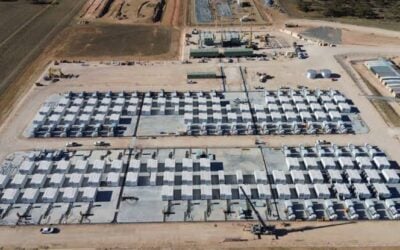
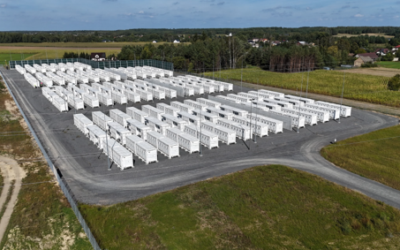
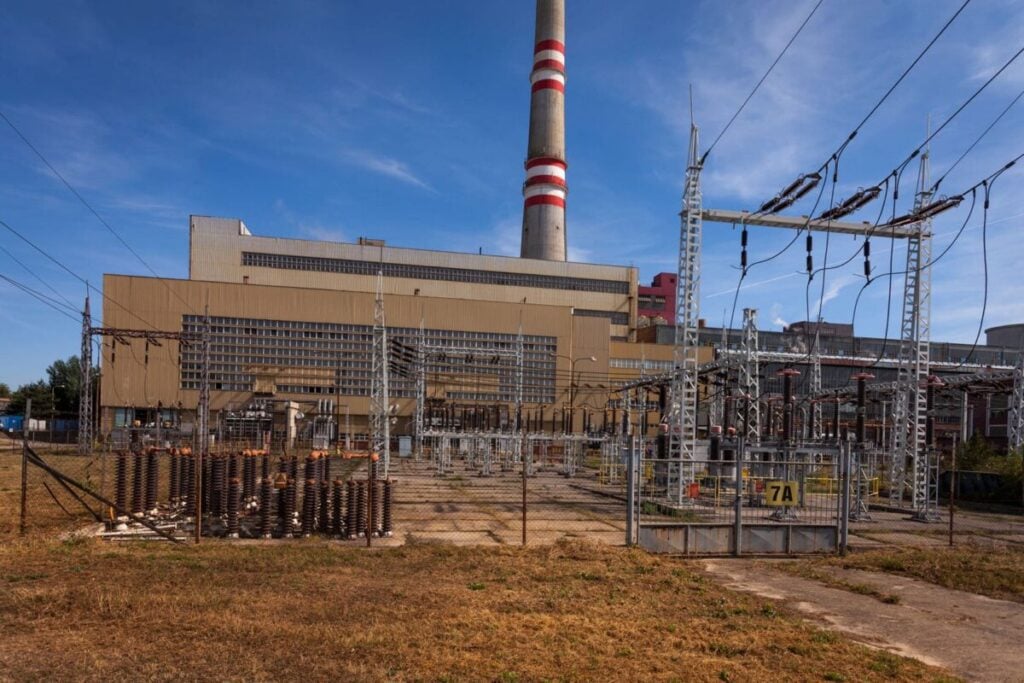
The BESS project was built on the site of a 110kV substation decommissioned in 2015. The utility removed existing infrastructure and kitted out the site with 22 battery storage containers and associated power conversion systems (PCS) and other balance of plant. SE utilised existing transformers that had been left onsite in decent condition, reducing Capex and engineering requirements.
“The biggest environmental benefit of this project is not just the technology itself, but the way it was created. We built it on the site of existing industrial infrastructure, without taking up new land and making maximum use of what was left on the site,” Slovenské elektrárne manager of international relations, European affairs and environment Robert Jamrich said.
It is SE’s second BESS project after a 3MW/4MWh pilot at a hydroelectric plant the company owns. That project also provides secondary regulation (automated frequency restoration reserve, or aFRR). SE is also developing a large-scale BESS at the site of the company’s Čierny Váh pumped hydro energy storage (PHES) plant.
The coal plant at Nováky closed its doors in 2023. SE, which produces about two-thirds of Slovakia’s electricity, became fully carbon-free in its generation fleet when it closed its final coal plant a year later. The Slovak Republic holds 34% of SE’s equity and the company’s generation portfolio comprises nuclear, hydroelectric and solar PV assets.