Minimising counterparty risk is a key component of the German BESS sector, particularly as ongoing political uncertainty continues to pose questions for the industry.
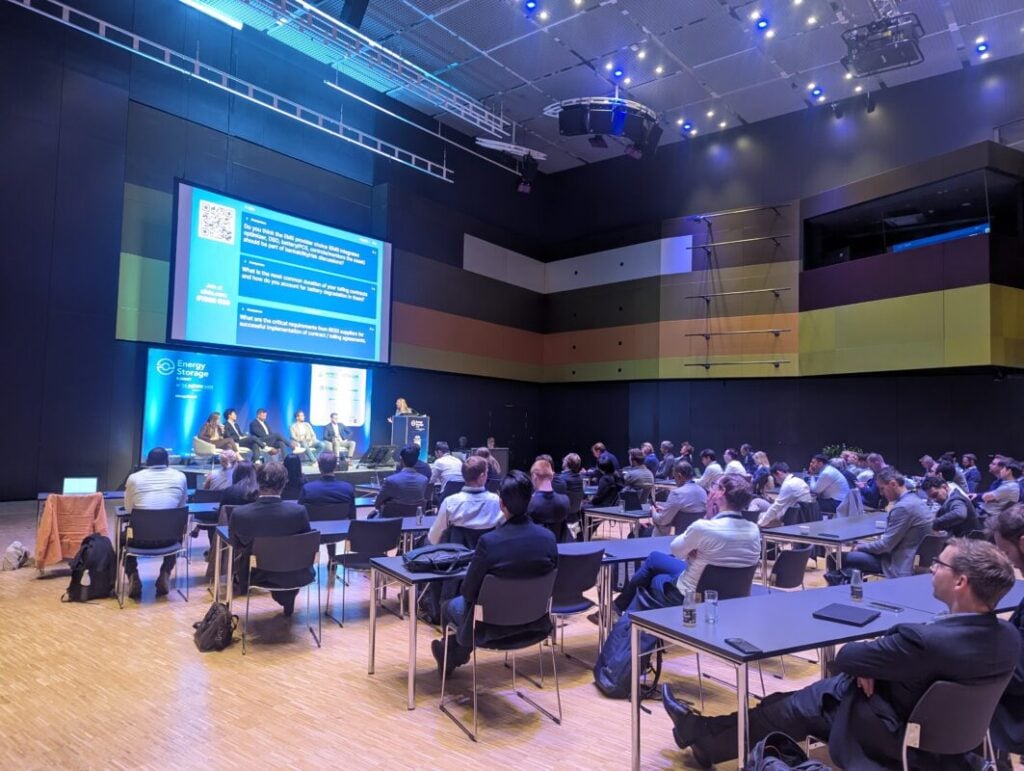
This was an opinion expressed by Eike Ahrens, associate director of energy and infrastructure at Berenberg, who spoke on a panel on the first day of the Energy Storage Summit at the Battery Show Europe, hosted by Energy-Storage.news publisher Solar Media and co-located with parent company Informa’s The Battery Show Europe, this week in Germany.
“It’s important to work with reliable and experienced counterparties, in terms of how they set up a project and how they approach things,” said Ahrens, noting that some of the challenges currently faced by the German battery energy storage system (BESS) sector are not unique, so working with financing and offtake partners who have industry experience can be a great benefit.
“Many of these topics have been around for quite some time already, for example revenue uncertainty and availability of contracted revenue,” he continued. “In the BESS industry there are newcomers for whom this does not always hold.”
Try Premium for just $1
- Full premium access for the first month at only $1
- Converts to an annual rate after 30 days unless cancelled
- Cancel anytime during the trial period
Premium Benefits
- Expert industry analysis and interviews
- Digital access to PV Tech Power journal
- Exclusive event discounts
Or get the full Premium subscription right away
Or continue reading this article for free
Minimising this risk is essential because, according to James Adams, a partner at Alexa Capital and one of Ahrens’ fellow panellists, the German BESS market remains a very high-potential investment environment.
“I think the German market opportunity for storage as an asset class is one of the best risk-adjusted returns that you can get in any kind of infrastructure asset class globally,” said Adams. “There’s opportunities in the US, and I think Germany is the next best risk-adjusted opportunity.”
Tolling agreements to provide security amid relative political uncertainty
However, this is not to diminish the significance of regulatory uncertainty, which was a common topic of conversation on the first day of the event. Oliver Prokein, director of energy at KfW who also spoke on Ahrens’ and Adams’ panel, said that the uncertain German policy landscape has make it more difficult to forecast and quantify key financial metrics, like risk and revenue.
“I completely share the view that stable revenue streams are a big challenge, in my opinion,” said Prokein. “A very important ingredient for a project from a senior lender’s perspective [is] having a regulatory framework in place… that that you have rules you can rely on [to] quantify risks in your financial models.”
Market mechanisms that look to deliver predictable revenues, such as tolling agreements, could be particularly common in this political environment. On a panel discussion on the summit’s second day, Dr. Stefan Englberger, head of commercial and investment analysis at ECO STOR, said that bankability is “one of the main reasons” that there is increased appetite for tolling agreements.
“When getting debt money and debt financing, we need risk mitigation measures,” he explained. “There we need tolling or contracted revenues.”
“Equity investors are looking for some form of fixed revenues,” added Amanda Niklaus, global head of markets at Ingrid Capacity, arguing that investors of all kinds would see tolling agreements as a form of much-appreciated security. “It’s not just for debt lenders, but equity lenders.”
Both Niklaus and Englberger said that these tolling arrangements can also include an element of flexibility, so as to be adapted to individual portfolios and investor preferences.
“We have a large portion of our portfolio that is fully merchant, so to balance it out we like to have some form that is under contracted revenue,” explained Niklaus. “We rarely speak about 100% tolling, I would say, it’s often a portion of tolling with an upside portfolio. We‘ve moved away from 100% fixed revenues.”
“We also see value in hybrid structures, where we don’t have 100% tolled,” agreed Englberger.