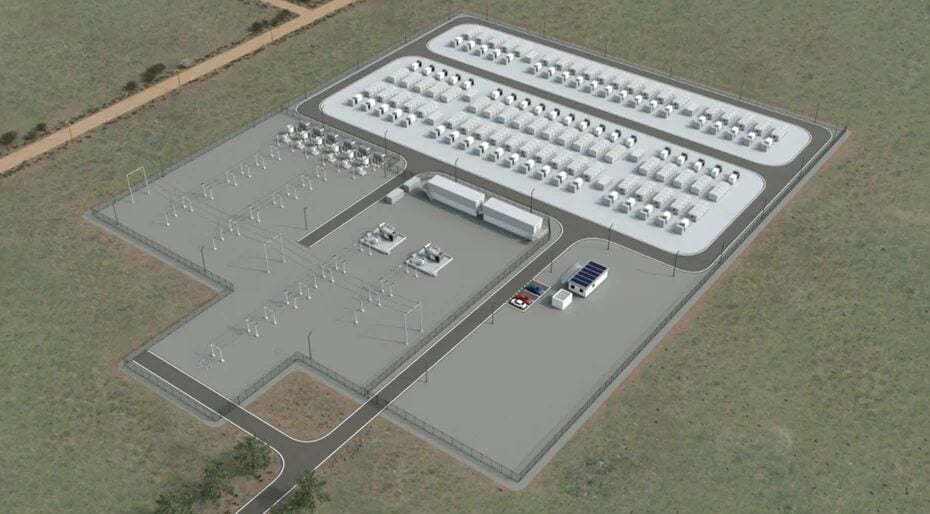
Developer Amp Energy has closed project financing for the construction of its 250MW/500MWh Bungama battery energy storage system (BESS) and a 339MWdc solar PV plant in South Australia.
Amp Energy Australia, the regional arm of the Canada-headquartered renewables, storage, and hydrogen project developer, said the first stage of the project, which will have an output of 150MW and a storage capacity of 300MWh, aims to begin commercial operations in the first quarter of 2026, with this having been delayed from the initial early 2025 date.
Construction of the first stage of the BESS started in October 2024. The site is designed to operate for 25-years.
The non-recourse senior debt facilities for stage one of the BESS have been secured from numerous banks and financial entities, including the Commonwealth Bank of Australia, Westpac Institutional Bank, and Export Development Canada. The financing also provides Letters of Credit to support the project security obligations.
Try Premium for just $1
- Full premium access for the first month at only $1
- Converts to an annual rate after 30 days unless cancelled
- Cancel anytime during the trial period
Premium Benefits
- Expert industry analysis and interviews
- Digital access to PV Tech Power journal
- Exclusive event discounts
Or get the full Premium subscription right away
Or continue reading this article for free
Daniel Kim, head of Amp Energy Australia, hailed the financing as a critical milestone that will enable the construction and operations of the BESS.
“This milestone is a significant achievement for Amp and marks a crucial step in our mission to build a high-quality Power-to-X platform in Australia and accelerate the energy transition,” Kim said.
Amp will work closely with Balance of Plant (BOP) contractor Enerven on the BESS in what is their fourth collaboration.
Amp Energy pursues renewable energy hub in South Australia
Amp Energy’s project is situated in the Mid-North region of South Australia and represents the initial phase of a major Renewable Energy Hub development. In September 2023, Amp Energy Australia secured an agreement to connect the project to South Australia’s high-voltage network with grid operator and owner ElectraNet.
The hub is set to comprise several large-scale solar PV power plants and standalone BESS installations. These will be split across three locations, including Bungama, with assets also to be deployed in the localities of Robertstown and Whyalla. Amp Energy is also establishing a hydrogen production facility, Spencer Gulf Hydrogen Energy Ecoplex, within the hub.
According to Amp Energy, delivering all of the planned resources and associated infrastructure for the Renewable Energy Hub will require an investment of around AU$2 billion (US$1.26 billion).
As noted previously, the new financing will help develop a 339MWdc solar PV plant around 6km east of Port Pirie in the Mid-North region. This will form part of the wider hub.
Wärtsilä to deploy its Quantum High Energy solution
Finnish marine and energy technology group Wärtsilä has been contracted by Amp Energy to deliver the 300MWh BESS, which will connect to the National Electricity Market (NEM). Wärtsilä is also delivering the systems for the multiple stages of Origin Energy’s 700MW/2.8GWh Eraring BESS.
The company confirmed that it would supply its Quantum High Energy storage technology for the 2-hour duration BESS, which, as with all previous Wärtsilä BESS technologies, will run on the company’s GEMS energy management platform.
The Gridsolv Quantum High Energy supports high-energy density customers in developing their projects. The product was designed for Wärtsilä to capitalise on the market trend of customers preferring more compact solutions with smaller footprints.
Wärtsilä launched its GridSolv Quantum High Energy in November 2023, touting its use of 306Ah lithium iron phosphate (LFP) cells, which enable 9% higher energy density than the previous iteration of its GridSolv Quantum solution.
The technology will be first deployed at a 300MW/600MWh project in Scotland, UK, being pursued by Zenobē Energy, a developer and investor in energy storage and electric vehicle (EV) charging solutions. It will also be deployed at the Eraring Power Station BESS project.
Wärtsilä revealed that the Eraring BESS will operate in virtual synchronous machine (VISMA) mode. This will enable short-circuit current capabilities, such as reactive current, droop control, and synthetic inertia, to support grid stability and security. This will be achieved via Wärtsilä’s GEMS energy management platform and advanced inverter hardware.